Orangutan Foundation S...

An Interview with Kusasi

One of the rules of working around orangutans is to never get within arm’s reach of them.  On Saturday, in the middle of an interview with a journalist, I was horrified to find Kusasi less than 2m away and coming straight at us. If I was horrified, I dread to think what the journalist thought!  Her tape contains the memorable line “Time to GO!” 

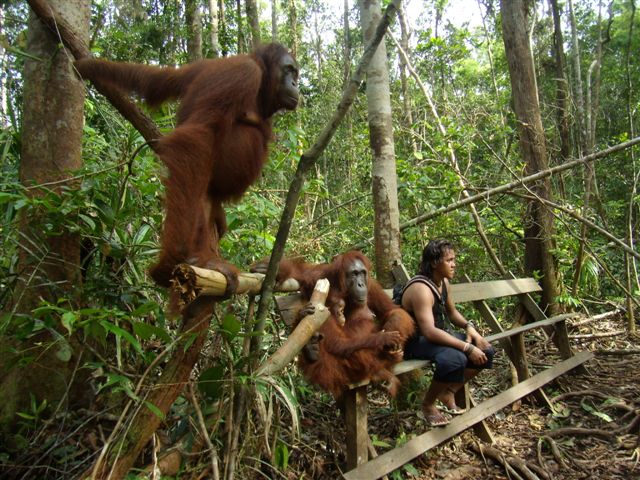
The problem was we were watching Unyuk and her baby who were joined by Uning and Ukraine.  When we arrived at the feeding station Unyuk, who has a reputation for being naughty, was sitting peacefully with Mr Otter.  They looked like two neighbours having a chat.  Mr Een then walked up and Unyuk went over to say hello to him.  Shortly afterwards, Uning and Ukraine swung in.  Uning is Unyuk’s daughter so we were looking at three generations of their family:  Unyuk the mother and grandmother; Uning the daughter and Ukraine the grandchild.  It was a captivating sight.

unyukotter_29nov08.JPG

unyukuning_29nov08.JPG

Rather too captivating:  never forget what is going on behind you!  Een’s eyes went wide and he slide off to the side. I turned around and there was Kusasi. All I could see was him!  I won’t say he was going for us, but I will say he was moving in a straight line for Uning and we were in the way.  Look at the photos:  the vine Uning is holding onto at the start is the very same one Kusasi is on: she had the sense to get out of his reach.

unyukeen_29nov2008.JPG  

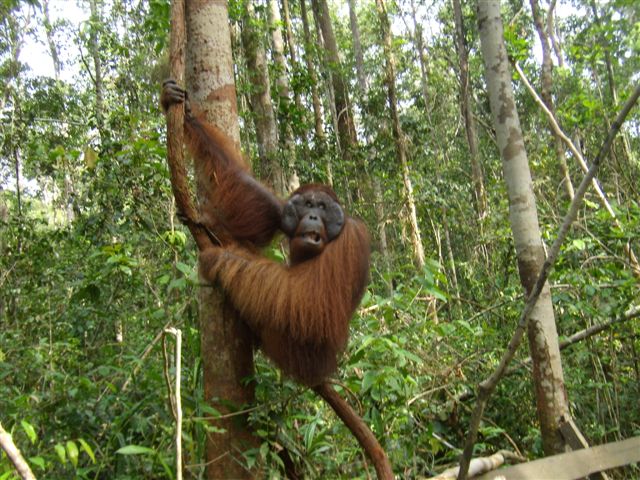
I grabbed the microphone case and pushed the journalist with my other hand.  Kusasi passed behind us stopping in the spot recently vacated by Uning.  Once heart-rate and blood pressure had returned to normal we got some photos.  Just look at the size of his arm! 

kusasi_29nov08_01.JPG

That evening, I left the journalist to spend a night on her boat in the park, and I travelled back to Pangkalan Bun.  The sunset was spectacular.  The sky was every shade of red which was reflected off the still black-water of the Sekonyer River.  It felt as though we were speeding through fire. 

sunset.jpg 

Back at the office, I saw the education team had returned from their field trip.  From the state of the car it looked like they had had their own adventures! After all of which, I would like to say thank you to Julie (Art for Gorillas) and Adam Hardy for their sympathetic comments.  Adam, I agree with you: there is no comparison between an 8mb broadband internet connection and a fast-moving 120 kg male orangutan.  I’ll stop complaining.

strada_29nov08.JPG

One year on…

It has been nearly a year since Stephen started this blog on the 23rd November 2007 and so far you have donated US$4,680 towards our programmes in Central Kalimantan, Borneo. This money has been spent on; buying medical supplies for the orangutans at the Orangutan Care Centre and Quarantine; for enclosure repairs (remember the escapees!); fire beaters and equipment to tackle forest fires in Tanjung Puting National Park; and more recently the new feeding system for released orangutans in Lamandau Wildlife Reserve. THANK YOU! THANK YOU! THANK YOU! We are hoping to reach the $5,000 target by the end of November. What we really need at the moment or what the Indonesian field staff need is new equipment. On our donation bar under One Time donation there are the options Uniforms or Compass & Wrist Watch. A donation for one of these would be a practical and useful contribution towards our work. Please consider a donation to support our work this month.

On behalf of Orangutan Foundation in Indonesia and the UK thank you for your interest and support over the last year.

Cathy

(UK office)

Visiting Orangutan Foundation Programmes

As you will no doubt know from Stephen’s posts about a month ago, I recently ventured out of the London office and over to Pangkalan Bun (Borneo) or, more accurately “the field”. This was not my first time there; my employment here (for my part!) is the result of me being completely overwhelmed by the plight of the orangutans when I stumbled upon the Volunteer Programme in 2001. Amongst other things, I now run the Volunteer Programme here at Orangutan Foundation and continue to get enormous pleasure from arranging for people go over to Indonesia for what pretty much always ends up as a life-changing experience. The small size of the UK office means that I have my fingers in many of the Orangutan Foundation pies and so my trip out there was also to see the programmes that I write about day-in-day-out. In short, it was an amazing trip and reminded me that I work primarily to save the orangutans and their home, something that seems to slip the mind in hectic times.

The highlight was most definitely going to Camp Rasak (orangutan release in Lamandau Wildlife Reserve) and knowing that the orangutans I saw in the trees were primarily orangutans that would have been in the Orangutan Care Centre on my last visit in 2001. A close second was Belantikan. It really is a beautiful area and needs to be saved.

Belantikan Forest

Belantikan Forest

Belantikan Forest

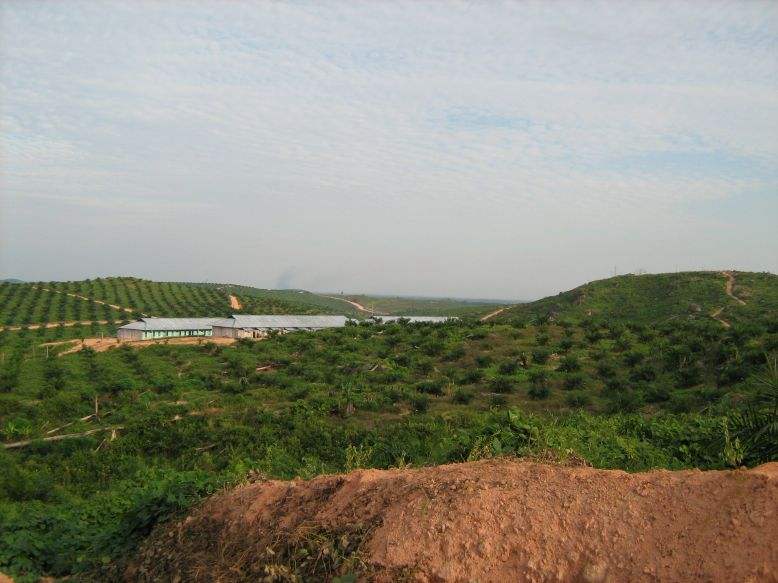
It not only has orangutans but is some of the most amazing forest that I have ever seen (and I have seen a lot). Time is key too – in an eight hour journey there we drove through oil palm for six hours and heavily logged areas for one hour.

oil palm plantations en route to Belantikan

oil palm plantations en route to Belantikan

oil palm plantations en route to Belantikan

Oil Palm Plantation

logging in the Belantikan

Logging on the journey to Belantikan

It really was quite surreal –little dumper trucks carrying kernels or actual palm oil were the only traffic on the road…..and they seemed to infiltrate EVERY bit of land….

Seeing this destruction on the way really enforced how important our work with Yayorin, our Indonesian partners, in Belantikan is for these forests, its wildlife and the local communties who live here.

Catching up with the Volunteer Programme seven years on was one of the main reasons for me to go to Indonesia. I said I'd try and post about my time on the programme so I'll do this in the next few days!

Thanks,

Elly

Development & Volunteer Co-ordinator UK Office

New Vet For Lamandau Wildlife Reserve (orangutan release site)

Last month we were awarded a grant by the Gemini Foundation to implement a system of veterinary health care for the orangutans released into Lamandau Wildlife Reserve. This will mean recruiting our own vet, which is very exciting. In Lamandau there is a system of post release monitoring and the orangutans are given supplementary food to help with the transition back to the wild. However, approximately 5 – 6% of all released orangutans are taken back to Orangutan Care Centre & Quarantine at some point, most commonly for small injuries or skin diseases and very rarely for more serious conditions, like Zidane. In common with all orangutan rehabilitation centres the OCCQ is full to capacity so the return of orangutans only puts an extra burden on them. Having a vet in Lamandau will reduce the chance of orangutans returning to the OCCQ, thus minimising potential stress caused to the orangutans as well. Tigor (Lamandau Rehabilitation Camps Manager) and I have finalized the job description and the advert has now gone out. Interviews will begin at the end of the month.

On to less interesting matters, it is report time again. October marks the start of the final quarter for the year; this is the time when we panic about how much or how little money is left over and what is still to be done. The written reports I can handle, it’s the budgets that I struggle with!

How I feel tackling accounts! (Photo by Sarah Seymour)

I probably share the same expression when I have to tackle Excel! (photo by Sarah Seymour)

Back at University, I remember courses on cell structure and function, zoo-physiology, population genetics, the biology of animal adaptation. I do not remember Accounting 101! What on earth is the meaning of “=SUMIF ('General edger' !$C$49:$C$115,C72, ' General Ledger'!$F$49:$F$115)”?

How I feel tackling accounts! (Photo by Sarah Seymour)

I love the two photos in this post, courtesy of Sarah Seymour. While the orangutans are undoubtedly cuter, their facial expressions remind me of mine as I look at those Excel spreadsheets.

Orangutan Making Good Recovery.

Thank you all very much for your kind and supportive comments on Zidane. Yesterday, I had to go out to the Care Centre again and so took the opportunity to look in on him. I couldn’t believe it – he wasn’t there!!! The vets said he had been so energtic in the morning, once his sleeping-cage door was opened he took his carers hand and wandered off into the nursery forest. Time was limited so I did not follow him out there. Clearly though he continues to go from strength to strength.

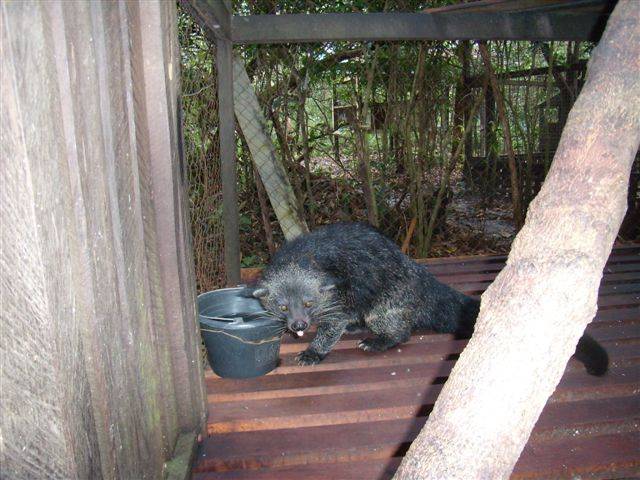
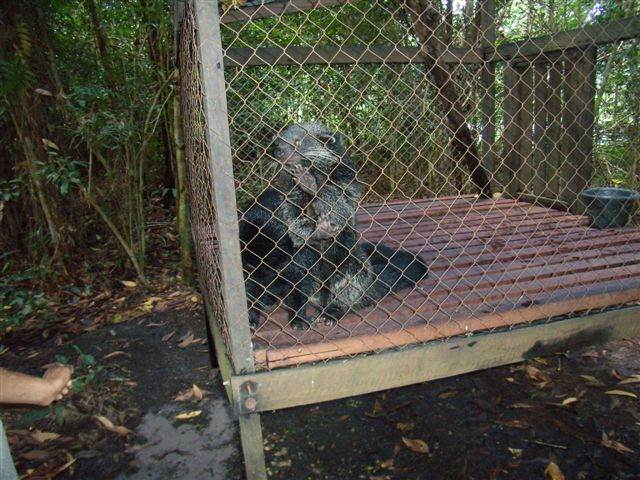
I did however pop over to see the binturongs.

binturong

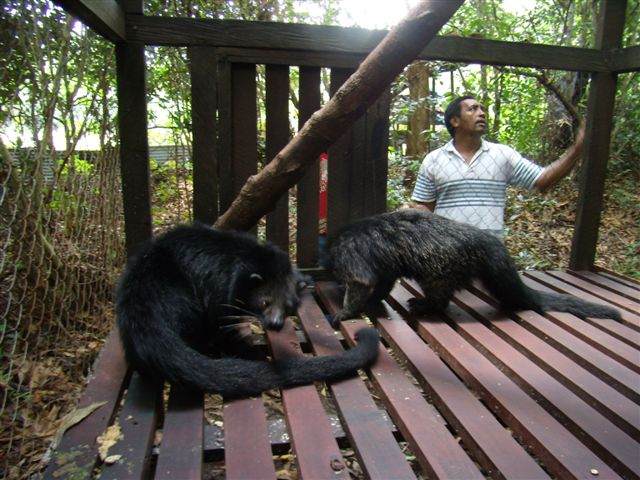
They weren’t best pleased to be woken up in the middle of the day but did happily come down for a sniff around. I still think they are amazing. Scientifically, binturongs are classed as carnivores in the family viverrids, which includes civits and genet cats. It may be simpler for US readers to think of them as racoons with attidute or, for European readers, to imagine a badger with a prehensile (gripping) tail.

binturong & Mr Sehat

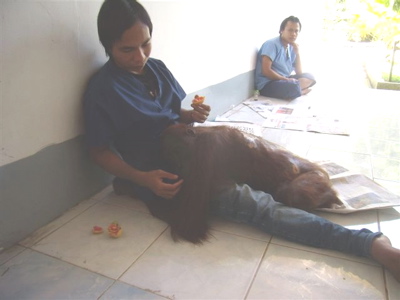
By the way, the man next to the binturongs’ cage is Mr Sehat, the senior assistant at the Care Centre. He is absolutely amazing with the orangutans and is, beyond all doubt, Montana’s best friend.

There have been a few comments asking about who shot Zidane. These are good questions and it is still being investigated so unfortunately I can't give you any more information at the moment.

Thanks again,

Stephen

Orangutan still very sick but now eating.

I went out to the Care Centre today to check on Zidane. While still in a pretty awful state he is improving. We have brought one of the Camp Buluh staff back to town to sit with him throughout the day. He offers Zidane food whenever he feels like it. Zidane is eating but he is reluctant to drink. However, the affection he shows for people is touching. He actually slid off his makeshift cot for a hug. Thank you Brigitta for your generous donation of $100 it is very much appreciated by all of us. Zidane at OCCQ September 2008

(Apologies if the photo is dark – I deliberately switched the flash off)

Elly, from the UK office, is visiting the field projects at the moment so she came to the Care Centre too.

Elly at OCCQ

Elly at OCCQ

Elly receiving an enthusiastic welcome.

There is a pair of binturongs (Arctictis binturong) also known as bearcats at the Centre at the moment.

Bearcats

Bearcats

They are very cool animals. It is a dream of mine to see one in the wild… as well as to Zidane back in the trees.

Bringing the office to our orangutan release camps.

A huge thank you Anna M, Kit C and Wanda H for responding to our recent ask for donations towards the solar power sets and the new feeding system, that we are establishing in Lamandau at our orangutan relesase camps. Both projects are very important and still require your support so please do consider donating. In response to my post about my awful journey to choose a guard post site, Sheryl (thank's Sheryl for your offer of a donation as well) commented “Your day at work is always infinitely more interesting than my day at work”. Do you really think so? I can assure you we deal with just as many mundane, administrative issues as everyone else. The only difference is the physical environment.

A trip Uli, who is our office manager, and I made proves the point.

The Indonesian government has a health insurance scheme onto which we want to enrol all our staff. In order to do that the necessary paperwork has to be completed. Before the paperwork can be completed the staff have to, firstly, receive the papers – we are talking about eight different project sites - and then know what they have to do.

A lot of our field assistants are, putting it in completely western terms, “country folk”. That, of course, is why they are great for us: they know the trees; seasons; animal behaviour and everything else you could possibly want to know about the forest. However, the flip side is paperwork is completely alien to them.

CampBuluh_Jamsostek

Kitchen

Boths the above photos show Camp Buluh one of our release camps in Lamandau.

So Uli and I set off on a whistle stop tour around four of the five Lamandau release camps, (the idea being for her to explain the form and for me to get a day out of the office!). I am sure it would be a modern “Human Resources Department” worst nightmare. Four people could not remember their own birthdays, with two not even being able to hazard a guess at the year.  A lot of the Dayak’s only have one name. Therefore “Riti” was a typical example of what was written for the section “Mother’s maiden name”. Uli, whose full name is Iria Yuliasih Siregar and who came to us from an office job in Jakarta coped admirably with a situation that was way beyond anything she’d experience previously. And it wasn’t just cultural….

Outside the windows curious orangutans were looking in.

campgemini_audiencejpg.jpg

An interested audience!

At Camp Buluh, Omang actually swung onto the boardwalk to get a closer look at why so many people were talking so animatedly at once.

Omang

Curious Omang

And if I said there was an orangutan at Camp JL called Hercules my guess is you are not picturing a cuddly infant. You’d be right. Hercules is a strapping sub-adult male in the full flush of the testosterone rush which precedes the development of cheek pads.

If I am ever in a camp at feeding time, I always try to accompany the guys out to see the orangutans. Uli came along too. It was good to see Bobi and Dodon with their youngsters. It was less good to see Hercules barrelling towards us once feeding was over.

At a push Uli might agree with Sheryl in describing the day as “interesting”. The rest of us described it as “Phew!!! That was fun”. Which is amazing as all we were trying to do was fill in some forms.

More orangutans returned to the wild.

Wow Kusasi certainly proved popular! Thank you for all the positive comments and nice to hear from you again Brigitta. If people want to see the film "Kusasi from Orphan to King" I understand it can be bought on-line from PBS.

The other week I wrote that July was Pondok Ambung, our Tropical Forest Research Station’s, "month". Certainly, the research activities there dominated my time, but that does not mean everything else stopped. In fact, four more orangutans were released from the Orangutan Care Centre & Quarantine into the Lamandau Wildlife Reserve.

I now have a bit of time to tell you about them. Biruté Galdikas supervised the releases with Tigor, the Manager of the five release camps. On 28 July, the adult female Sasha was released along with her adopted daughter Monica. Though Monica was no longer an infant, it is always good to see these adoptions work; no matter how competent the staff at the Care Centre are, obviously a female orangutan is the best possible mother for youngster.

The second release on 4 August was a bit more traumatic. The orangutans, Ucok and Lori, were OK, but the people had some problems! The orangutans were moved out of the Care Centre in the morning, to avoid them travelling in the heat of the day and were carried in a kelotok (a traditional boat a bit like a motorized canoe). Biruté, Tigor and other staff travelled up later in speedboats. Or at least that was the plan; low water levels meant the speedboats could not get up. They lost two propellers and cracked the hull of one of the boats after colliding with submerged logs. Eventually, the kelotok had to come back for them.

The pictures below show the release from the Care Centre to Camp Rasak and then freedom, once again, in the wild.

 Monica

Monica

Sasha & Monica 4

Sasha & Monica

Monica and Sasha leaving the OCCQ

release

release 2

release 3


Feeding plaform

Feeding platform 2

 Back in the wild

These photos show the orangutans being moved from the Care Centre, into the kelotok, then having a few minutes peace on the feeding platform before some other interested orangutans came for a nose.

All the photo's were taken by Uduk, Tigor's deputy, on a camera recently donated to the Orangutan Foundation at our Members and Supporter's Evening in London, in July.

An evening walk in Lamandau Wildlife Reserve

“Hey Jak” I called over my shoulder “Are you following me or the path?”. “Following you” Jak replied.

Not good.

I wasn’t leading; I was merely walking in front. For the last 100 odd metres I’d become increasingly convinced we’d left the path and were following a pig’s trail through the forest. It was 5pm. It would be dark in an hour. We were both soaked to the skin and had been walking in ankle deep water for the last twenty minutes, as a result of the afternoon downpour. And a 100 metres may not sound much but given I wasn’t sure of the exact distance our chances of back-tracking weren’t promising.

I remembered there was a tree with unusually large leaves where the proper trail re-entered the forest after crossing the open bit where we were now standing. Jak’s face was a picture when I said “look for a tree with big leaves”. In a forest, right… good idea.

Example of forest

(Example of the forest terrain, without the water!)

Still, I had my revenge. Jak got out his GPS which told us accurately where we were on the earth’s surface and it even told us it was only 2.9km to the guard post. Did it, however, tell us where the path was? The path that would enable us to get through the forest and to the post before nightfall? The path that I had been unable to follow in daylight let alone pitch blackness?

I wanted to turn east along the forest edge, Jak opted for north-west. As I had got us into this mess I decided not to argue and to follow him. Of course, he was right. Consequently, I was secretly delighted when he failed to notice the tree with big leaves and I could call out “here it is” as we crossed the right track.

That was Tuesday evening. We were in the field until Friday…last week was a long one!

Morning at the Orangutan Care Centre

As promised, I went to the Care Centre this morning to check on progress with the cage repairs. As requested, I also gave Montana “a nod”, as well as a bunch of flowers which he devoured. To be honest, I think he was more interested in watching the workman than in eating. His neighbours, however, were watching the flowers greedily. Montana May08

Montana

neighbours

Montana's neighbours

Thank you so much for everyone who donated to the repairs. The welding has been completed. The metal work is now being painted with rust proof paint which will then be covered with the standard green paint used at the Care Centre.

Cgae repairs 1

Cage Repairs 2

Cage Repairs 3

Repairs 4

Sleeping shelves and tyres will then be fitted. After which, all that remains to happen is to fill it with orangutans. And that should not be difficult. The escapees are crowded into one cage just down the line from Montana. We are hoping that once their enclosure is fixed, we’ll be able to repair the one they are now in.

Escapees’

The Escapees

It was good being at the Care Centre in the morning, as I could see the orangutans being taken out for their day’s exercise in the forest. As always, it was amazing to watch Mr. Laju, one of our blind assistants, leading the orangutans out. Mr Laju went blind later in life but he can still follow the forest paths and board walks into the surrounding forest, and when I say board walk I mean a single plank pathway!

Mr Laju

Mr Laju

The other incredible thing is the orangutans never mess him around. If you and I tried to take them out, I guarantee they would be scrambling up the surrounding bushes, dashing off here and there. Mr Laju does ties a piece of string around their arms but that can’t be the secret. Any self respecting orangutan could pull away from that, if they wanted to. Clearly, they don’t.

Also at the Care Centre at the moment is a female sun bear. I did take a couple of photos but, even by my low standards, they were only fit for the recycle bin! Of course, I have excuses: the bear’s enclosure is very dark; it would not stop moving around; there are too many branches in the enclosure - that's my excuse.

Sunbear 1

Sunbear head shot

Sunbear

There is also a gibbon newly arrived at the Centre which we’ll arrange to have sent to Kalaweit, a specialist gibbon rehabilitation centre, in the next few days. We have our hands full with orangutans, without adding gibbons into the mix.

Again, many thanks.

Small feel of freedom

I had a great weekend but the home-coming was a little rough. As we have said, the orangutans at the Orangutan Care Centre & Quarantine (OCCQ) are let out to play and learn in the forest. That is good. When the orangutans let themselves out, that's a problem! On Monday eight of the little, "less-than-adorable" orange bundles of mischief took it upon themselves to demonstrate just how rusty their enclosure had become. They popped out its side. Three were obviously a bit shocked at their new found freedom and contented themselves climbing up the outside. One went straight for the food room while the others dispersed themselves around the adjacent cages and our guess is they wanted to find the girls.

All of which would be an amusing anecdote if weren’t for the fact that their enclosure really is beyond repair. For a long time we have actually being patching up earlier repairs but that is getting ridiculous. It is time for a rebuild. And, as the staff are quick to point out, there is another cage in almost the same state.

Cage that has broken

Photo of the enclosure (middle one) that has now broken.

Rusting cages

Rusting bars

I am writing in the hope you will consider donating towards the cost of the repairs. A rebuild will cost 13,000,000 Rupiah (approximately $1,410/£714 each). The Foundation has found the money for the first - just so we can minimise the over-crowding that would be caused by moving the eight escapees to other already occupied spaces. At this stage, we have no budget allocation for the extra repairs. We are hoping to raise $3000. This will cover the cage repairs and money remaining from your donations will go towards building temporary holding cages in Lamandau, our orangutan release site. Your support, helping us to reach this target, will be most appreciated.

To put the “happy” story of the breakout into context, that same afternoon we received a tiny infant orangutan, probably around 9 months old. It is rumoured that his mother had been shot and eaten (a practice still carried out by some remote Dayak tribes), he was being kept tied up in a house. The village he came from is at the very southern edge of the Belantikan region but is in the same logging concession in which the Foundation/Yayorin's, Belantikan Conservation Programme (BCP), work. The orphan was found by a couple of logging operation supervisors who took him from the house and gave him to Iman, head of the BCP team. Iman immediately set off on the seven hour drive back to the OCCQ.

Abraham -infant

I am sorry I did not have my camera with me on Monday - this is an orphan we received sometime ago called Abraham. Helpless doesn't quite capture it, does it?

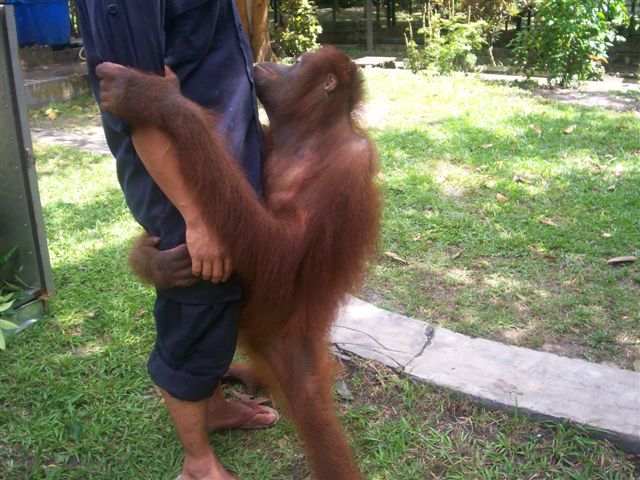
That orphan will almost certainly have to remain in captivity for four years. And he is only one of the thirty or more orphans we are likely to receive this year. I think there is no better testament to the work of Mr Sehat, Dr Popo and all the other staff at the OCCQ that they can nurture tiny, helpless, traumatized orphans into the boisterous youngsters who then break out. The number of orphans we take in and the length of time rehabilitation takes also explain the wear and tear on the cages.

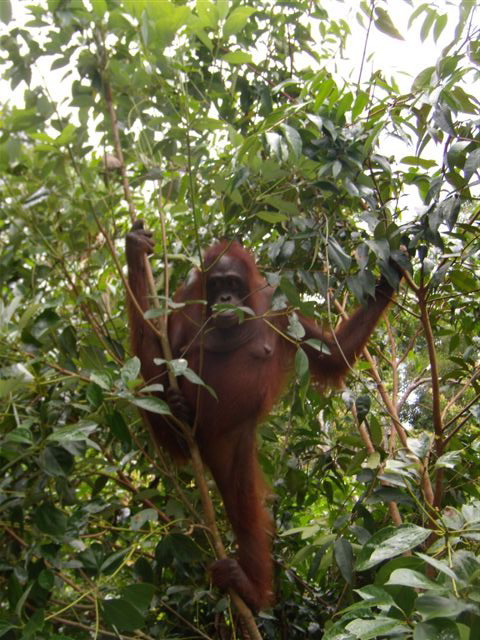
A final word, to end on a positive note, what made my weekend so good: I went to Camp Leakey, the old orangutan release site. Seeing the orangutans which have been successfully rehabilitated, climbing free in the trees (see photos below) reminds you that there can be a happy outcome to such tragic beginnings.

Apologies for my awful photography.

SB Camp Leakey 4/08

SB 2 Camp Leakey 4/08

SB 3 Camp Leakey 4/08

A quick reply to comments…

Thank you for all your comments on Montana. Clearly, his story has touched you as much as it does us. Montana spends 90% of his time in his cage, which is partly what makes it so tragic. The only time he gets out is when we need to give his cage a 'deep clean', put in more ropes and tyres or, as frequently, repair it! The problem is, he is so big and strong he simply cannot be taken out with the other orangutans. Even Pak Sehat (see photo below) who is magical with orangutans cannot control him. Mr Sehat

Mr Sehat with an ex-captive orangutan (not Montana)

The other issue is that the OCCQ was never designed to provide a permanent home. It is only a 'half-way house' for the orangutans on their way back to the forest. Therefore, finding a long-term solution for Montana requires careful thought as the existing facilities are not designed to be used permanently, especially by orangutans of his age and size.

Photo below of Ashley Leiman (Founder & Director of Orangutan Foundation) and I hard at work!

Stephen Brend and Ashley Leiman

Many thanks,

Stephen

Thank you

Last night I closed my blog by saying thank you for all your support. This morning there was an email from the UK office detailing exactly how much we had received in response to our appeal for ‘fire beaters’ (Muriel T $10, Tatsuya H $10, Christopher W $500, Sheryl B $10, Brigitta S $50, Francis D $20, Lucia C $100 and Theresa S (four donations totalling $250)).I am afraid I understated my thanks:

Thank you all, very, very much!

Firstly, here’s the proof we are directing your money as stated.

Fire Beaters

The fire beaters kindly modelled by Abdi (left) and Devis (right).

We have 47 beaters almost ready - we just need to bolt the rubber to the poles, and there are lots more on order. Our aim is to have one beater per staff member along with buckets, jerry cans and hand sprayers. We also want to ensure we have enough beaters available, so they can be handed out to volunteers from close by villages, if there is a fire. Devis actually said “Now I’ll feel guilty if it rains!”. However, the tragic reality is, if not this month or even this year, we will need this fire fighting gear at some point on in the future and now we will be prepared.

The second thank you is due to Theresa who donated money for Malaria medicines. I spoke to the vets who said their greatest need was actually for oral antibiotics which they prefer to use instead of invasive injections. Also, if it is a sick free-ranging, rehabilitated orangutan that needs treatment, they can leave tablets with the field staff for mixing/hiding in food. The vets asked for “Marbocyl” which the UK office kindly procured. Ashley Leiman, Founder & Director of the Orangutan Foundation brought out the Marbocyl, with a lot of other supplies for the OCCQ, and gave them to Dr. Popo and Mrs Waliyati (Senior Administrator) on Saturday.

OCCQ supplies

Donated antibiotics

OCCQ supplies 2

Dr Popo (in blue) and Mrs Waliyati (in red) with the OCCQ supplies.

OCCQ carers

OCCQ carers taking the orangutans out to the forest

Rerin with orphaned infant

Rerin, a carer at the OCCQ, with one of the many orphaned infants.

Theresa, I hope our buying an antibiotic not an anti-malarial is OK with you. After all, it is what we were told the little ones needed!

Once again thank you all very much for your support!

Tough Times

I apologise for the lack of orangutan news recently. I was at my desk for all of last week because every year, during January, we have to write up the previous year’s activities and prepare the work plan for the year ahead. These reports are then submitted to the Government. It is not without its interesting moments, but essentially it’s a bureaucratic exercise that certainly doesn’t involve watching orangutans. And it hasn’t been the easiest time to do all this. The reality of life here is that if it is not a power cut it is a fuel shortage. I am typing (thank you laptop) this by candlelight – we have had no electricity since 5pm and it is now 9 pm. There is virtually no diesel in town, which is why the electricity generating station is only operating part time and kerosene has already run out. Indeed, even in Jakarta families are being rationed to 1 litre per week which is nothing when kerosene is the main cooking fuel. In our camps and guard posts the Assistants are having to cook on wood fires, something we hate having to do. The lack of diesel is providing a challenge for our forest patrols. Only journeys that are essential can be made so we have to prioritise our work carefully in order that we can maintain our high profile monitoring and vigilance. The forests need protection fuel or no fuel.

The fuel shortages don't just affect my work life but my home life too. Recently I was asked about snakes. Snakes, while certainly not my favourite animal, I can cope with. Spiders, however, give me the heebie-jeebies. The other day I went into my bathroom and saw a huge black huntsman above the door. I fled – naturally. Then there was a power cut -great timing. That night, I went back into the bathroom, with a candle, to wash and wouldn’t you know it the spider had disappeared. And that’s what I hate about spiders: they just appear and then disappear. And my bathroom is next door to the bedroom and trying to find a spider with candle in hand isn't fun. I still haven't found it!

Spider

The spider!!

We not only have fuel shortages but we are also experiencing high seas and so very few supplies are getting through. The price of nearly everything; rice, soy sauce and even cement has increased. The weather has been completely unseasonable with very little rain falling this month. The rivers are unbelievably low. February normally heralds the start of the fruit season, but without rain the fruit will wither on the branches. Life is tough in the field, inflation is on the way up and, for the orangutans, there could be lean times ahead with the rehabilitants having to rely on supplied food, which is funded entirely by the Orangutan Foundation.

We’re laying plans and there is a general upbeat mood; to be honest things can really only get easier!

More real orangutan news soon.

Protection Works

The Orangutan Foundation’s protection of the Lamandau Wildlife Reserve and Tanjung Puting National Park has been extremely effective in reducing the level of illegal activities. Because of the protective measures that we have in place, in 2007, we recorded just 12 incidents of illegal logging in Lamandau. This may seem high but without our monitoring and constant presence illegal activities would, without a doubt, be much more prevalent. Jak LECP Patrol Manager

Jak the LECP Patrol Manager

Jak, short for Jakiruddin, Patrol Manager of Lamandau Ecosystem Conservation Partnership (LECP), who I have mentioned a few times in my blog, has only been working in this role since April 2007. Jak is excellent at his job. His strong leadership skills not only mean he is very effective at leading his team but he has also earned the respect and the confidence of external institutions that the Foundation works with, such as local Ministry of Forestry Department’s Office for the Conservation of Natural Resources.

Jak supervises the Foundation assistants who are assigned for the mobile patrols and to the guard posts, which are located on the rivers (the only way in and out of Lamandau, for us and illegal loggers). Every Thursday Jak brings logistical supplies and necessities to the network of guard posts for the week. He uses the VHF radio to organize his personnel in the different locations. It is fortunate that Jak is determined as he has received numerous threats from illegal loggers. Nevertheless, he continues to perform his task professionally and he will not step back just because of the intimidation.

Patrol Team on Klotok

The local Ministry of Forestry on patrol

Last year, on the Mangkong River, Jak and his team found a large quantity of illegal logs, an estimated one thousand cubic metres. The logs, which had been cut into approximate lengths of 2 to 4 metres, included the valuable timber species, Kempas and Meranti. The logs had already been made into a raft and were waiting to be floated away by the illegal loggers.

Illegal logs - Lamandau Wildlife Reserve

Police support for patrols

Photo above - the illegally cut logs made into a raft were found by Jak and his team

Police support - standing upon the rails made by the illegal loggers so that they can roll the logs out to the river.

The logs were destroyed by the local Ministry of Forestry and the Police in order to send a clear signal that illegal logging will not be tolerated. All access to the Lamandau Wildlife Reserve will continue to be guarded. The combined forces of the local Ministry of Forestry and LECP will add extra personnel for each of the current seven guard posts.

The mission of the Orangutan Foundation, and of Jak, is to see Lamandau totally free from illegal activities. With the participation of the surrounding communities we are determined to keep Lamandau's forest intact so it continues to provide a viable habitat for orangutans and a sustainable livelihood for the local people.

A few photos..

As promised, here are a couple of pictures of Boni, one of the four orangutans that we released into lamandau at the end of last year. Boni

Boni - up in tree at OCCQ forest (photo by Jodie Sheridan)

Boni - release

On their way to freedom!! Boni is on the right. (Photo by Jodie Sheridan)

PKB office team

This photo should really have gone with my last post - Working in Borneo. My fellow office workers. From left to right there is Jak, Ully, Devis and Astri.

Working in Borneo

Wildlife Direct suggested I give you more information about my life working in conservation with orangutans, what it's like working as a conservationist, in the field, in Borneo compared with Africa. I will try to give you a better picture of what it is like working in Borneo, a "typical day" if you can call it that. Despite the impression you may have gathered from this blog, like many people in the world, I work in an office in the town of Pangkalan Bun and it feels like 90% of my time is devoted to emails and Excel spreadsheets. The Orangutan Foundation has a conscious policy of capacity building and investing in Indonesians, so I am the only expatriate employee. Indeed, I am the only westerner in town! I am responsible for project supervision and all English language communication, particularly reporting to donors. I have to make regular reports from the field to the overseas offices, disseminate information from those offices to the relevant people in Indonesia, and help with proposal writing and forward planning.

Naturally part of my job involves fundraising. I think like most field based people I get so convinced by the worth of the cause I struggle a bit to complete grant applications, especially those using buzz words, for example “Tell us about the multiplier effects of your planned project” (huh, we’re trying to multiply orangutans aren’t we?!) Crucially we have recently received large grants towards habitat protection work. For instance, the United Nations Environment Program with European Union funding supports our work in the Belantikan Hulu; this region contains the largest population of wild orangutans outside of a protected area. However, all of our orangutan rehabilitation work is funded from private donations and last year that cost over US$100,000. As the UK office has grown tired of telling me “Stephen, buying lottery tickets is not a sustainable fundraising strategy!”

The Orangutan Foundation office has a friendly relaxed atmosphere and is a lovely place to work from. There is a garden with a fish pond and mango, rambutan and banana trees, producing the most delicious fruit. The whole operations of the Foundation are co-ordinated from the office, we communicate by radio to all our field posts and my colleagues do a truly fantastic job. In the office there is Ully, the Office Manager; Astri, the Liaison Officer, who also helps me with this blog; Jak, the Patrol Manager; Teguh, the Guard Post Supervisor; Devis from Pondok Ambung and finally the Belantikan Conservation Programme team also work from the office. Tigor, who runs the Lamandau Rehabilitation Camps, works out of the Orangutan Care Centre and Quarantine facility (OCCQ). There are numerous powercuts in Pangkalan Bun and so those lucky enough to have a laptop, Jak, Asti and I, often giggle at the moans coming from the others when the power cuts out! When around the orangutans, or on patrol, we wear a uniform which helps the orangutans to recognise and distinguish between Foundation staff and other people who might pose a threat.

OF office PKB

Inside OF office PKB

Top photo - outside of the office. This photo -inside of the office

Teguh and I are the only Christians. The rest of the people in the office are Moslem & our field staff are a mix of Christian, Moslem and Dayak – which is useful as it means someone is always willing to work on one or other of the religious holidays. Jak and Teguh are married with two children each, Astri is married, Devis is too young, or so we tell him, and everyone is forever teasing Ully about when she’ll get married. However, given her IQ is about the twice that of the rest of us (probably combined) when the time comes, I have no doubt she’ll be the one doing the choosing.

Today was a fairly typical day: I was at the OCCQ just after 8 am, as I had to give the vets some darts (injectable syringes for their blow pipe) that have just been donated.

Orangutan at OCCQ

I also wanted to check on a female orangutan, Mumsie, who had been brought down from Lamandau suffering from suspected anaemia - blood loss possibly with malaria. Thankfully she is fine and, all being well, will be returned to the forest in a few days. I then went back to the office. For most of the day I continued writing up our 2007 Annual Report which, as it also has to be in Indonesian, Astri and I did together. The head of one of Tanjung Puting National Park’s management units stopped by to discuss plans for 2008. It was then back to my desk briefly before heading out in the afternoon with Jak to check on a new guard post we are building in Lamandau.

Guard post Gaja

River - lamandau

The new post site

This post, which will stop people using a river to enter the Reserve, is part funded by the Australian Orangutan Project and I need to update them on progress. We got back to town at 6.30pm and, after having fed myself, I am typing this at 8pm. I’ll stop soon!

Apart from us here in Indonesia, there is the UK Office without whose support none of this would be possible. I give them more problems than they deserve and still they continue to back us up 100%. For that I can not thank them often enough.

There are two other things that are probably worth saying about my work with orangutans; firstly, unlike just a few short years ago, the sense we have now is no longer of trying to stop orangutans from falling over the brink into extinction but in pulling them further away from the brink. Not everywhere – certainly not across their entire range – but in specific places we are well on the way to saving orangutans, and we should all feel good about that. Vigilance and on-going dedication is still needed; the fires of late 2006 threatened to undo all the gains we had made. Nevertheless, better to focus on the positives than the negatives.

Orangutan TPNP (Mark Fellows)

Orangutan in Tanjung Puting National Park (photo by Mark Fellows)

The second thing is that, partisan as I may be, the Orangutan Foundation is honest, and that is almost entirely due to the culture Ashley Leiman, the Orangutan Foundation Founder and Director, has established for the organisation. Of course, we’ll tell you our successes, but we’ll also be honest in saying when things don’t go well: in the middle of last year we managed to stop a palm-oil plantation from being established along Lamandau’s borders. But the year before, we failed to stop Tanjung Puting from losing some 5,000 + hectares.

In my blog I talk about my work with orangutans but it is not just saving orangutans. What is really great to think about is the incredible biodiversity (proboscis monkeys, gibbons, kingfishers and hornbills -I could go on and on!) found in their habitat that is also protected as a direct result of conserving a flagship species, the orangutan.

Going to great heights for orangutans!!

I think I wrote before that all Orangutan Foundation guard posts are equipped with solar power and radios. The solar power sets we buy locally are brilliant. The panel is made overseas but the battery, charger, cables and lights are all made ‘in country’. The battery should last three to five years and the lights as long. Setting up the system takes less than two hours and is literally as easy as wiring a plug. Indeed, one set was put up using nothing more than a pocket multi-tool! Solar Panels

Solar power set

Radios have been installed at the Orangutan Care Centre and Quarantine, the Foundation office in Pangkalan Bun, and in all the Tanjung Puting National Park and Lamandau Wildlife Reserve camps and guard posts, making a tight network that helps us to effectively monitor the protected forests and support both the people and, in case a vet needs to be called, the orangutans too. The Field Assistants have daily (and sometime hourly!) contact with the other camps and guard posts. The system is very robust, practical and sustainable.

Late last year, the Foundation refurbished TPNP’s guard post on the Buluh Besar River. The final task was installing the solar power and radio sets. Mr Teguh, the Post supervisor, and I went down there on the Foundation’s new “kelotok” (traditional motorised long-boat); a longer but much more pleasant journey than the one we had in the speedboat during Teguh’s look-see interview (see post: Wet & Wild and that's just getting to the guard posts).

TNTP_PosBesar_Dec07

Buluh Besar River - TPNP (note the radio mast in the background!)

The solar power set was installed quickly and easily on the afternoon we arrived. The night there was great too; playing cards with the Assistants, bathing in the river and watching proboscis monkeys on the river bank. The location is unbelievably scenic.

The problem was the next day’s job was nowhere near as much fun. A radio needs an antenna and the antenna needs to be up high. Frequently we put the antenna on top of a tree but, on the Buluh Besar, the National Park had previously installed a radio mast, which is naturally where the antenna had to go. The only question was who was going to climb up. The guys justified their selection of me on the basis of my being the only one without family!

SB radio mast

Things I do for orangutans!!

Tropical pitchers and questions answered!

Mr Devis has sent an update from Pondok Ambung Reseach Station, TPNP about tropical pitcher plants - a fascinating carnivorous plant species. First though we have received quite a few comments and questions from our last post 'Lamandau Ecosystem Conservation Partnership - community meeting'. We'll deal with those before "handing over" to Mr Devis. Thank you F.J.Pechir for your comment and question about the survey of the orangutans in Sabah. Without seeing the study and knowing more about it it is hard to comment on. There was a study published in December 2004 by Marc Ancrenaz et al. which also used aerial surveys for estimating the distribution and population sizes of orangutans in Sabah (perhaps it is this study which you are referring to?). Before this study the previous estimates for Sabah ranged from less than 2,000 to 20,000 orangutans, the M. Ancrenaz study estimated the population at around 11,000 orangutans and we think is an accurate figure.

Thank you Theresa Siskind for your question about eco-tourism in Lamandau. The Orangutan Foundation doesn’t run an eco-tourism programme to the Lamandau Reserve because it is an orangutan release site. With the Lamandau Ecosystem Conservation Partnership we want to develop long-term sustainable incomes for the local communities and in our experience eco-tourism isn't a source of income to be relied upon because it is often influenced by global issues, for example, terrorism. Some products made by the local communities, rattan baskets or mats, are on sale to tourists who come to visit Tanjung Puting National Park. We do value and realise the potential of eco-tourism to help protect wildlife and it has certainly done this in TPNP. Please visit our eco-tourism page on the Orangutan Foundation website.

The tropical pitcher is a very interesting carnivorous plant species and the uniqueness of its shape and colour has captured the interest of Mr. Devis who has been studying the tropical pitcher plant at Pondok Ambung. Over to Mr Devis....

Mr Devis looking at pitcher plants

Our survey began in the peat swamp forest around Sungai Sekonyer Kanan. Exploration has to be limited to the dry season because during the rainy season the rising water levels make it almost possible! We have so far discovered two types of tropical pitcher plant; Nepenthes ampullaria which looks like the pitcher cup and Nepenthes reinwardtiana which looks like a cylinder tube (see photos below).

We noticed that Nepenthes ampullaria grows in large quantities, in a centralized position in one particular spot. Our second survey was in the swamp forest around Pondok Ambung and this time three species of tropical pitcher were discovered. Two were species found in the first survey. The third species, Nepenthes rafflesiana (Raffles' Pitcher Plant) which has lower pitchers are generally round, squat and winged, while the upper pitchers are narrower at their base. We discovered that Rafflesiana grows well as a colony with Nepenthes ampullaria.

Nepenthes ampullaria

Nepenthes reinwardtiana

Three pitchers have been discovered so far Nepenthes reinwardtiana, Nepenthes ampullaria and Nepenthes rafflesiana. We need continuous surveys so we can uncover other types of tropical pitcher and learn more about their distribution so that conservation efforts can be taken.


I am hoping that there will be others researchers who have a similar interest in Tropical Pitcher research. Fellow researchers - I wait for your arrival here in Pondok Ambung!!

Camp Mangkong

A quick blog to let you know about a very good day. But first the background. About a month or so ago we removed some illegal loggers from the Mangkong River and subsequently we built the guard post there – the post which flooded. Map of TPNP and Lamandau

I accompanied a follow-up patrol to make sure there was no more logging taking place upstream. Well there was definitely no logging but, even better, we found what appeared to be an ideal orangutan release site (see photos below). I won’t bore you with all the factors that come into play when choosing a release site but suffice it to say “location, location, location” isn’t everything! You have to have forest, access and a clearing for the buildings plus a few other things. Anyway, we saw this site and all said “perfect”.

CampMangkong_Dec07

The Patrol Team, who monitor illegal activities, are seperate to the Camp's staff, who monitor the released orangutans in Lamandau and they are separate again from the staff at the Orangutan Care Centre Quarantine (OCCQ) where the orangutans start the rehabilitation process. One of my jobs is to try to integrate all the different branches of our operations, so last week I went back up the Mangkong with Mr Tigor, the Camp's Manager, a couple of his staff and staff from the OCCQ.

CampMangkong2_Dec07

Foremost among the OCCQ staff was Mr. Sehat, he is someone I truely admire and he has an absolutely magical way with orangutans. At the OCCQ he is the "dominant male" – bar none. I once watched an orangutan trying to wrestle a tub of fruit from one of the other assistants. Mr. Sehat happened to be walking past. Immediately, the orangutan let go, sat down meekly and gratefully accepted his allotted share. There is no force or aggression in his manner, it is simply will power and years and years of experience. Sehat once carried a sub-adult male weighing some 70 kg (154 lbs) from his enclosure to a traveling crate just so the orangutan would not have to be anesthetized.

Mr Sehat

Photo taken of Mr Sehat on an earlier orangutan release.

To continue, if Mr. Sehat agrees with something we know it has to be alright and he took one look at the selected site and asked grinning, “Why haven’t we found this place before?”. Ukim, one of the other assistants, sized it up perfectly – and with the brevity typical of a Dayak. He looked around and said simply “it’s never been burnt”. Fires destroy the natural seed bank in the soil (rainforest trees are not adapted to cope with fire). Even if an area has been logged it will recover but once it is burnt, recovery will be much, much slower. Mr Tigor was equally enthusiastic and he had even started pacing the layout of the new site. For my part, it was reassuring to know that everyone was in agreement, this was a perfect release site. You can expect to hear more about the Mangkong Camp and the orangutans, who will make their home there, in the future!