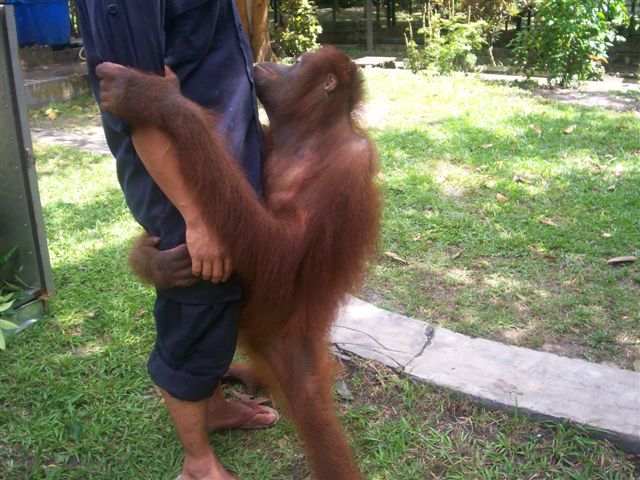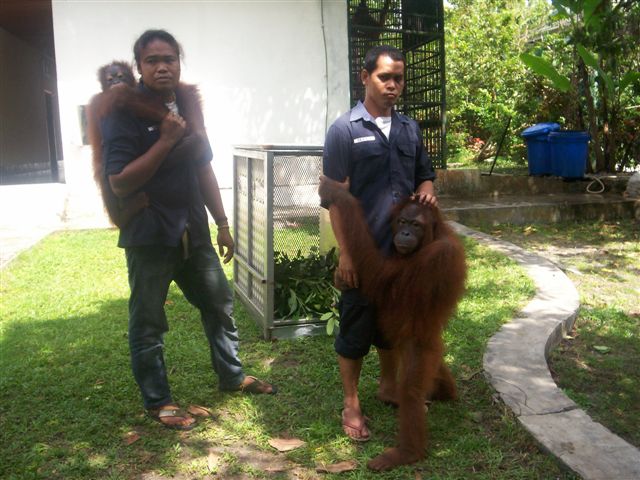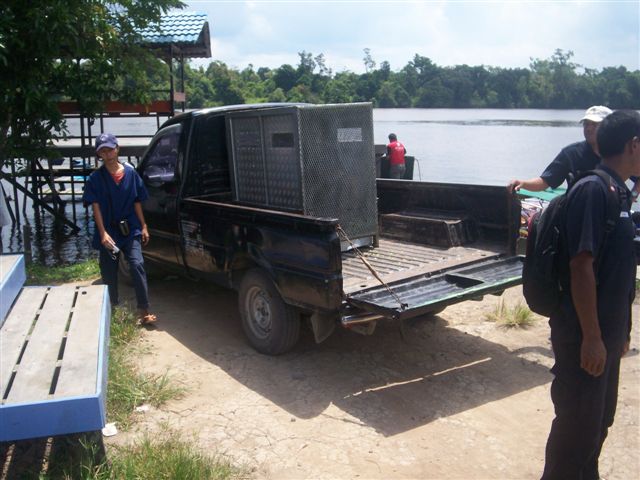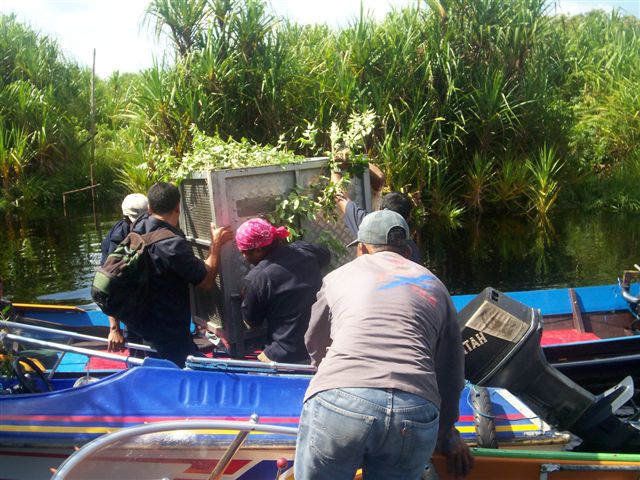
Lamandau River Wildlif...

Monitoring released orangutans

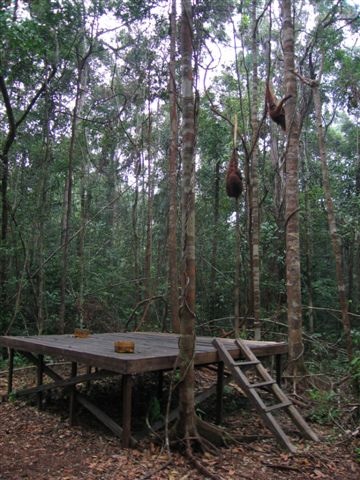
I see a number of people have asked how we monitor the orangutans once they have been released into Lamandau. There is nothing technical involved: our field assistants follow the orangutans from sunrise to sunset (or as we say, "nest to nest") everyday for a week. If after that time it is clear the orangutan has adapted to life in the forest, they will then be followed occasionally like the other previously released orangutans. If after the first week, the assistants are concerned that the orangutan may not be adapting they will continue to follow he or she for a month. Common causes of concern are the orangutans not making their own nests but choosing to sleep on the feeding platform or making a bee-line for Camp and not exploring their new surroundings. Within the first week, we expect to see the orangutans making their own nest, trying wild food and travelling. Nearly all achieve this.
04_andi.JPG

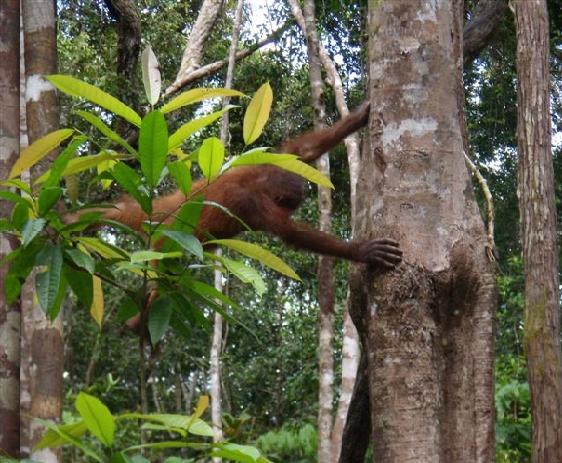
Most newly-released orangutans tend not to go too far in the first couple of days but then they start to travel further and further. Last December I told you about the release of Sawit and her adopted son Andi. They took off within their first week, probably because Sawit was being hassled by a sub-adult male. The Assistants could not follow her through the swamps to the west of Camp Rasak. However, on 22 April, back they came, still together.

Which brings me onto the last element of the post-release monitoring; the daily supplemental feedings. In Tanjung Puting, where orangutans were released from the early 1970s to the mid-90s, the rehabilitants are offered food once a day. In Lamandau food is provided twice a day. This serves three purposes: it keeps up the nutrition levels of the released orangutans; it decreases competition for scare food resources with wild orangutans, gibbons, hornbills, and other wildlife and finally it enables us to monitor the orangutans’ development. All individuals coming to the feeding stations are recorded; over the course of a year, at least half of all released orangutans are seen. The Assistants also note whether they are consorting with the opposite sex, pregnant or with an infant and their general health.
 ladydi_may08-1.JPG

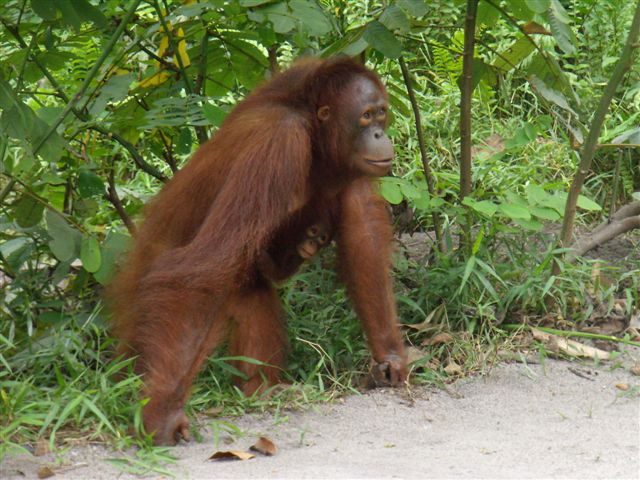
For example, Boni who was released at the same time as Sawit and Andi came into feeding 26 times during April, and then every day in May and June. Lady Di, whose picture I showed you in April, was around for 28 days in April, May and June but Hongky was there for just 9 days in April, 14 days in May and 25 days in June.

ladydi_may08-2.JPG

In answer to “Rick, El Paso, TEXAS” question about the availability of this data, I am afraid to say it is not available online. We produce quarterly reports, in Indonesian, covering this information but the reports are for the Forestry Department and our own internal use. However, Tigor who manages the Lamandau Camps is providing information about our release program to an Indonesian PhD student at Cambridge University in the UK. So hopefully it will be peer-reviewed and published.

ladydi_may08.JPG

Please keep asking questions and I’ll try to keep answering them! Many thanks.

More orangutans returned to the wild.

Wow Kusasi certainly proved popular! Thank you for all the positive comments and nice to hear from you again Brigitta. If people want to see the film "Kusasi from Orphan to King" I understand it can be bought on-line from PBS.

The other week I wrote that July was Pondok Ambung, our Tropical Forest Research Station’s, "month". Certainly, the research activities there dominated my time, but that does not mean everything else stopped. In fact, four more orangutans were released from the Orangutan Care Centre & Quarantine into the Lamandau Wildlife Reserve.

I now have a bit of time to tell you about them. Biruté Galdikas supervised the releases with Tigor, the Manager of the five release camps. On 28 July, the adult female Sasha was released along with her adopted daughter Monica. Though Monica was no longer an infant, it is always good to see these adoptions work; no matter how competent the staff at the Care Centre are, obviously a female orangutan is the best possible mother for youngster.
The second release on 4 August was a bit more traumatic. The orangutans, Ucok and Lori, were OK, but the people had some problems! The orangutans were moved out of the Care Centre in the morning, to avoid them travelling in the heat of the day and were carried in a kelotok (a traditional boat a bit like a motorized canoe). Biruté, Tigor and other staff travelled up later in speedboats. Or at least that was the plan; low water levels meant the speedboats could not get up. They lost two propellers and cracked the hull of one of the boats after colliding with submerged logs. Eventually, the kelotok had to come back for them.

The pictures below show the release from the Care Centre to Camp Rasak and then freedom, once again, in the wild.

 Monica

Monica

Sasha & Monica 4

Sasha & Monica

Monica and Sasha leaving the OCCQ

release

release 2

release 3


Feeding plaform

Feeding platform 2

 Back in the wild

These photos show the orangutans being moved from the Care Centre, into the kelotok, then having a few minutes peace on the feeding platform before some other interested orangutans came for a nose.

All the photo's were taken by Uduk, Tigor's deputy, on a camera recently donated to the Orangutan Foundation at our Members and Supporter's Evening in London, in July.

Land rights and forest ownership

Sheryl raised two interesting points in her comment on the illegal farming: 1) “I’m sure the farmers knew they were on reserve land” We are pretty sure they did too as, in this part of the world, the Reserve is where the trees are! However, this is almost impossible to prove and, even knowing it is a conservation area, won’t necessarily stop the villagers from laying a claim to the land.

Slah and Burn 2

Slash and burn is commonly used to clear the forest.

Slash and Burn

Illegal settlement in cleared forest.

Secondly, Sheryl wrote “don’t people have to own the land or have permits from landowners to burn forest and start a farm? I mean, here I couldn’t just drive out to the country and start farming!” Bizarrely, Indonesian laws concerning community use of forest lands still end up promoting forest clearance. If you clear the land it is deemed an improvement. Anyone who improves the land has de-facto usage rights to it. And those rights are passed down from generation to generation. I have been in some very old secondary forest only to be told this is “Mr so and so’s land…”

In the case of the illegal farms, our only weapon is that the farm was clearly established after the Reserve was gazetted. It is illegal.

Kind regards,

Stephen

Illegal Farming Inside Protected Area

Following on from my last post “Busy, busy, busy”, here’s some more detail about the illegal farming. The farm was obviously productive and well-maintained. It had a fence around it to keep out wild pigs and deer. Inside, bananas, rice, cassava and a number of vegetables were all growing well. Indeed, if our agricultural demonstration plots looked that good we could be justifiably proud. LWR -illegal farming Illegal farm inside Lamandau Wildlife Reserve

But there was one big problem with this farm – it is inside the Lamandau Wildlife Reserve. It is obvious from the surrounding forest the farmers were not making use of fallow land, as we try to do with the demonstration farms. No, here, they had cleared the forest and then burnt it to boost soil fertility.

Illegal farming

Note the surrounding tree-line.

This situation gives us a problem, as there is no real alternative to evicting them. We do not wish to have a confrontation with the surrounding villages; one of our aims is to establish harmonious relations between the neighbouring communities and conservation areas. However, if there is a flagrant violation of the law, as in this case, there is little that can be done. The farmers can not be allowed to continue. They are clearly damaging the forest, increasing the risk of forest fires and would almost certainly persecute any wildlife that took to crop raiding.

Farming inside Lamandau

Once forest, now farm land.

Technically, the farmers could be arrested, but pragmatically this would only inflame local sensibilities and even the police would be reluctant to arrest someone for (as they will see it) “just growing food”. The balancing act facing us, therefore, is to get the people out of the Reserve without turning their whole village against us but, at the same time, creating a strong enough front to deter anyone else from attempting to farm there. The Forestry Department officials, under whose auspices we work, have suggested giving the farmers six months to complete the current harvest after which they must leave.

This seems reasonable. We can easily monitor them to make sure there is no further expansion or burning. We can also make use of this time to erect a signboard/ block on the river the farmers are using for access to prevent anyone else from saying “I did not know it was a Conservation Area”.

It is worrying that people still do not respect Lamandau’s borders but it is encouraging that our patrols clearly have good enough ground coverage that they were able to detect the farm and, secondly, that the Forestry Department has the resolve to deal with it. A strong display now will go along way to reducing such incidents in the future.

- P.S. Brigitta, thank you for the comment. It is a pity about the video question and answer session, but it will still be good to meet up. As I said, I will be at Pondok Ambung or Camp Leakey on the 10th, so we’ll meet up then. Safe travels!

Busy, busy, busy

Once again, I find myself in the unenviable position of having to apologise for the long silence.  I know I have neglected to keep you up to date with all that is going on in orangutan-land.  If I have an excuse it is only that I have been struggling to keep up myself.  June has looked like this:  afloat_again.JPG

 (Supply boat after it was refloated, repaired and painted)

First week:  Five straight days in the field investigating a case of illegal farming inside the Lamandau Wildlife Reserve, which is when I managed to get Jak hopelessly lost (or vice-versa as I still maintain!) followed by a meeting with the mangers of one of the palm-oil plantations which border the Reserve.  After that, we continued onto Sukamara, the next district capital, where we are establishing an office. 

jak__illegalfarm.JPG

Second week: To Jakarta where Astri, I and representatives of seven other projects attended a coordination meeting with the European Commission Delegation prior to the opening of the Indonesia Environment Week exhibition.  If nothing else, the meeting made us proud our little project is holding its own at the sharp end.  I also met with the director of a company which conducts bio-carbon surveys.  Many people are talking about trying to protect forests through carbon-offsets, or Reduced Emissions through avoided Deforestation and Degradation (REDD) projects, but very little is actually happening on the ground. That is a ring into which we want to throw our hat – Belantikan is a stand-out candidate for protection.  For a taste of what this involves have a look at http://www.climate-standards.org/ and follow the links to “Climate, Community & Biodiversity Project Design Standards, Draft Second Edition”.  Finally, I met with the coordinators of the cross border, USAID funded project we are working on. 

Third week:  Should have been back in the office attending to paperwork, but it did not turn out that way!  Our supply boat was battered in heavy seas, made it to the Buluh Besar guard post then promptly sank.  Our supervisor, Teguh, was apologetic but he really needn’t have been: clearly not his fault.  I also went back to Lamandau to check on progress at the new release camp which the volunteers are building.  Then, last weekend, I went up to Pondok Ambung to have a few days with the crocodile researcher.

kelotok_sunk.JPG

In between there was the usual mix of staff management issues (how do you budget for out-of-the-blue double digit inflation?); an audit; a volunteer with a horribly infected leg derived from over-zealous scratching of mosquito bites and my Indonesian counter-part saying he can’t continue to work in Borneo with his wife – who is expecting their first child – still in Java.  He has been like a second limb to me, and his departure is big blow.

volunteers_work.JPG   

I am sure like many other people reading this blog, my problem is trying to juggle too many balls at the same time. A problem which is made worse by my being a mere male who is genetically incapable of multi-tasking!  The up-side, however, is that I did manage to sneak up to Camp Leakey to see Uning the daughter of one of my favourite orangutans, Unyuk.  Uning has just had her first baby.  It was great to see them.

uning_01.JPG

uning_02.JPG

Many thanks,

Orangutan Foundation

An evening walk in Lamandau Wildlife Reserve

“Hey Jak” I called over my shoulder “Are you following me or the path?”. “Following you” Jak replied.

Not good.

I wasn’t leading; I was merely walking in front. For the last 100 odd metres I’d become increasingly convinced we’d left the path and were following a pig’s trail through the forest. It was 5pm. It would be dark in an hour. We were both soaked to the skin and had been walking in ankle deep water for the last twenty minutes, as a result of the afternoon downpour. And a 100 metres may not sound much but given I wasn’t sure of the exact distance our chances of back-tracking weren’t promising.

I remembered there was a tree with unusually large leaves where the proper trail re-entered the forest after crossing the open bit where we were now standing. Jak’s face was a picture when I said “look for a tree with big leaves”. In a forest, right… good idea.

Example of forest

(Example of the forest terrain, without the water!)

Still, I had my revenge. Jak got out his GPS which told us accurately where we were on the earth’s surface and it even told us it was only 2.9km to the guard post. Did it, however, tell us where the path was? The path that would enable us to get through the forest and to the post before nightfall? The path that I had been unable to follow in daylight let alone pitch blackness?

I wanted to turn east along the forest edge, Jak opted for north-west. As I had got us into this mess I decided not to argue and to follow him. Of course, he was right. Consequently, I was secretly delighted when he failed to notice the tree with big leaves and I could call out “here it is” as we crossed the right track.

That was Tuesday evening. We were in the field until Friday…last week was a long one!

Non-timber Forest Products

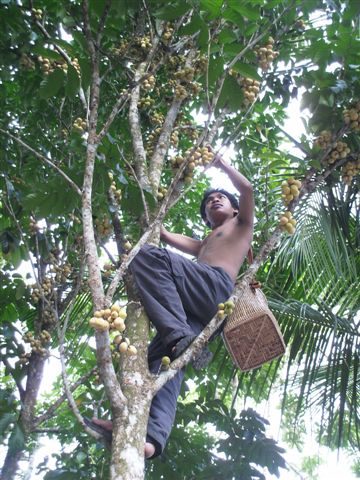
This morning we attended a meeting organised by the local forestry department. They are creating “An Inventory of the Potential for Non-timber Forest Products” in the local government district. Non-timber forest products, or NTFP, as they are referred to in conservation jargon, are an often used argument for the protection of forests. Local people for millennia have exploited NTFP and although their impact on the local environment and wildlife may be debated, in comparison to bulldozers their impact on the forests was negligible. Therefore, we consider NTFP a valuable tool in protecting the forests and we are pleased that the local government is taking this initiative (see the photos below showing various examples of NTFPs).

fruit picking

Fruit picking

making baskets

Making rattan baskets

Baskets

Rattan Baskets

Rattan craft wear

Other craft products

This week I’ll have my own opportunity to assess the sustainability of NTFP. I’m off into the Lamandau Wildlife Reserve until Friday. A pleasant round of investigating reports of farming inside the reserve, plantation expansion on its border, and an assessment of activities on the western edge. Hopefully, I’ll see an orangutan or two.

I’ll write again when I get back on Friday or Saturday.

Sowing the seeds…

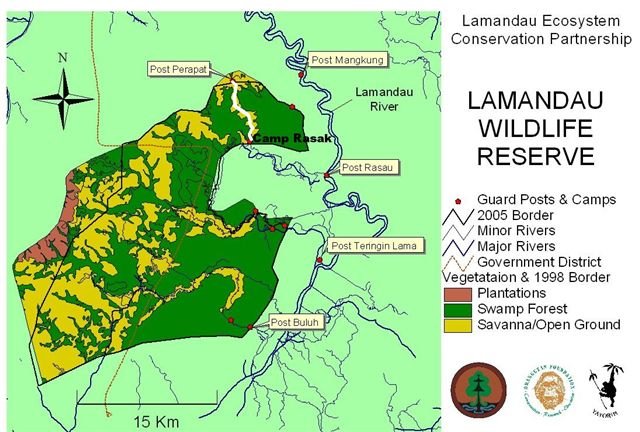
My every sense says the forests on the northern border of the Lamandau Wildlife Reserve are in trouble. Already split into thin fingers of forest, separated by degraded areas, it seems these forests are retreating not expanding. However, with the support of local communities, we have chosen this area as a reforestation site. A few days ago I went there with Rene Dommain, the visiting German peat researcher, and we stayed at the very northern point of the Reserve, where we have a guard post, Post Prapat (see map).

Map Lamandau

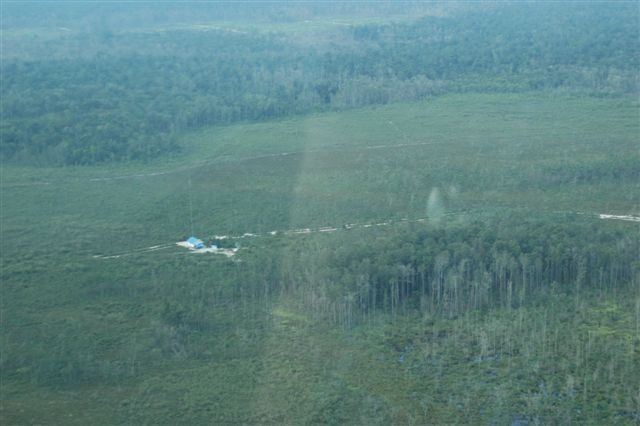
Behind the post is one of the fingers of forest. Here there are tall trees, including those species found in deep forest, but they are only 20 metres away from sand. Clearly this is remnant primary forest and the thinner it gets, the more vulnerable it becomes.

Ariel view

Aerial view of Post Prapat with the remnant forest behind.

Rene helped to explain the process and no surprises here – the villain was fire. Whilst he described it as an “anthropogenic impact”, you and I can hear “man made”. The southern part of Borneo is a relatively “young” landscape. The base material is sand, deposited either from erosion of the high interior mountains or during the periods when the area was an ancestral seabed. Over thousands of years, grasses, shrubs, and then trees gradually covered the sand and forests grew.

Fires have had a major impact on this ecosystem. The first fires burning through the shallow humus layer, killing the trees’ roots. With the trees fallen the next fires to occur were even more destructive with subsequent fires encouraging scrub growth. Ultimately this left an exposed layer of sand with the original nutrient rich humus having been destroyed. Presently, these remaining forests are just waiting for the next dry year, the next fire.

The aim of the reforestation programme is not ambitious – even in our wildest dreams we cannot envisage the day when this will be thick forest. What we are trying to do is broaden the forested fingers, reduce the gaps and push the balance in favour of the trees not the scrub.

It is a tall order to regenerate this area, but you know us, we like a challenge!

We have established a tree nursery at Post Prapat. The people from the surrounding communities have been enthusiastic in finding wildings (seedlings harvested from wild seed-fall) to stock it. We will keep the trees in the nursery until their rooting systems are well established.

Nursery

Nursery

The whole process is hugely resource-intensive and the return may be as little as 50ha (1/2 km2 or 123 acres). But that is hardly the point. The real points are:

  • People learn about how fragile these ecosystems are.
  • We are demonstrating that protecting the existing forest is much more effective than trying to re-grow it
  • By protecting the fragile fringes, you prevent damage spreading to the core

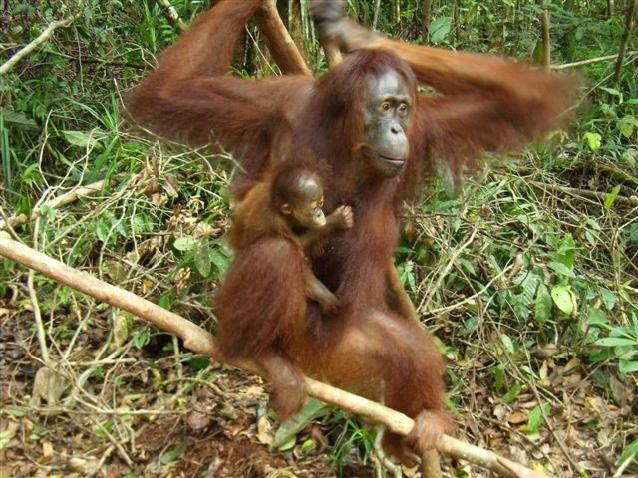
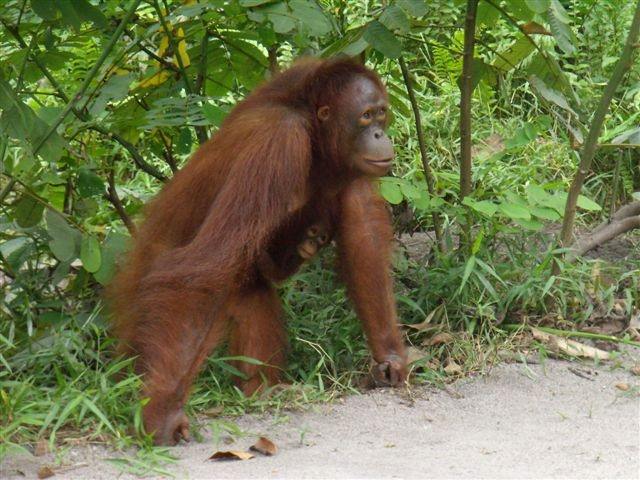
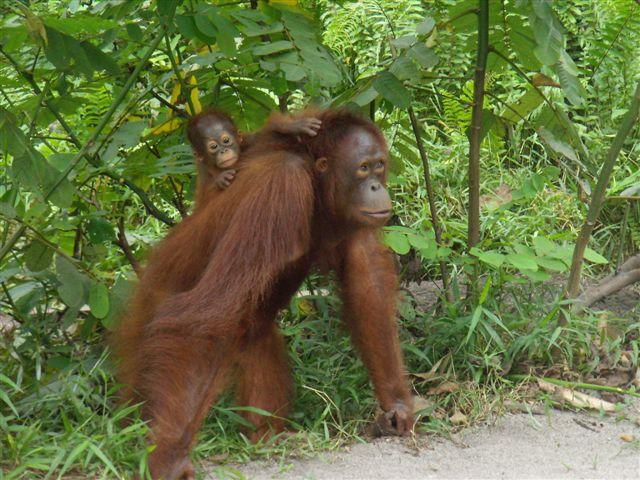
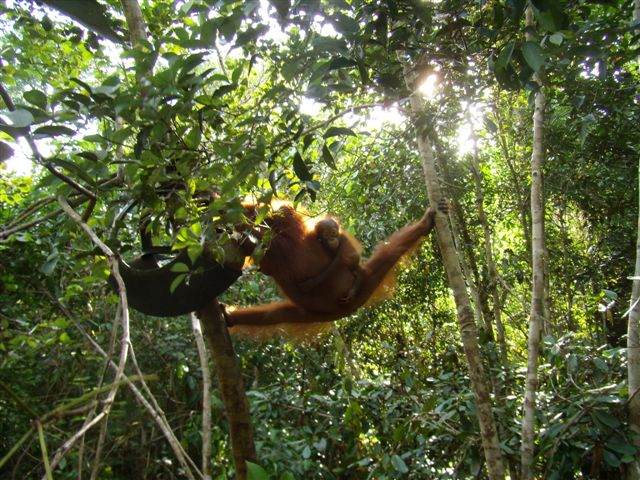
In the case of Lamandau, the forest core is still rich in biodiversity. I led Rene on the 7 km walk southwards from Post Prapat to Camp Rasak. On the way, we saw a few birds and a snake. At Camp Rasak, I was hoping to catch of glimpse of Boni who we are told is seen most days and neither did we see Andi and Sawit, who seem to have gone off together (see post 'More orangutans back in the wild'). However we were fortunate to see Lady Di and her baby.

Lady Di and infant

Lady Di and infant 2

Lady Di and infant 3

Lady Di was released into Lamandau in Febuary 2006 and this is her first baby.

It is hard to believe our reforestation programme site is only 7 km away, but without this added protection, this forest and these orangutans would seem a lot more vulnerable.

- PS, Sheryl, you’ll be pleased to know once the eagle, snake and monkeys were out of the traps, I also set the fish free :-)

We are participating in WildlifeDirect's business strategy. Please help us by taking this user survey, thank you.

WD user survey

Trapped Wildlife

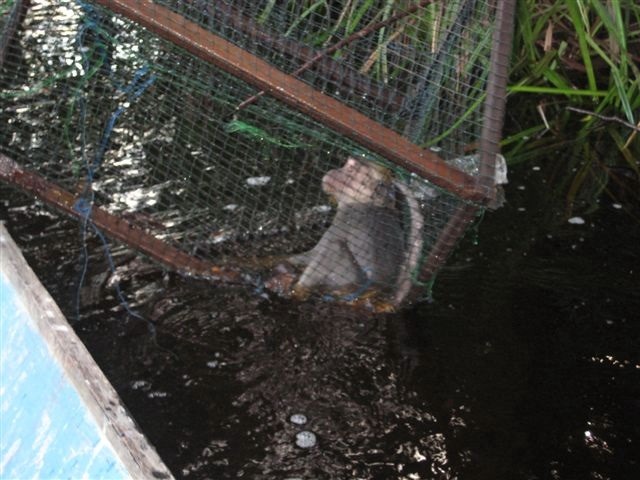
Releasing caged wildlife is rarely anyone’s idea of fun. Panic-stricken animals tend to lash out and they don’t have claws, teeth and talons for nothing. Which is why, yesterday, finding an eagle, a snake and two macaques caught in fish traps provided a challenging finish to the day. As always, I must apologise for the photos; but this time we did have a good excuse; we were all a bit too busy to take photos. So, thank you Rene (a peat forest researcher) for taking the ones below. The fish traps were made of a wooden frame wrapped in netting with an inverted slit through which fish can enter but can not escape. Because the water level in the Mangkung River, the Lamandau Wildlife Reserve, has dropped so much the traps were exposed and the fish inside had obviously tempted the monkeys and the crested-serpent eagle in for an easy meal. Certainly, I have never seen animals caught in them before.

Jak, the Lamandau Patrol Manager and I tackled the eagle first, only to find there was a small python in the trap as well. I was certain that as we cut away the netting the eagle would either peck or slash with its talons, which were wrapped in the netting. Amazingly, once the roof was cut away the bird freed its feet and flew out right in front of our faces, without scratching either of us.

Trapped Eagle

Crested serpent-eagle caught in a fish trap (photo by Rene Dommain).

The python was half way through the netting but having gorged on the trapped fish had a bulge three quarters of the way down its body, which would not fit through the mesh. Jak was all for leaving it and I have to say as its head twisted around I thought he had a point. However, as it was, the snake would be a sitting target for the next eagle to come along. So trying to keep the sharp edge away from its skin, I slid my knife in between the snake and the netting and cut it free. Great, we were now in the water with a python and neither of us wanted to think about crocodiles!

Trapped juvenile macaque

Juvenile macaque caught in a fish trap - once freed he swam away (photo by Rene Dommain).

The macaques were about 100m downstream. In one trap there was a juvenile and on the opposite riverbank, an adult female, thrashing around madly. We were able to free the youngster and I swam over to cut out the female. Again, having some experience of macaques, I thought as soon as the top was open she would come flying out and bite. My dulcet tones did nothing to calm her and, as I cut away each side, she would retreat into the opposite corner ensuring she was always under netting until the whole top was cut off. Only then did she come out.

It was obviously our lucky day for instead of flying out as predicted she actually dove down and swam away under the water. We saw her pop up and climb out, maybe, 15m away.

Four animals released without injury to either them or us. Not bad. Then I scrapped all the skin off my shin climbing back into the boat!

Nancy M., thank you very much for your donation of $50, that you made at the end of April, your support is much appreciated.

"We are participating in WildlifeDirect's business strategy. Please help us by taking this user survey, thank you"

WD user survey

Feeding orangutans - a new approach

“Why do you do it like that?” “That’s the way it has always been done.”

One of the standards in orangutan rehabilitation is released orangutans are fed on a platform.

Pondok Tanggui -feeding platfrom

Feeding platform

Old feeding platform

Photos showing the feeding platforms that have always been used.

Everyone does it; as do we. But then we got to thinking there has to be a better way. Wild orangutans, especially in Borneo, rarely if ever, feed in groups. So why should ex-captives?

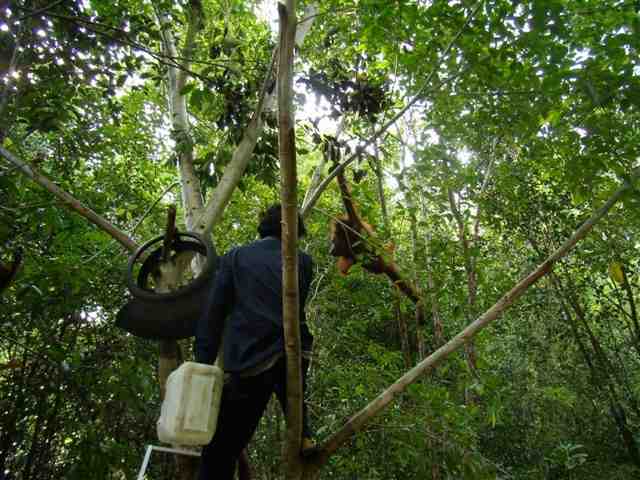
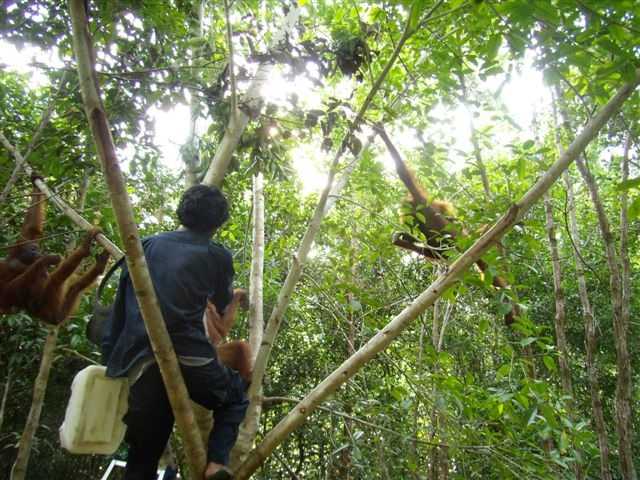
Without the platform though, how do you feed them? By hand is not an option. So we thought “put a bucket on a tree”. No, the orangutans will destroy a bucket in seconds. OK, use a cooking pot. Imagine the noise they would make banging that around, plus they will rip it off the tree! Alright then, use an inside out car tyre as a bucket. Fine, but how are you going to attach it; we don’t want to bore into the tree? Here’s an idea, when you cut off the side walls to invert the tyre, use the off-cuts as straps to hold the tyre against the tree.

New Feeding 2

Old tyres- they have many uses, if not for fire beaters then as a feeding bucket

So we’re settled: the food goes in the car tyre strapped to the tree. But how do you give them their milk (which many love more than fruit)? Cups – they’ll break, be lost and will become litter. Water bottles – even worse. Let’s try coconuts. Cut the top off, pour the milk in, put the coconut in the tyre; if the orangutans drop it, it will be easy to find and even if we don’t it is hardly litter.

All good then - let’s try it.

New feeding 1

Its a good job our assistants are tree climbers too!

New feeding 3

New Feeding 4

The feeding system has been running in Camp Siswoyo for a month now. It is not perfect. More than one orangutan may descend on each tyre. Some still walk on the ground between the feeding trees. We are buying an awful lot of coconuts – the orangutans drink the milk then eat the nut! It is more work on the staff and they have to be quick to get the food out.

New Feeding 5

But is it better than the platforms? Oh yes. You can ensure a fairer distribution of food. It lessens competition, facilitates giving medication when necessary and it keeps the orangutans feeding in the trees.

New feeding 6 -mother & infant

The system needs to be tweaked, but as a first attempt at a new idea we are all delighted with the result. And here’s where I have to add a thank you not only to Tigor and his staff for their enthusiasm to give it a go, but also to Jodie and Peter: the endless night’s talking about how we could make individual feedings work were worth it!

"We are participating in WildlifeDirect's business strategy. Please help us by taking this user survey,

thank you"

WD user survey

Violet - A chance to be free again.

We found Violet in a chicken coop. She was chained around her neck, covered in dirt, and scars, and she smelt. Her skin was dry and she had discharge from her eyes and a bloated abdomen. She had been fed the same food as the family who kept her: rice, tofu, vegetable and sweet tea. The owners claimed that they had “found the orangutan in their field six months ago.” At first they did not want to give her up because “they loved the orangutan”. Violet -chicken coop

Violet with chain in chicken cage

Violet with chickens

Violet with the chickens

Violet being rescued

Violet being rescued by the mobile education team

Ironically, it was the mobile Education Team who found her. They had gone to the village of Bukit Raya, Central Kalimantan to raise awareness about orangutan conservation amongst the people. The cage they found Violet in was, at most, 1 x 0.5 meters and her mother had almost certainly been killed. The Education Team told the family the law and Violet was duly passed over. That same afternoon, she was brought to our Orangutan Care Centre and Quarantine Facility (OCCQ).

Violet stayed three week in Quarantine at OCCQ. Veterinary tests showed she was suffering from anemia caused by parasitic infestation: amoebic dysentery, to you and me. She was given the medication that she needed and plenty of food.

Violet at OCCQ

Violet at OCCQ 2

Photos, taken last year, of Violet at the OCCQ

Three and a half years on, and she is almost unrecognizable. These days, Violet lives in “Pondok Medang” along with 32 other orangutans. Every second day she is taken to the forest where she is allowed to climb and play in the trees. She can not go to the forest everyday because we try to separate male and female orangutans – we are happy if they have babies in the forest, but we do not want more babies at the Care Centre.

Violet clearly wants to live in the forest full time. On the days she goes into the forest, she climbs high into the trees and is reluctant to come down – even in the rain. This doesn’t make her too popular with her carers but they are pleased with her forest skills.

Violet in OCCQ forest

Violet high in trees

Violet up in the OCCQ forest

Rather worryingly, Violet has become bored with bananas. As you can imagine, they are a bit if a staple at the Care Centre. However, it is now mango season and Violet still loves mangos. When I last saw her, she was sat on a basket of fruit, which was meant for the other orangutans, greedily stuffing mango after mango into her mouth!

Two weeks ago, I wrote that I was going to the Care Centre and promised you a story. Violet’s is that story. There are over 300 orphaned orangutans at the Care Centre; it is impossible to follow all their progress. Some, however, touch you and Violet’s story is so tragic, but heart-warming, she is the orangutan for our Foster Programme.

I had gone to the Care Centre, for a meeting, to discuss the 10th anniversary of the creation of the Lamandau Wildlife Reserve, our Government designated release site. So far, 153 orangutans have been returned to a life in the wild in Lamandau’s forests. This year, we’re pushing for it to be Violet’s turn.

Violet

Violet grass

Violet now - soon she'll be given the chance to live in the wild once again.

I know I should have sent this blog to you as soon as I wrote it. As so often, we found ourselves juggling priorities and I never reached the “send stage”. Tonight – blissfully with electricity – I am also happy to say we had a steady drizzle for two hours, on the back of some heavy but localized showers last week. The rain is not enough to fill the swamps and rivers; two days ago I went passed our food store where we have a high and low jetty – the low jetty is still four feet above water level. However, the rain is enough to drop the fire risk, which is a relief. The beaters are almost ready; today we collected the rubber flanges. If the rain does not continue, with your help, we will at least be better prepared.

Again, I apologize for the lack of news but I am truly grateful for the support you give us. Keep your rain dancing shoes on!

What to do with illegal logs?

Dear Sherri Your point about using illegally felled wood is a good one and is something we have debated at length. There are essentially three options when dealing with illegal loggers:

1. Evict them and thus the fallen wood is left behind 2. Evict them and render the wood useless by sawing it into unusable pieces that can't be used. 3. Arrest and process the loggers. After their trial the timber, which is classed as evidence, can then be auctioned.

Option three is by far and away the best. Wood bought at a Police auction is transparently 'clean' and could be used for a good purpose. Unfortunately, this option requires full police involvement and happens infrequently. Our staff have general powers of "citizens arrest" but that isn't enough. The Police really need to be there at the time of the arrest but, not un-understandably, they are frequently reluctant to press charges against small time loggers who, after all, are just local people. Also, the wood needs to be sold, not given away, as the Police need the proceeds to cover the cost of the trial.

logging raft

What we find - illegal logging raft

Option one is the worst, though this was the strategy we had to use when we were overwhelmed by illegal logging a few years ago. While the wood remains in the forest, someone will be tempted to get it out. Being hardwood the timber remains useable for years after being felled but there is no way either we or the Government could use it. It would appear we were either profiting from the illegal logger's efforts or, bizarrely, even robbing them. In the local context, where arguably double standards apply, we have to be whiter than white. We simply could not use illegal felled wood directly without someone holding it against us.

Illegal logs with police

Cutting wood into unuseable pieces

Cutting the wood into unusable pieces with police support

Option two is the method most commonly used. By chopping up the wood, the logger's efforts are in vain, resulting in a net loss to them (they hire the chain saws, borrow money for food and equipment etc.) However, without the teeth of a more severe punishment, some people may accept being evicted as a risk worth taking. That's where Jak comes in. He pushes the Police to at least hold the loggers in custody for some time, even if they do not actually end up in court. People here are scared of the Police and going to jail for an unspecified period of time is a terrifying prospect.

This year, we will be trying to fund large signboards along the major rivers, which the Police have requested, saying logging is forbidden and warning of the consequences. The Police always accompany us when the illegally felled wood is destroyed (see photo) but, when it comes to arresting people, they want to be in a position where it is 100% clear; there can be no excuses for logging in these places.

Do we admit the system is imperfect? Yes, completely. But is it about as good as we can get it at the present time? Probably.

Kind regards

Stephen

Protection Works

The Orangutan Foundation’s protection of the Lamandau Wildlife Reserve and Tanjung Puting National Park has been extremely effective in reducing the level of illegal activities. Because of the protective measures that we have in place, in 2007, we recorded just 12 incidents of illegal logging in Lamandau. This may seem high but without our monitoring and constant presence illegal activities would, without a doubt, be much more prevalent. Jak LECP Patrol Manager

Jak the LECP Patrol Manager

Jak, short for Jakiruddin, Patrol Manager of Lamandau Ecosystem Conservation Partnership (LECP), who I have mentioned a few times in my blog, has only been working in this role since April 2007. Jak is excellent at his job. His strong leadership skills not only mean he is very effective at leading his team but he has also earned the respect and the confidence of external institutions that the Foundation works with, such as local Ministry of Forestry Department’s Office for the Conservation of Natural Resources.

Jak supervises the Foundation assistants who are assigned for the mobile patrols and to the guard posts, which are located on the rivers (the only way in and out of Lamandau, for us and illegal loggers). Every Thursday Jak brings logistical supplies and necessities to the network of guard posts for the week. He uses the VHF radio to organize his personnel in the different locations. It is fortunate that Jak is determined as he has received numerous threats from illegal loggers. Nevertheless, he continues to perform his task professionally and he will not step back just because of the intimidation.

Patrol Team on Klotok

The local Ministry of Forestry on patrol

Last year, on the Mangkong River, Jak and his team found a large quantity of illegal logs, an estimated one thousand cubic metres. The logs, which had been cut into approximate lengths of 2 to 4 metres, included the valuable timber species, Kempas and Meranti. The logs had already been made into a raft and were waiting to be floated away by the illegal loggers.

Illegal logs - Lamandau Wildlife Reserve

Police support for patrols

Photo above - the illegally cut logs made into a raft were found by Jak and his team

Police support - standing upon the rails made by the illegal loggers so that they can roll the logs out to the river.

The logs were destroyed by the local Ministry of Forestry and the Police in order to send a clear signal that illegal logging will not be tolerated. All access to the Lamandau Wildlife Reserve will continue to be guarded. The combined forces of the local Ministry of Forestry and LECP will add extra personnel for each of the current seven guard posts.

The mission of the Orangutan Foundation, and of Jak, is to see Lamandau totally free from illegal activities. With the participation of the surrounding communities we are determined to keep Lamandau's forest intact so it continues to provide a viable habitat for orangutans and a sustainable livelihood for the local people.

More orangutans back in the wild

At the very end of last year, we released four more orangutans into the Lamandau Wildlife Reserve. It was a great way to end the year for me, and I hope it was for the orangutans as well. They certainly took to the forest with enthusiasm. For two of the orangutans, it was not their first taste of life in the wild. Boni and Sawit were returned to the Care Centre earlier in the year with medical problems. Boni miscarried and our staff feared there were complications. However, after a period of recuperation she was back to normal and ready for re-release. I don’t go on every release but, as this would be the last release of the year, it seemed auspicious.

As an aside, though my photos of her won’t do her justice, Boni is actually a particularly attractive orangutan. I know some people are uncomfortable with the idea of judging orangutans but we might as well be honest: just like people, there are fat ones, thin ones, light coloured, dark, long-haired types, balding, heavy browed, floppy-lipped orangutans and a whole lot more. I am not pretending to run a beauty competition but I will say Boni is Hollywood’s idea of what an orangutan should look like! And I don’t think I am alone.

They arrive!

Orangutans as they arrive (Boni is the darker orangutan in the middle)

As soon as she was let go, she ran straight up to a sub-adult male who had come in to meet the new arrivals. They noisily disappeared into the trees and did not even come down for the food which was laid out for them.

Andi was one of the first time releases. Normally we release orangutans when they are between six and eight years old, roughly their natural independence age. Andi however is only four. At the Care Centre he had been adopted by Sawit and it was only right that they were released together. Despite the number of orphans at the Care Centre surprisingly few adoptions actually work. Older females will be happy cage-mates with young orangutans but their relationship won’t develop to the extent of sharing food, carrying, protective behaviour or sleeping together all of which a natural mother would do. In Andi and Sawit’s case the relationship was complete. They were in separable, as I learnt to my cost.

The Release

Andi - released orangutan

Andi at full stretch!

The orangutans were released at Camp Rasak which is where Kath and Jutak were released in November. I am pleased to report that Kath has moved away from the release site into the forest and this is not surprising as she was an older orangutan. Jutak makes the occasional appearance but is not seen every day. The Assistants feel she is still wary of the sub-adult males but she may be seen more frequently as her confidence increases.

Camp Rasak

Camp Rasak was built by our volunteer teams in 2005 and it is a great camp, incredibly peaceful and, perhaps best of all, it is built on dry ground which is hard to find in swampy Lamandau. It is a refreshing experience to be able to walk normally rather than sloshing through water. I therefore did not mind slinging Sawit on my back for the short walk to the release site.

Short walk? Feeding sites are moved regularly because of the pressure the orangutans exert on the area; they break trees and branches, and often nest nearby. Changing the feeding location stops one particular area being degraded too heavily. Our diligent staff had moved the feeding platform a further 300m away from Camp. And, of course, I wasn’t just carrying Sawit on my back – Andi was on hers!

So in moving the platform the staff were being conscientious which I am sure I would have found pleasing had I not been lugging a combined 57kg of red ape; couldn’t someone have told me?!

Settling In

Settling in to their new home, the forests of Lamandau.

Tropical pitchers and questions answered!

Mr Devis has sent an update from Pondok Ambung Reseach Station, TPNP about tropical pitcher plants - a fascinating carnivorous plant species. First though we have received quite a few comments and questions from our last post 'Lamandau Ecosystem Conservation Partnership - community meeting'. We'll deal with those before "handing over" to Mr Devis. Thank you F.J.Pechir for your comment and question about the survey of the orangutans in Sabah. Without seeing the study and knowing more about it it is hard to comment on. There was a study published in December 2004 by Marc Ancrenaz et al. which also used aerial surveys for estimating the distribution and population sizes of orangutans in Sabah (perhaps it is this study which you are referring to?). Before this study the previous estimates for Sabah ranged from less than 2,000 to 20,000 orangutans, the M. Ancrenaz study estimated the population at around 11,000 orangutans and we think is an accurate figure.

Thank you Theresa Siskind for your question about eco-tourism in Lamandau. The Orangutan Foundation doesn’t run an eco-tourism programme to the Lamandau Reserve because it is an orangutan release site. With the Lamandau Ecosystem Conservation Partnership we want to develop long-term sustainable incomes for the local communities and in our experience eco-tourism isn't a source of income to be relied upon because it is often influenced by global issues, for example, terrorism. Some products made by the local communities, rattan baskets or mats, are on sale to tourists who come to visit Tanjung Puting National Park. We do value and realise the potential of eco-tourism to help protect wildlife and it has certainly done this in TPNP. Please visit our eco-tourism page on the Orangutan Foundation website.

The tropical pitcher is a very interesting carnivorous plant species and the uniqueness of its shape and colour has captured the interest of Mr. Devis who has been studying the tropical pitcher plant at Pondok Ambung. Over to Mr Devis....

Mr Devis looking at pitcher plants

Our survey began in the peat swamp forest around Sungai Sekonyer Kanan. Exploration has to be limited to the dry season because during the rainy season the rising water levels make it almost possible! We have so far discovered two types of tropical pitcher plant; Nepenthes ampullaria which looks like the pitcher cup and Nepenthes reinwardtiana which looks like a cylinder tube (see photos below).

We noticed that Nepenthes ampullaria grows in large quantities, in a centralized position in one particular spot. Our second survey was in the swamp forest around Pondok Ambung and this time three species of tropical pitcher were discovered. Two were species found in the first survey. The third species, Nepenthes rafflesiana (Raffles' Pitcher Plant) which has lower pitchers are generally round, squat and winged, while the upper pitchers are narrower at their base. We discovered that Rafflesiana grows well as a colony with Nepenthes ampullaria.

Nepenthes ampullaria

Nepenthes reinwardtiana

Three pitchers have been discovered so far Nepenthes reinwardtiana, Nepenthes ampullaria and Nepenthes rafflesiana. We need continuous surveys so we can uncover other types of tropical pitcher and learn more about their distribution so that conservation efforts can be taken.


I am hoping that there will be others researchers who have a similar interest in Tropical Pitcher research. Fellow researchers - I wait for your arrival here in Pondok Ambung!!

Lamandau Ecosystem Conservation Partnership (LECP)- community meeting

A few weeks ago the Orangutan Foundation participated in a community meeting held in Terantang village, which is located on the boundary of the Lamandau Wildlife Reserve. Stephen Brend at CM Terantang

Local communities have the right to the sustainable use of non-timber products from Lamandau. This meeting was organised to enable stakeholders to raise and discuss any problems or issues. The meeting was facilitated through the Lamandau Ecosystem Conservation Partnership (LECP).

Community Meeting of Terantang Village

Mr. Ade Suharso (Local Head of the Forestry Department’s Office for the Conservation of Natural Resources) and representatives from the police department and community leaders were invited to contribute to the meeting.

Terantang community meeting

The Chairman of Terantang Consultative Assembly, admitted the community, including himself, is aware that cutting-down trees, especially in the conservation area, is forbidden. However, he demanded that law enforcement needs to be fair. He said that police officers should not have arrested only minor illegal tree-cutters but also the illegal logging syndicates.

The Chairman of Kumpai Batu Bawah Consultative Assembly, has given his support to forest conservation. He added that some villages near Lamandau Reserve, such as Terantang and Mendawai have experienced flooding during the rainy season. He believes this is due to an environmental imbalance that is being created through deforestation of the local area. In the discussion representatives from Kumpai Batu Bawah Village requested the government do more to empower the local community in safeguarding the natural resources. A resident of the village asked for help so the local communities can be assisted to find alternative sources of earning income besides cutting-down trees in the forest.

Map of LWR and surrounding villages

All the speakers agreed to try and resolve the issues that had been exposed during the meeting. Help has been promised to develop the local community’s economy so that alternatives to illegal logging can be found. Brigadir Harto, from the police department assured villagers that the law enforcement officers will act professionally and fairly as demanded. Mr. Ade Suharso will  continue to collaborate with the community so this conservation area can be protected.

Orangutan Care Centre and Quarantine (OCCQ)

The last time I wrote, I talked about Mr Sehat from the Orangutan Care Centre and Quarantine (OCCQ). I thought you might like to learn a little more about the Centre and what goes on there. The OCCQ is located in a village on the outskirts of Pangkalan Bun and is where we receive orphaned, confiscated or injured orangutans. It is the first step of the rehabilitation process, which will end with the orangutans being released back into the wild in the Lamandau Wildlife Reserve. The Centre was opened in 1998 and its facilities include an operating theatre, X-ray room, laboratory, library and separate quarantine complex. Adjoining the OCCQ is a remnant patch of rainforest which provides a learning area and “halfway house” for the orangutans before they return to a life in the wild. Three Indonesian vets, two laboratory technicians and over 100 local people are employed there. Currently, the OCCQ is caring for over 300 orangutans in various stages of rehabilitation. Orangutans are received as young as four months old and may remain at the OCCQ until the age of ten, or even older. Often when they arrive, the orangutans need 24-hour care. Many are severely traumatised and suffer from disease, injury and malnutrition. Without a high degree of care, they would not survive.

It is very difficult to describe how one feels about the OCCQ. It certainly confuses me. The orangutans receive the best of care and it is real joy to witness their recovery and development as they go through the process of rehabilitation. However, the fact can't be ignored that far too many are in captivity and this is because their habitat is being destroyed. Over-crowding is a chronic problem, which is why finding release sites, like the new Mangkong one, is so important. OCCQ from above

OCCQ from above - (Jodie & Pete Sheridan)

The OCCQ generates an endless wish list – medicines, equipment, children’s multi-vitamins, infant-formula milk and a host of other things. With some of those things, I can try to help but with limited resources available it does create the dilemma of where money would be best spent - improving the short-term welfare of the orangutans at OCCQ or tackling the longer term problems of habitat loss and therefore protection for the wild population. We try to get the balance right. By working intensively in the Lamandau Wildlife Reserve, a government designated release site, we achieve both welfare and conservation gains. We can get the orangutans out of cages while, at the same time, protect a large area of forest.

I have included a short piece about the OCCQ from Jodie Sheridan. Jodie and her husband Peter are Australians who are volunteering at the OCCQ under the Australian equivalent of VSO or the Peace Corps. Jodie had written a piece for her sponsorship programme’s newsletter which makes interesting reading.

Jodie writes:

It’s hard to believe Pete and I are fast approaching the two year mark for living here in Indonesia. It feels like only yesterday that the Australian Orangutan Project (AOP) and the Volunteering for International Development from Australia (VIDA) Program selected us to come to Borneo to help orphaned orangutans. It has been an adventure to say the least, full of amazing moments and tough times too.

Highlights come to mind easily.

For Peter, being a huge snake fan, seeing spitting cobras, vipers and reticulated pythons in the wild certainly rates a mention from him but his most rewarding moment came after working solidly for three months building a playground for the smallest of the orangutan orphans and seeing them use it for the first time.

Orangutan Playground

Play time! (Jodie & Pete Sheridan)

Watching the small babies swing, roll, jump, smile and laugh because of the work we had done felt truly amazing.

For me, it’s too hard to choose just one highlight so you get a couple of my most favourite moments!

Setting up enrichment programs to stop the orangutans getting bored on days they can’t play in the forest. Something as simple as a hessian sack or cardboard box can provide hours of fun. Going with armed Indonesian Police in the middle of the night and seizing an orphaned orangutan being kept illegally at someone’s house certainly gets the adrenaline pumping. Generally the orangutans are kept in such appalling conditions that if we don’t get to them quickly they can die from malnutrition, neglect or disease. But I guess I would have to say the most magical moment was releasing an orangutan named Gloria back to the wild. When Gloria was captured she received major wounds to her upper arm and as a result had very little use of one hand, she was also terrified and angry towards people. I befriended Gloria and was able to take her to the forest regularly to strengthen her muscles. After 5 months she had almost full use of her hand and even though she was young, her forest skills were remarkable. Gloria was taken to our release site and as she moved off into the jungle, she turned and looked back at me before slipping out of sight. Thinking about that moment still gives me chills. She is still occasionally spotted and is happily living independently in the forest and I could not have asked for anything better.

But it devastates us to think that even with all the work done on trying to save the orangutan species that more orangutan infants are orphaned everyday and the problem is only getting worse. Indonesia’s rainforests are destroyed at a rate of a 6 football fields every minute due to illegal logging and clear felling to make way for a booming palm oil industry. Palm oil, that is on every shelf, in every supermarket, in every country in the world

Camp Mangkong

A quick blog to let you know about a very good day. But first the background. About a month or so ago we removed some illegal loggers from the Mangkong River and subsequently we built the guard post there – the post which flooded. Map of TPNP and Lamandau

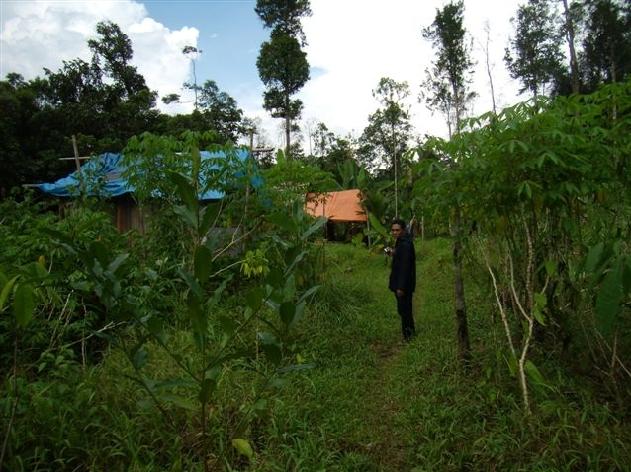
I accompanied a follow-up patrol to make sure there was no more logging taking place upstream. Well there was definitely no logging but, even better, we found what appeared to be an ideal orangutan release site (see photos below). I won’t bore you with all the factors that come into play when choosing a release site but suffice it to say “location, location, location” isn’t everything! You have to have forest, access and a clearing for the buildings plus a few other things. Anyway, we saw this site and all said “perfect”.

CampMangkong_Dec07

The Patrol Team, who monitor illegal activities, are seperate to the Camp's staff, who monitor the released orangutans in Lamandau and they are separate again from the staff at the Orangutan Care Centre Quarantine (OCCQ) where the orangutans start the rehabilitation process. One of my jobs is to try to integrate all the different branches of our operations, so last week I went back up the Mangkong with Mr Tigor, the Camp's Manager, a couple of his staff and staff from the OCCQ.

CampMangkong2_Dec07

Foremost among the OCCQ staff was Mr. Sehat, he is someone I truely admire and he has an absolutely magical way with orangutans. At the OCCQ he is the "dominant male" – bar none. I once watched an orangutan trying to wrestle a tub of fruit from one of the other assistants. Mr. Sehat happened to be walking past. Immediately, the orangutan let go, sat down meekly and gratefully accepted his allotted share. There is no force or aggression in his manner, it is simply will power and years and years of experience. Sehat once carried a sub-adult male weighing some 70 kg (154 lbs) from his enclosure to a traveling crate just so the orangutan would not have to be anesthetized.

Mr Sehat

Photo taken of Mr Sehat on an earlier orangutan release.

To continue, if Mr. Sehat agrees with something we know it has to be alright and he took one look at the selected site and asked grinning, “Why haven’t we found this place before?”. Ukim, one of the other assistants, sized it up perfectly – and with the brevity typical of a Dayak. He looked around and said simply “it’s never been burnt”. Fires destroy the natural seed bank in the soil (rainforest trees are not adapted to cope with fire). Even if an area has been logged it will recover but once it is burnt, recovery will be much, much slower. Mr Tigor was equally enthusiastic and he had even started pacing the layout of the new site. For my part, it was reassuring to know that everyone was in agreement, this was a perfect release site. You can expect to hear more about the Mangkong Camp and the orangutans, who will make their home there, in the future!

A PALM OIL COMPANY CARING FOR ORANGUTANS?

Last week, we were surprised to receive an invitation to a "Public Consultation on the results of a survey of the Population, Distribution and Habitat of Bornean Orangutans, as well as Human Socio-Economic Aspects in Palm Oil Plantations especially in PPB Oil Palms Sdn Bhd-CKP (Central Kalimantan Project )/ PT Mustika Sembuluh Group”. Public Consultation Surveyors

This is the first time we had heard of a palm-oil company surveying orangutan populations and could not tell from the invite whether the idea was intriguing or scary. I could not go, so my colleague Astri Rozanah went, along with Mr Ade Suharso, the local head of the Forestry Department’s Office for the Conservation of Natural Resources. Other participants in this public consultation came from government (province and district level), private institutions, universities, NGOs, local community groups and the press.

This is what Astri reported:

“The Orangutan population survey was conducted by WWF survey team who made a presentation of their findings. Based on the survey research, WWF and team found that PT Mustika Sembuluh Group forest area has a quite high biological diversity. They found orangutans, 8 other primate species, 25 mammal species, 168 birds species, more than 10 reptile species, 29 fish species and 88 plants species. The highest estimated population density (found in an area near the Seranau River), was 2.2 orangutans per km2. (NB: This is a high density)

After their presentation, the program continued with an open discussion. The palm-oil company PT Mustika Sembuluh Group intends to set aside over 7,000 ha of forest which is assessed as being of high conservation value as a conservation area. This is even though the forest is located inside their existing plantation area.

At the end of discussion, they recommended a 'full assessment’ to generate a spatial plan for the areas which have high conservation value. This assessment will indicate how the forest will be managed; conservation must be combined with helping to meet local communities’ social and economic needs. The assessment will also indicate who best should have management responsibility for the conservation-forest, the Company, an NGO or the Forestry Department”

Oil Palm Plantation

Oil palm plantation - once tropical forest now a desert landscape

Here’s a palm-oil company apparently, voluntarily, choosing not to destroy rainforest; They are seemingly prepared to put “their money where their mouth is” by setting aside an area for conservation; The area they are proposing to conserve is sizeable – over 250,000 palms could be grown on 7,000 ha and they are talking of setting aside more; The Company is clearly prepared to work with NGO’s and the Government in a transparent way; Surely they must be thinking of trying to sell their produce at a premium with some kind of green-label.

Now, despite all my “seeminglies, apparentlies and surlies” those are all positive developments. Yes, we still have reservations - I will try to explore those with you some time soon. But I want to end this quick blog on a positive note – and it is this.

PT Mustika Sembuluh Group is clearly aware of the rising tide of public opinion against the destructive practices of palm-oil companies. And what does that mean? It means, your and my voices are being heard. As ultimate consumers you can ask your supermarkets to source responsibly and you can create markets for the products you want to buy.

I am not saying this is anything but early days. But we are detecting signs of change and for that I thank you. We can all be orangutan conservationists.

Thank you Theresa S for your very generous donation of US$500 we really appreciate your support and interest in our work. In a few of my posts I have mentioned that we hope to raise funds in order to build a new orangutan release site, in Lamandau. We will direct all open donations received from Wildlifedirect towards the release site, which we plan to build in 2008. We will keep you updated!

Volunteer programme

Committed, enthusiastic, slightly nutty (it helps!) and hard working - our volunteers. Another year's volunteer programme has ended and again it has proved to be invaluable to our field operations. The programme has been running successfully for seven years. Each year, between April and November, we have up to four teams coming out to work with us in the field. Volunteers pay £600 for six weeks which covers all their living expenses but also importantly pays for all the construction and material used during the programme. All of the money received from the volunteer programme stays in the field.

For the past few years, the main target area of the programme has been the Lamandau Wildlife Reserve. Projects have included the construction of guard posts, building release sites for ex-captive orangutans, marking out boundaries and assisting with reforestation programmes. In 2008 we hope to build two new orangutan sites in Lamandau in order to relieve pressure at the OCCQ. All of the teams in 2008 will be concentrating on constructing one of the release sites and we hope to raise funds for the construction of the other site.

Vicky Dauncey, the volunteer co-ordinator for this year has sent us a taster of what the last two teams got up to....

Map of TPNP and Lamandau

Map - to help to get your bearings!

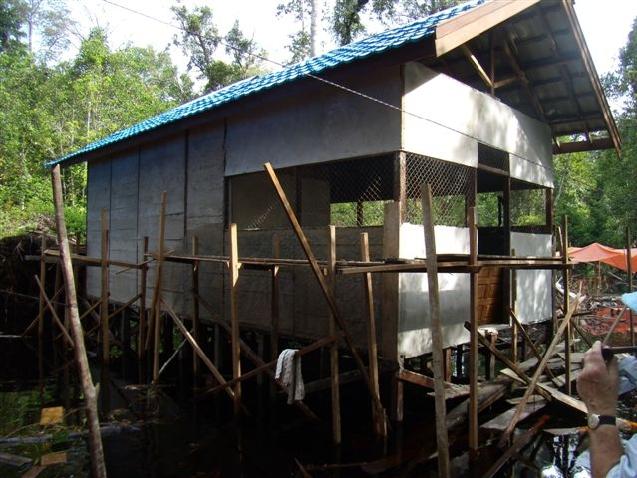
Team 3 - Our focus on this team was to construct a guard post in Sungai Mangkung, Lamandau. We experienced a lot of rain!!

vol prg T3

By the second week there was no dry land except the pondok and the building site but the upside to this meant it was cooler in the day and so it made the physical work less demanding. Morale stayed high during our work in Lamandau despite the flooding (in the last few days the water entered the pondok!).

Volunteer programme 2

Team 3 Vol prg 2007

Volunteers and Orangutan Foundation staff at Sungai Mangkung, Lamandau

Eventually we were forced to leave without finishing the post. This meant that we had a few days, on the beach, at Tanjung Keluang, planting saplings and cleaning the area of rubbish. This was funded by the Forestry Department and we worked with two forestry department staff whilst we were there. Living (sleeping in hammocks) and working at Tanjung Keluang was an incredible experience and one I hope the volunteers will not forget.

Team 4 - The first week was spent in Sungai Buluh Kecil, TPNP. Re-planting an area destroyed by fire. First we had to check an area that had been previously planted and replace dead saplings. This was particularly physically tough as the terrain is swamp. After six days the volunteers were exhausted and, although proud of their work, they were happy to leave!

Buluh kecil-river shot

Buluh kecil guardpost

Sungai Buluh Kecil, TPNP

Two rest days were spent in PKB and during this time we visited the OCCQ. The OCCQ really brings home the importance of building the guard posts and release camps in Lamandau and really helps to motivate the volunteers.

After the rest we went to Lamandau to finish the guard post at Sungai Mangkung, that was started by team 3. In comparison to the first week this seemed like light work and it helped that we were working in a beautiful location and that the water had receded!

Pak Sariamat, Pak Matjuri, Ibu Opit are long standing staff members and highly valued on the volunteer programme. Thank you for your continued hard work.

If the Volunteer Programme interests you please visit the Orangutan Foundation website www.orangutan.org.uk