Lamandau Wildlife Reserve

Orangutan Stories: Labetty is pregnant... again!

As a tree-dwelling species, observing the re-introduced orangutans in Lamandau Wildlife Reserve is not always easy; with trees comes height and camouflage! Staff were therefore surprised when they noticed that Labetty was pregnant... her third time in six years!

Labetty, 2025

Orangutan pregnancies are not dissimilar to that of humans; there is a gestation period of around nine months, changes occur both physically and mentally, and behaviours become less strenuous, with more time spent sleeping. Though Labetty’s behavioural changes have been far from peaceful!

Mother and infant resting in Lamandau Wildlife Reserve

Labetty was born in the wild in 2007 to ex-captive Lady Di, who had sadly suffered from a miscarriage the year before. 19 years later, Labetty is now pregnant with her third offspring. Suspiscions arose about her pregnancy from physical indications and altered behaviours in the female, but her enlarged abdomen confirmed the news – and we are delighted!

During Labetty’s pregnancy, her behaviour has changed in its own way. Typically indifferent towards the staff around her, paying them little to no attention, Labetty has been spotted chasing visitors of Camp Rasak, where she has been spending much of her time resting.

Labetty with previous infant (Lego), 2025

Our four camps in Lamandau Wildlife Reserve are only accessible by boat; the team arrive each morning by speedboat to begin their day of work. Last week, staff arrived as normal to the soundtrack of birdsong and the stirring of the orangutan carers who sleep at the camp. As they disembarked the speed boat, walking down the jetty towards the call of camp responsibilities, the speedboat driver Anto took a moment to secure the boat.

Speedboat

Soon after, with the boat in place, Anto followed the team down the jetty... but an angry Labetty soon emerged behind him! Less familiar with Anto, Labetty who had been sleeping beneath the jetty began had clambered on top and began to chase Anto! Luckily, Anto noticed her and managed to get clear... a warning nonetheless from the pregnant female!

Labetty climbing aboard a longboat at camp

It is difficult to confirm the reason for Labetty’s aggression, but it is likely due to mood changes associated with her behaviour. All the team are very excited for Labetty’s birth; this will be the sixth wild birth in the past year!

Orangutan Stories: Fantastic Four

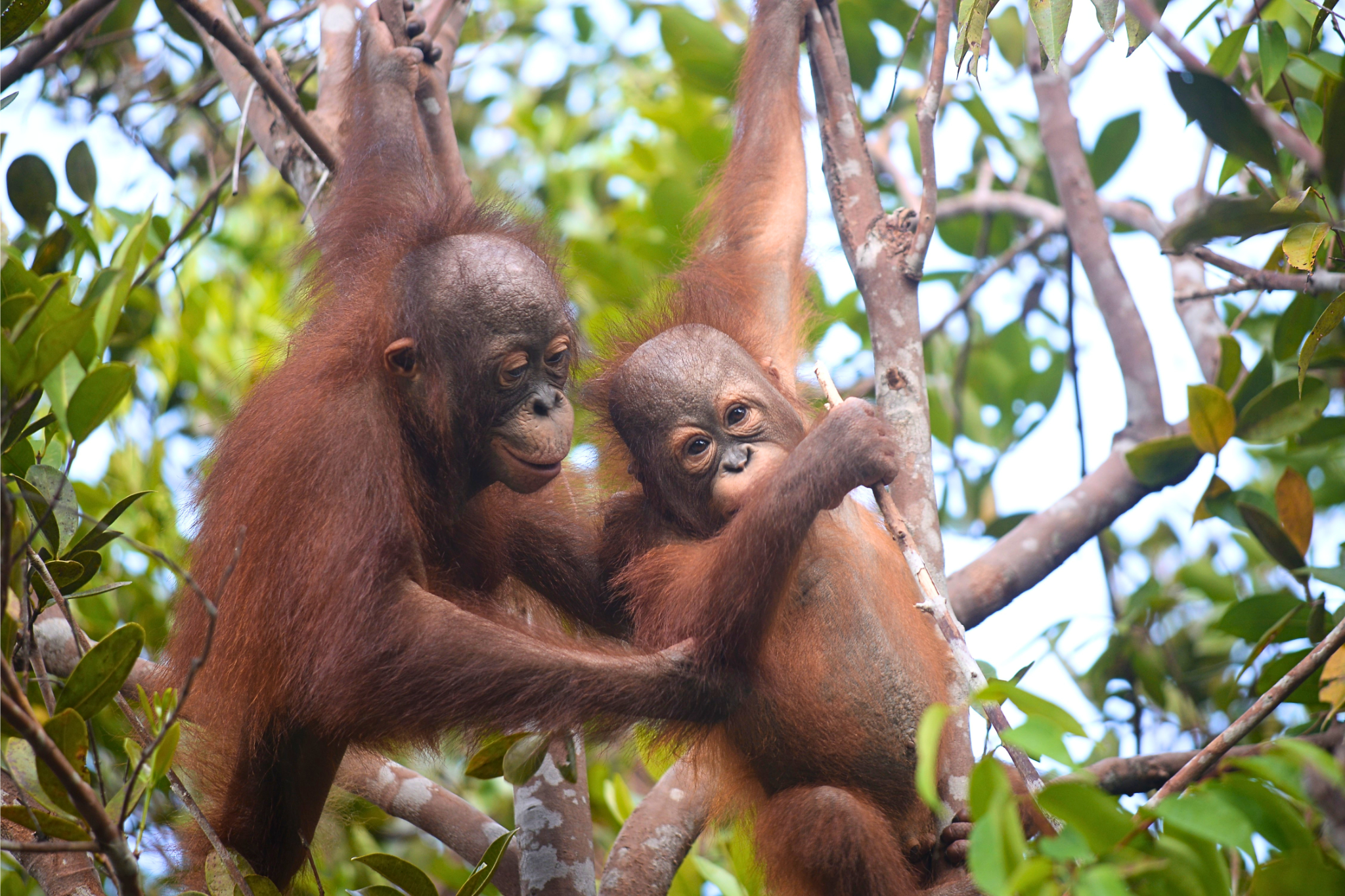
Four infants were recently handed over to our care to join the soft-release programme for orphaned orangutans. But one orangutan, Kiki, is very particular about who is friends with! Orangutans have personalities from a very young age - and can are very entertaining as they grow into themselves more and more.

In Conversation: From bottles to new beginnings – the orangutan carers

Have you ever wondered what it’s like to be an orangutan carer? In the depths of Borneo’s forests, our camps support orphaned orangutans on their journeys back into the wild - and it is the carers that are there for every step of the way. In this ‘In Conversation’, we catch up with the carers of latest release Mona.

Orangutan Stories: Gunawan‘s progress in the soft-release programme!

Gunawan in the soft-release programme is growing in confidence… on his first attempt at climbing, he is here to show that a life in the trees is instinctive for the forest ape.

In Conversation: a day in the life of an Orangutan Foundation veterinarian

In Conversation: a day in the life of an Orangutan Foundation veterinarian

There is never a dull moment for an Orangutan Foundation veterinarian… from rescuing sun bears to midnight visits to the local hospital as to not alarm residents, in this ‘In Conversation’, we catch up with Dr. Wawan and Dr. Dimas.

Orangutan Stories: welcome to Amel – but what happens to the mothers of orphaned orangutans?

Kept in a small enclosure for eleven years, we hope it is not too late for twelve-year-old Amel to learn how to be an independent orangutan. But Amel’s story highlights a deeper issue - what truly happens to the mothers of orphaned orangutans?

Orangutan Stories: Sony lends a helping hand to his sibling!

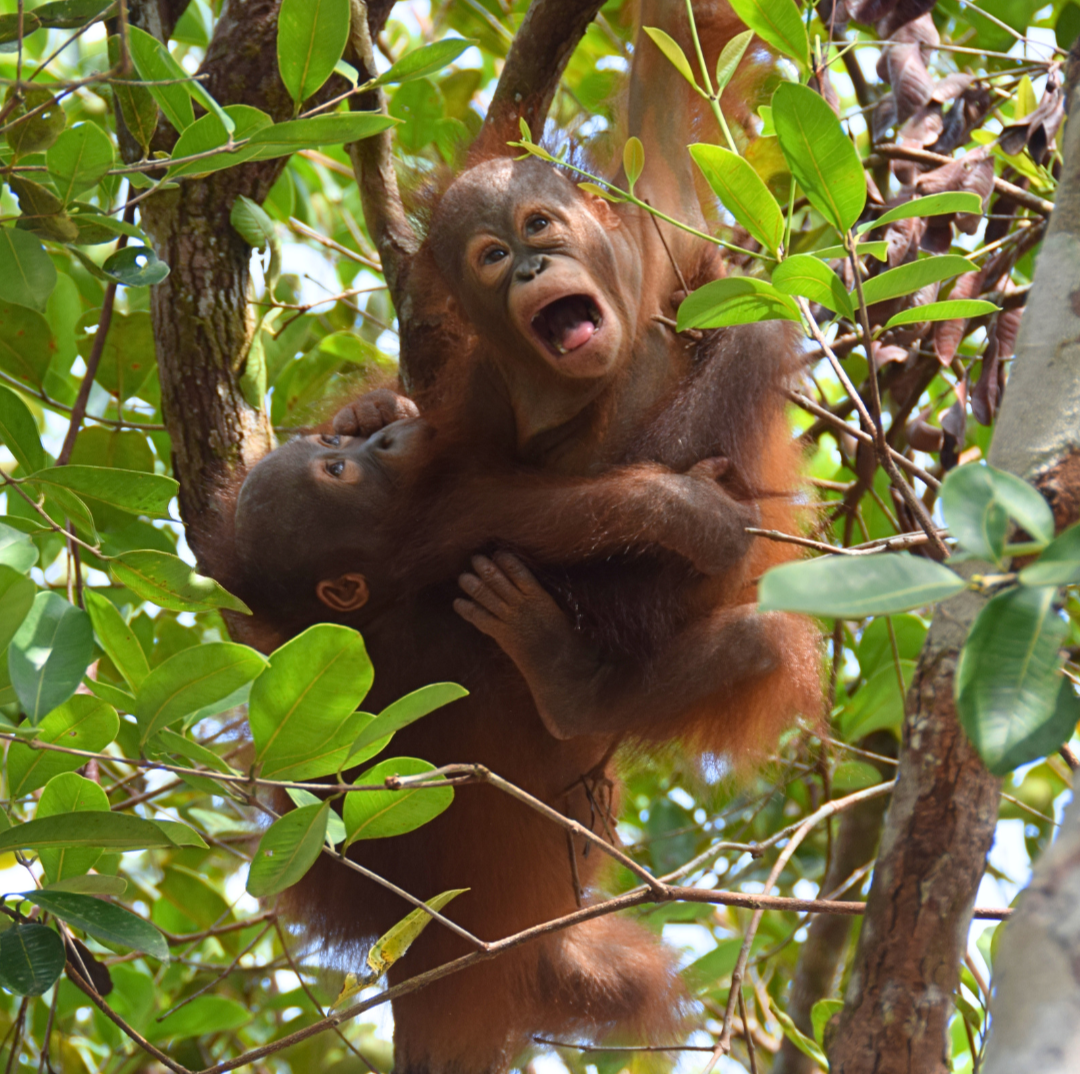
Orangutans are a semi-solitary species, rarely interacting as adults. But wild orangutan Sony has been seen helping his younger brother navigate the canopies whilst their mother is not around - an extremely unusual interaction!

Drones taking flight for habitat protection

The use of drones has been on the rise - they have become critical in conservation, enhancing our habitat protection efforts and changing the way we work.

Peat swamp forests: the critical home to the orangutan

Peat swamp forests support unique biodiversity not found anywhere else on earth - but less known is their critical role for our planet in mitigating climate change. With over 80% of peatlands already destroyed, we must do our part to protect those that remain… before it’s too late.

2024 highlights: A look back on our conservation achievements together for orangutans, forests, and people

Orangutans, biodiversity, forest, research, and fundraising. A look back at the critical conservation success we have had together in 2024.

Orangutan Stories: The return of Andy!

The reappearance of long-lost orangutan, Andy! In this orangutan story we explore where Andy has been, as well as his unusual upbringing as an adopted orangutan.

Orangutan Stories: Exploring Food in the Forest

Orangutan Stories:  Exploring Food in the Forest

Orangutans consume a variety of food from the forest to support their large size. Being arboreal species gives them access to the food they need to sustain their body size.

Orangutan Stories: Mores & Marsha

When our team discover that a female orangutan in the wild is pregnant, there’s a certain energy that’s suddenly felt around camp. Every newborn is vital for the future of this critically endangered species so there’s excitement at the thought of another addition to the population, but also a sense of trepidation, hoping that the birth will go well.

Female orangutan Mores shelters from the rain

This is how our team at Camp Gemini felt back in 2019 when we learnt that reintroduced orangutan Mores was pregnant for the third time. Every time we would see her moving around in the trees within the Lamandau Wildlife Reserve, we’d crane our necks to see if there was a little newborn hiding under her long orangey hair. It wasn’t until June that our team were finally rewarded. Emerging from the vegetation came Mores clutching her new tiny infant for the first time!

Mores shows off her newborn

Our monitoring team have to be particularly vigilant for the days following an orangutan birth. It’s the most vulnerable time for any animal in the wild, so to keep a close eye on mother and offspring without disrupting their first moments together is very important.

It was satisfying to see that Mores and her newborn were progressing nicely over the first few days. With her young by her side, she would travel gracefully through the trees and eat plenty of food to keep up their strength. After a while we were finally able to determine that the infant was female, and to follow her mother’s ‘M’ lineage, she was given the name Marsha.

Since then, our staff have enjoyed watching Marsha grow in size and personality in the forest. Witnessing the way her mother climbs, builds nests, and searches for food; the young orangutan is slowly being painted a picture of what an independent life in the rainforest looks like. She still has a few more years to go until she’ll be ready to go it alone, but thanks to her mother’s teachings, Marsha is starting to show the first signs of maturity.

Marsha is Mores’s third offspring, having previously given birth to Marcell and Martin in the wild. For Mores to have grown her family tree so well is truly a fantastic achievement, especially when we consider that she began her life in captivity before her release into the reserve in 2003. A testament to how successful reintroduction can be when orangutans have a safe forest to roam.

Mores and Marsha are thriving in the Lamandau Wildlife Reserve

It’s fair to say that Mores has played her part for the future of these critically endangered great apes, unfortunately though, not all orangutans have the opportunity to do so in a habitat that is protected. Orphans taken into the illegal pet trade have an uncertain future, but at the Orangutan Foundation our staff can offer a route back to the wild through our soft-release programme. Please click below to find out how you can adopt an orangutan today and ensure orphans as young as Marsha also have the chance to be independent.

Orangutan Stories: Queen & Quentin

The connection between an orangutan mother and her infant is almost unparalleled in the natural world. While other great apes like gorillas and chimpanzees congregate in groups so each one can contribute to parenting in some way, an orangutan infant has up to eight years of one-on-one time with its mother and is therefore totally dependent on her to survive.

Queen is spotted with her new born Quentin for the first time

In the early stages, every aspect of a young orangutan’s life is catered for by the mother: Travel- They hold onto her as she climbs and swings through the forest. Food- Even when they’ve grown out of breastfeeding, their mother will find the best fruiting trees to keep them well-nourished. Shelter- Every night they’re kept warm and safe up in the forest canopy by a nest that their mother fashions out of branches. It’s why when young orangutans are discovered in the wild or in captivity without their mother, there’s a challenging path to independence that lies ahead for the orphan.

Young orangutan Quentin can rely on his mother Queen for support

This powerful maternal bond is clear to see when our monitoring team watch female orangutan Queen care for her infant Quentin in the Lamandau Wildlife Reserve. The young male was born two summers ago in the forest surrounding Camp Buluh, and today the pair are ever-present around camp, enabling us to accurately study his development.

Their favourite pastime it seems is to forage for food along the riverbanks. Whether searching for fresh pandan leaves to eat by the water’s edge, or fishing for fallen fruit in the river, Queen will often place Quentin on her head to stay dry as she wades through the water.

It’s an idyllic scene, watching mother and infant gracefully going about their business along the riverbank. However, the recent news of the crocodile attack on male orangutan Brian looms large, so it’s natural for our team to feel a little uneasy of their presence in the water now.

Despite this potential hazard, Queen certainly seems to know what she’s doing. She was one of the first orangutans to be introduced to the protected reserve back in 2003 as a six-year-old, and since then has built a strong legacy of successors. Quentin may be her first son, but previously Queen has raised three females since her release into the wild, so she has a wealth of experience on her side.

While he’s still young, our team will continue to enjoy Quentin’s presence around camp. Each day he spends watching his mother is another day closer to understanding forest life. In the years to come he will gradually learn what it takes to go out and begin his own legacy, but in the meantime, we’re delighted to keeping watching his progress.

Orangutan Stories: Boy

Orangutans are like humans in so many ways. We share around 97% of our DNA which means that biologically speaking there are a number of similarities. We have the same number of teeth, both age in a comparable way, and we can even use a human pregnancy test to check for prospective orangutan mothers!

This means that humans and great apes can also suffer from the same ailments, and orphaned orangutan Boy’s medical history is a prime example of this.

Boy is discovered at a local village in April 2017

As a three-year-old, Boy was separated from his mother and then kept as a pet in a local village. Cages can dramatically restrict an orangutan’s development, and after a few months on his own, Orangutan Foundation staff and government officials BKSDA were alerted to Boy’s presence and hurried to his aid. A thorough medical examination from our vet showed that despite his ordeal, Boy was in good health and ready to embark on his next chapter in the Foundation’s soft-release programme within the protected Lamandau Wildlife Reserve.

On his rescue, Boy receives a full-body examination to check his health

In the wild orangutans are a semi-solitary species, which means that although they generally explore their habitat independently, from time to time they do interact with one another. While they develop their natural abilities in our soft-release programme though, Boy and the other orphaned orangutans spend many hours together, learning and playing with one another on their daily trips to the forest.

Boy enjoys company and is perhaps one the most sociable of the young primates under our supervision. He loves exploring the trees with fellow orphan Adib as they climb and practice nest-building. In fact, Boy has even been spotted spending time with wild infant Marsha, until her mother Mores intervened and playfully shooed him away!

Boy swings in the trees with his campmates

Like the other orphaned orangutans in our care, Boy receives regular health check-ups to monitor his development, but recently we discovered something a little unusual. Last month Boy didn’t appear to be himself, he was vomiting and looked very weak and lethargic. Blood tests revealed that he had caught a cold and was suffering from anaemia, a condition which can occur from a lack of iron in the blood, so a course of multivitamin injections and medicines was prescribed by our vet to help alleviate this.

Another ailment which has affected the young male from time to time over the years is hair loss. Like us, every orangutan is unique so they each have varying amounts of hair on their body, but Boy has experienced unusual periods of baldness in recent times. It’s not thought that this is linked to his recent anaemia, so to treat this, our team have begun to use a new shampoo when washing him in the river which will hopefully encourage growth.

A week after his latest illness, our team were delighted to see that Boy’s blood tests were looking more positive. What’s more, the growing great ape appears to have more energy and has bounced back to his usual active self, frolicking with the others in the forest again. We will continue to keep a close eye on Boy’s health as he progresses and we look forward to the day when he will be experienced and strong enough to be released on his own into the wild.

We all have ups and downs, and Boy’s story is another reminder of how like us orangutans can be.

Orangutan Stories: Amoi

It’s strange to think that 20 years ago, if an orangutan outside of a protected forest needed rescuing, there were few secure places they could be released in Central Kalimantan, Indonesian Borneo. Thankfully however, with the establishment of the Lamandau Wildlife Reserve, great apes in need have a safe haven where they can be set free.

Six-year-old female Amoi (below) was one of the early orangutans to be translocated to the Reserve in 2004. Swapping a cage for the forest, it was wonderful to transport her from the Orangutan Care Centre and Quarantine (run by Orangutan Foundation International) and release her into the protected forest around Camp Siswoyo.

Growing up alongside humans meant that Amoi had a very tame nature. In fact, to start with she seemed to prefer spending time around camp instead of exploring the surrounding trees. Soon though she really got into the swing of things, and after a few years she was ready to give birth to her first offspring. Our field team were thrilled to discover that Amoi had adapted so well to her new home in the wild, but in a devastating piece of news shortly after, we learnt that she had sadly lost her young. It’s not uncommon for first-time orangutan mothers to lose their newborn, but reassuringly we would soon find out that Amoi had not lost her mothering instincts.

In 2008, another adult female orangutan named Ruta unfortunately passed away leaving her young son Richard to fend for himself. Our team weren’t sure how Richard might cope as an orphan in the forest, but with a little encouragement we discovered that Amoi was happy to take the inexperienced young orangutan under her wing. She’d become his surrogate mother. The pair prospered in the forest together and when Richard was ready for independence in the wild, Amoi was fully prepared for the next chapter of her story when in 2013, along came Alex.

Our staff fell in love with Amoi’s daughter Alex the first time they laid eyes on her. Initially she was so petit that it was difficult for our team to identify her sex (hence why she was given the unisex name). Even after a couple of weeks Alex was still tiny, in fact she could barely lift her head from her mother’s side (above). It’s amazing that this little primate even had the strength to hold onto her mother as they travelled through the forest, but after some time Alex finally began to grow and demonstrate her character.

In the trees around Camp Gemini within the protected habitat, mother and daughter would often be seen playing together and foraging for fruit wherever they could. The years of experience Amoi had built up were finally coming into practice, she’d proven that she could successfully raise an infant of her own.

That was until the moment in 2016 when Amoi and Alex ventured deeper into the forest and out of sight. The Lamandau Wildlife Reserve spans across almost 160,000 acres of peat-swamp habitat, so its not unusual for recognised orangutans to explore other patches of forest away from our regular patrols. Nonetheless, what a wonderful surprise it would be if our team spotted them in the trees again!

Amoi’s calmness and tranquillity in spite of the challenges is textbook orangutan behaviour. Wherever she may be now, it’s encouraging to think of the legacy this gentle and caring mother has had for this critically endangered species.

Photos taken by Wawan

We rely on your support to ensure orangutans like Amoi and Alex continue to have a safe place to call home. From just £2, you can help our team protect an acre of their tropical rainforest for a whole year!

Orangutan Stories: Satria

For some animals, as soon they’re born, they’re ready to explore the wild on their own. For orangutans though, their home in the tropical rainforest is full of potential hazards and often limited sources of food. They consequently must observe and learn from the teachings of their mother before they can be truly independent. This is a complicated process however, and can take 6-8 years for an orangutan to be fully prepared, longer than any other species in the animal kingdom.

Therefore, to be separated from their mother and kept alone as a pet in a cage genuinely holds back the development of a young great ape. Sadly this is how Satria’s life began, until 2017 when the two-and-a-half year old was rescued from captivity and taken to the forest for the very first time!

In Orangutan Foundation’s soft-release programme within the Lamandau Wildlife Reserve, Satria could finally know what it was like to climb a tree and interact with other orangutans. At Camp Rasak alongside fellow orphan Endut, Satria was taken out into the surrounding habitat every day and gradually built up his range of forest skills. He took to climbing like a duck to water, and would often be seen playing with some of the younger wild great apes in the forest, but it would take him a few years to master the most complex orangutan talent- nest-building.

Our staff would take Satria to varying parts of the forest to familiarise him with different areas, and slowly but surely, he perfected the art of building a sturdy overnight nest in the trees. To ease his way into the wilder side, our team then supervised Satria as he spent a night or two in the forest independently. Building up the familiarity with sleeping in a nest he’d built was visibly helping his development, and this month Satria spent five nights in the forest surrounding camp on his own. A big milestone for a young orangutan but he took it in his stride, and it was clear that he was now ready to be released.

Following a final medical check-up from our vet and a negative test for COVID-19, Satria had made it. The time had finally come for him to leave camp for good and become entirely independent!

Satria receives a final check-up and COVID test from our vet before being ready for release

Now a fully-fledged young adult, Satria weighs 30kg. It was therefore a tiring 1km walk for our team and local government staff from BKSDA to carry Satria through the forest to his specially chosen release site. In the presence of Orangutan Foundation Founder and Director/Trustee Ashley Leiman OBE, Satria’s travel crate was eagerly opened and he quickly rushed out onto a nearby tree.

In a somewhat nervy start which saw him clambering over his travel crate, Satria seemed more interested in the group that had gathered to see him off, and it was only once everyone had dispersed that he decided to climb up into the trees to explore his new patch of forest. All his preparation had led to this moment and at last he’d graduated from our soft-release programme!

For at least 10 days after his release, our monitoring team will continue to observe Satria’s progress from afar. Already we’re delighted to see that he’s beginning to establish himself in the population of over 600 orangutans in this Reserve, and who knows, in the future we may see Satria become an impressive dominant male orangutan in the forest. For our team, there could be no greater reward!

Orangutan Stories: Batuah

In our latest remarkable orangutan rescue, we’re reminded not only of the challenges facing this critically endangered species, but also the dangers imposed on our wildlife rescue team. Everything doesn’t always go to plan:

Wildlife rescues can be dangerous for both animals and humans

Many residents of the small village of Batuah in Central Kalimantan, Borneo, rely on farming as a source of food and revenue. Situated on the outskirts of Sampit, the largest town in the area, Batuah sits beside tropical forest and is therefore frequented by wildlife from time to time.

Over the past year or so, one villager had been keeping his eye on a male orangutan that seems to reside in the forest nearby. That was until recently when the primate was seen a few days in a row in their orchards eating pineapples and jackfruit. To avoid a potentially hazardous encounter, it was time for government officials BKSDA and Orangutan Foundation’s rescue team to swing into action.

Villagers gather as our vet helps the orangutan

Arriving at the scene, our team could see that they might have a struggle on their hands. Although the orangutan showed no aggression, he was clearly a large and imposing figure, and surrounded by many villagers. For his safety he needed to be tranquilized and translocated to an area where he could roam freely.

Carefully the 55kg male was darted, captured safely in a net, and given a brief once over by our vet. It needed the help of some local people to lift the orangutan and get him into his transport crate. At first sight he had many cuts on his feet, most likely from sharp rattan and rubber trees in the plantation, but more worrying were the number of bullet wounds found on his skin. It’s unclear whether these came from residents of the village or further afield, but before he could be released into the wild, we would need to investigate the great ape’s injuries in more detail without so many people around.

The orangutan goes under the knife

The orangutan was given the name Batuah, after the village, and transported to offices in Pangkalan Bun for inspection. Unfortunately, eight rifle-pellets were found still lodged in Batuah’s skin so he would require minor surgery before being eligible for release.

For his operation, Batuah received an anaesthesia injection to send him to sleep but the large male was still moving while being taken to the surgery table. Carrying out treatment on such a powerful animal is extremely dangerous if they’re not completely anaesthetised so a second half-dose was required to make sure Batuah wouldn’t feel a thing. One, two, and then three pellets were successfully removed without incident, until our vet noticed something- Batuah was starting to move again!

For the safety of everyone involved, the team made the quick decision to end the surgery there and then. Batuah was hurriedly moved back into his transport crate where he could wake up in peace, and thankfully it appeared that the remaining pellets in his skin were not causing any pain or limits to his movement. With another day to gather his strength and recover from his surgery, the great ape would soon be ready to go back to the wild.

Batuah is taken by boat to a safe haven

The next day our team carried Batuah in his travel crate onto a speed boat and took him upriver into the safety of the Lamandau Wildlife Reserve. They were thrilled to see him dart out of his cage on his release and then sprint up into the forest canopy, safe and free. In his new home, Batuah can roam in confidence without the need to take food from plantations as if he’d never left the forest.

His story is one that perfectly summarises the challenges facing most orangutans in the wild today. The growth of human activity must expand into something, and in many places, it encroaches into forests which in turn leads to more human-wildlife interactions and conflict. The fact that Batuah can now survive in a protected habitat makes him one of the lucky ones, but as our towns and farmlands continue to expand, the number of rescues required will only increase.

In fact as we go to print, we’ve received news that a gibbon has also been rescued from a nearby village having been kept as a pet for seven years. It’s hoped this primate will also be released into the Lamandau Wildlife Reserve.

Orangutan Stories: Kotim & Torup

How time flies. It’s remarkable to think that it was six years ago this month when orphaned orangutans Kotim and Torup were released back into the wild after graduating from our soft-release programme. It feels like only yesterday, and Orangutan Foundation Director/Trustee Ashley Leiman OBE remembers it well:

“It’s always a joy when orangutans leave our care and successfully return to a life in the wild. When possible, we time the release dates for when I’m out in the field and I was delighted to be present to see Kotim and Torup beginning their independent life in the forest…

Kotim and Torup embraced their time in our soft-release programme

…Kotim and Torup were two young orphans that were found on community land in 2014 and brought to our soft release programme at Camp Rasak. After two years they had shown competence in orangutan skills such as finding food and making a nest to sleep. They were spending more and more time out in the forest, and it was getting harder to get them back – we knew that they were ready to leave.

They were carried by piggyback about 1 kilometre further into the forest. When the assistants lifted them down and put them on a tree, they instantly climbed high into the canopy. Torup went first and immediately started eating leaves, a great sign that he was both relaxed and capable of looking after himself. We stayed for about half an hour, watching ever further glimpses at the canopy level and then they disappeared into the forest. We couldn’t have hoped for a better start…

Kotim in her element in the trees

…For ten days Kotim and Torup were followed by our assistants, who kept an eye on them as they adapted to life in the wild. Since then, Torup has never been seen again, but Kotim comes back every now and then, and has befriended a few orangutans that are currently in soft release.

For the assistants who have been with them every day for years, releases can be an emotional time. For me, I just love the moment when the cage opens or the orangutans are set on a tree and instantly they’re orangutans – they can do this and they know what to do...

…I find it fascinating that a young orphan can make a nest without its mother there to teach it. Is it imprinted from the short time they are with the mother, or is it just written into their being like a computer code?

We don’t have to teach them orangutan skills, we just facilitate and watch until they’ve mastered it themselves. When we rescue orangutans and bring them for release in a transit cage, we take them by boat to the edge of the river, open the cage and they’re gone – straight up a tree as if they’ve never been away.”

Kotim’s now back in the wild where she belongs

Releasing an orphaned orangutan back to the wild is no doubt an incredible feeling for our team, but there’s a lot of hard work needed to care for a young active great ape. Adopt an orangutan in our soft-release programme for yourself or as a gift today and you can give a helping hand to primates like Kotim & Torup!