Orangutans

Go orange for orangutans!

Hello again, Stephen is hard at work showing EU correspondents all of our programmes in the field at the moment, so I thought I would use the opportunity to a) ease his workload and b) let everyone know about Orangutan Awareness Week.
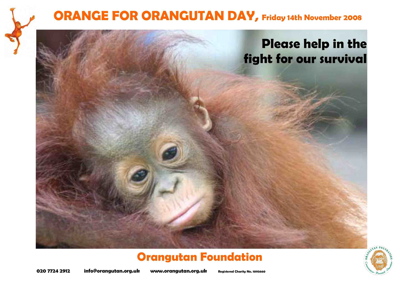
Orange Day Poster

Put the dates in your diary now!

The 10th - 16th November is Orangutan Awareness Week. This week was initiated over 10 years ago with the intention of creating a focal point for fundraising and awareness activities for our supporters. This year we decided that we want to make it easier for more people to be a part of this event and so I came up with the idea of “Orange for Orangutan Day” on Friday 14th November. The concept is simple: as an individual you wear orange clothing, an orange wig, or even dye your hair orange to raise awareness and generate funds for our conservation programmes.

To make it work even better, we ask you to organise your own Orange for Orangutan Day, maybe at work or at school. If everyone involved pays just £1 or $1.50 to do this then we will be able to raise huge amounts of money to invest in conserving the orangutans and their forest home. Interest so far has been amazing, and we are really excited about how people are cottoning on to the idea. In London, restaurants are putting orangutan dishes (tropical fruit salads or sweet potato "orange" mash) on their Special's menu and a London taxi cab will be driving around with an orangutan (not real of course) passenger!

In Indonesia, Yayorin, our partner organisation, are focusing their efforts for Orangutan Awareness Week in and around Pangkalan Bun. They are showing films at schools and villages; participating in a talk show on a local radio station; and putting up campaign banners in strategic points in the town of Pangkalan Bun.

On this blog, during 10th -16th November, we hope to bring you some guest posts. Ian Singleton, Director of Conservation, from the Sumatran Orangutan Conservation Programme is going to post for us. So make sure you check out this blog during Orangutan Awareness Week.

Go on, go orange for orangutans!

Please go to our website for more information about how you can become involved and for fundraising materials.

Many thanks,

Elly
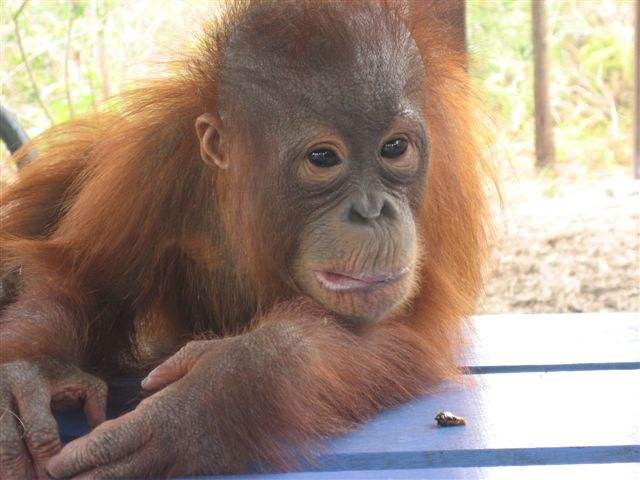
New Vet For Lamandau Wildlife Reserve (orangutan release site)

Last month we were awarded a grant by the Gemini Foundation to implement a system of veterinary health care for the orangutans released into Lamandau Wildlife Reserve. This will mean recruiting our own vet, which is very exciting. In Lamandau there is a system of post release monitoring and the orangutans are given supplementary food to help with the transition back to the wild. However, approximately 5 – 6% of all released orangutans are taken back to Orangutan Care Centre & Quarantine at some point, most commonly for small injuries or skin diseases and very rarely for more serious conditions, like Zidane. In common with all orangutan rehabilitation centres the OCCQ is full to capacity so the return of orangutans only puts an extra burden on them. Having a vet in Lamandau will reduce the chance of orangutans returning to the OCCQ, thus minimising potential stress caused to the orangutans as well. Tigor (Lamandau Rehabilitation Camps Manager) and I have finalized the job description and the advert has now gone out. Interviews will begin at the end of the month.

On to less interesting matters, it is report time again. October marks the start of the final quarter for the year; this is the time when we panic about how much or how little money is left over and what is still to be done. The written reports I can handle, it’s the budgets that I struggle with!

How I feel tackling accounts! (Photo by Sarah Seymour)

I probably share the same expression when I have to tackle Excel! (photo by Sarah Seymour)

Back at University, I remember courses on cell structure and function, zoo-physiology, population genetics, the biology of animal adaptation. I do not remember Accounting 101! What on earth is the meaning of “=SUMIF ('General edger' !$C$49:$C$115,C72, ' General Ledger'!$F$49:$F$115)”?

How I feel tackling accounts! (Photo by Sarah Seymour)

I love the two photos in this post, courtesy of Sarah Seymour. While the orangutans are undoubtedly cuter, their facial expressions remind me of mine as I look at those Excel spreadsheets.

Are released orangutans really in the wild?

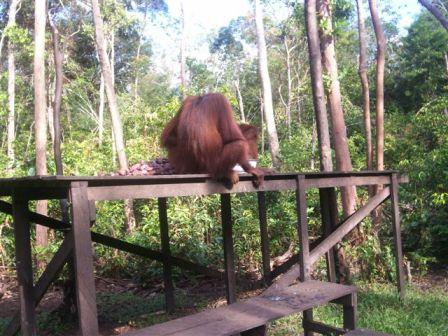
Bernadette thanks for your interest and yesterday’s question: Is the feeding site to ensure that the released orangutans can get food if they aren’t able to in the wild? I’d like to know more about how the release site will function? Is it a huge enclosure, or is it really the wild? Rehabilitated orangutans, released into the Lamandau Wildlife Reserve, are given supplementary feedings every day. This ensures they maintain their physical condition during the transition period from life at the Orangutan Care Centre & Quarantine (OCCQ) to life in the wild. The feedings also decrease potential competition with wild orangutans and they allow us to monitor the released individuals. Frequently, the only time they are seen is when they come in for food.

Orangutan in Lamandau

Orangutan in Lamandau

Orangutans in Lamandau (sorry the photos are so dark).

As for the question of how wild it is: it is definitely wild. The Lamandau Wildlife Reserve has no fences. It is 760km2 most of which is forested. As you can see from the attached map, our guard posts protect the buffer zone (between the Reserve and the Lamandau River) which adds to the area available to the orangutans.

Map Lamandau and Guard Posts

Just yesterday we counted six species of birds as we ate lunch on the jetty. During the time the volunteers were staying there they saw, red leaf-eating monkeys, proboscis monkeys, pig-tailed macaques (very rarely seen), a mouse deer and some snakes (admittedly the snakes were not so popular!).

They also saw leeches. However, let’s not be too hard on leeches as abundant leeches are a good indicator of a healthy mammal population; after all they do not exist just to prey on you and me. So even the leeches help answer your question. It is wild.

Thanks,

Stephen

Update on Zidane

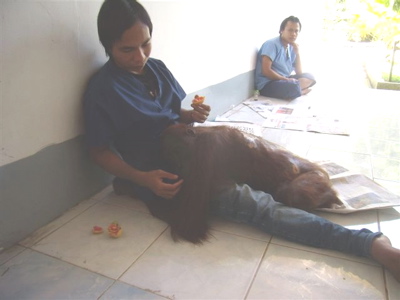
In haste, I was out at the Orangutan Care Centre yesterday and managed this time to catch up with Zidane. He was having quiet time with one of his carers. They say he continues to improve, being more lively and interested in food. Fingers crossed he keeps making progress.

Zidane 3/10/08

Zidane 3/10/08

Thanks,

Stephen

Sad and Rare Death of a Baby Orangutan Killed by a Pig.

Tragedy struck us again this week with the news from Camp Leakey, in Tanjung Puting National Park, that Tut, a female orangutan, had her two-year old baby killed by a pig. It appears the pig and orangutans were near to each other in Camp when the pig turned and snapped at Tiido, catching the young orangutan around the head. One bite was enough. Tut immediately picked him up and when the assistants rushed over they could see Tiido was still alive but, within an hour, he was lying limp in his mother’s arms.

I am afraid I don’t have a recent photo of Tiido but if you zoom in on the photo below, of Tut sitting by the tree, you can see a tiny arm across her waist. That was Tiido when he was new born.

Tut September 06

Peter’s photos show him when he was a year old. I am afraid I don’t have more recent photos.

Tut -Peter Ellen

Tut and Tiido -Peter Ellen

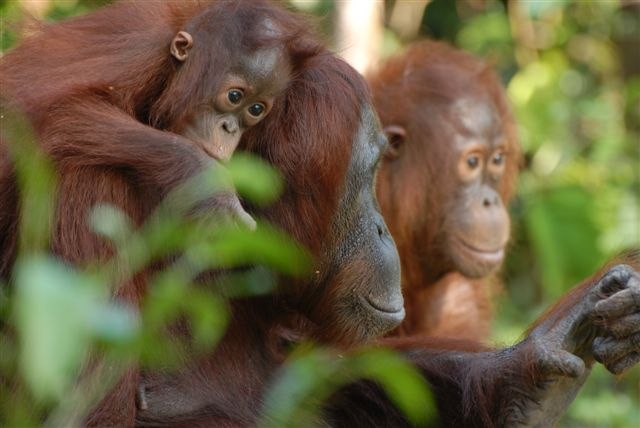
Tut with her beautiful baby Tiido. Photo by Peter Ellen.

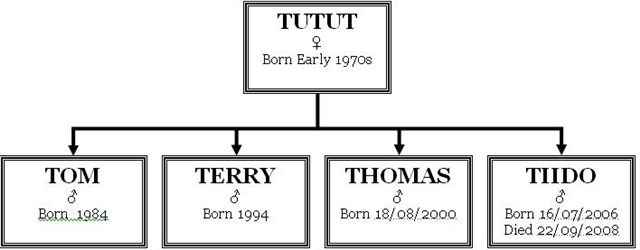
Tut was released at Camp Leakey in the very early days of Biruté Galdikas' research there. Indeed, she is the mother of Tom the present “King of Camp Leakey". Tiido was her fourth son.

Tut family tree

Bornean Bearded pigs are common in this area primarily because they are omnivorous; they will eat anything. This means they can survive in a wide variety of habitats including oil palm plantations – where they are considered pests – as well as in dense forest. They tend to hang around the orangutan feeding stations so they can scavenge left-overs or dropped fruit.

Bornean Bearded Pig

Bearded Pig

They are temperamental and have been known to chase orangutans, probably in the hope the orangutan will drop the food they are carrying. In 1985 Biruté Galdikas reported a pig killing a young orangutan. But this week’s incident was the first of its kind in over 20 years.

Regarding Tiido’s death, I know people will say “that’s life; it is nature red in tooth and claw”. In my heart of hearts I agree with them. But I still feel sick and a little heartbroken (I threw a branch at the first pig I saw on Saturday).

To end on a positive note, thank you very much Maciej G. for your donation of $130. This is hugely appreciated and will go towards our new feeding system in Lamandau.

Orangutan Making Good Recovery.

Thank you all very much for your kind and supportive comments on Zidane. Yesterday, I had to go out to the Care Centre again and so took the opportunity to look in on him. I couldn’t believe it – he wasn’t there!!! The vets said he had been so energtic in the morning, once his sleeping-cage door was opened he took his carers hand and wandered off into the nursery forest. Time was limited so I did not follow him out there. Clearly though he continues to go from strength to strength.

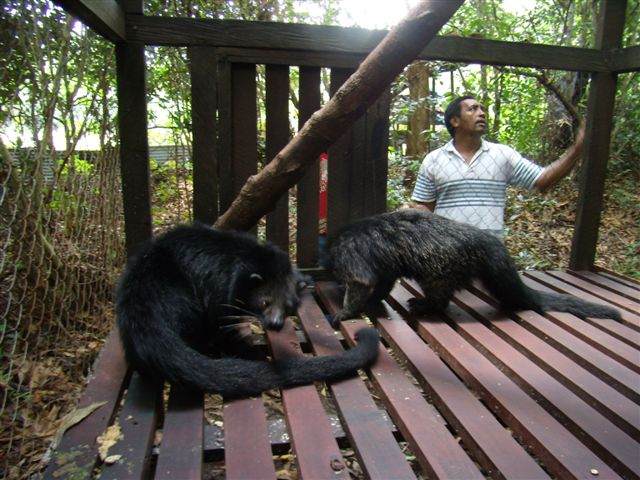
I did however pop over to see the binturongs.

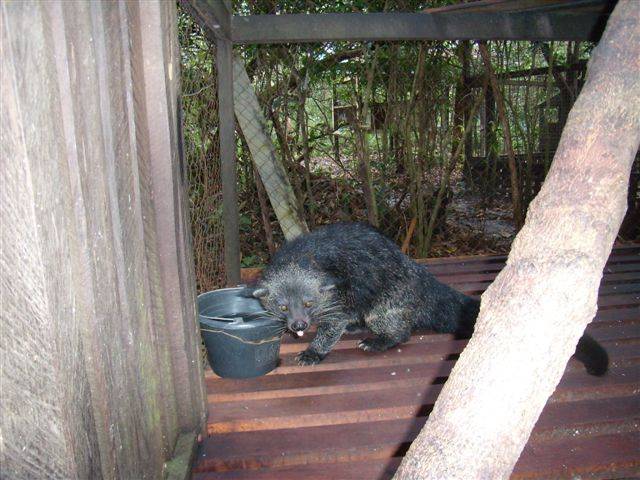
binturong

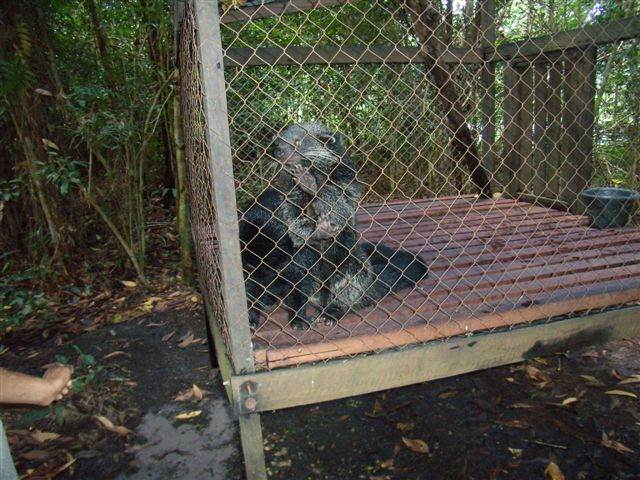
They weren’t best pleased to be woken up in the middle of the day but did happily come down for a sniff around. I still think they are amazing. Scientifically, binturongs are classed as carnivores in the family viverrids, which includes civits and genet cats. It may be simpler for US readers to think of them as racoons with attidute or, for European readers, to imagine a badger with a prehensile (gripping) tail.

binturong & Mr Sehat

By the way, the man next to the binturongs’ cage is Mr Sehat, the senior assistant at the Care Centre. He is absolutely amazing with the orangutans and is, beyond all doubt, Montana’s best friend.

There have been a few comments asking about who shot Zidane. These are good questions and it is still being investigated so unfortunately I can't give you any more information at the moment.

Thanks again,

Stephen

A short trip in Tanjung Puting National Park

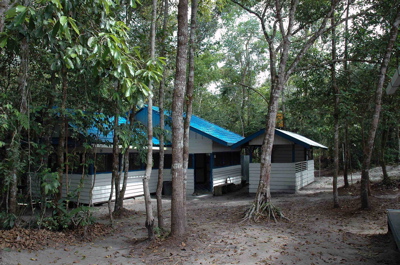
Last night, before I was side tracked into giving you an update on Zidane (who I saw again today and he is still looking good), I thought this story of a weekend trip to Tanjung Puting National Park would be quite good fun. Now I have started it, I have a feeling it is going to be dull! As I've mentioned Elly from the London office is out on a short visit. Devis and I took her up to Pondok Ambung and Camp Leakey. The night at Pondok Ambung was great as ever and nothing is better than waking to the sound of gibbons singing.
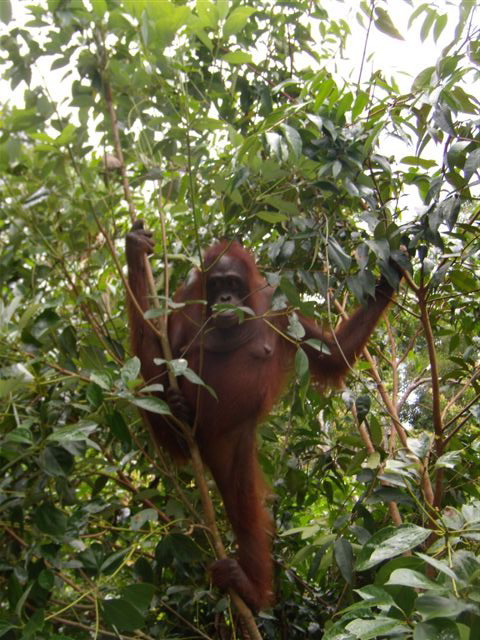
After breakfast we decided to go for a short walk to have a look around. Besides one glorious veiled-lady fungus (beautiful but very smelly) and some pitcher plants, we did not see too much besides water.

Veiled-lady fungus

Veiled-lady fungus

Pitcher Plant

Pitcher Plants

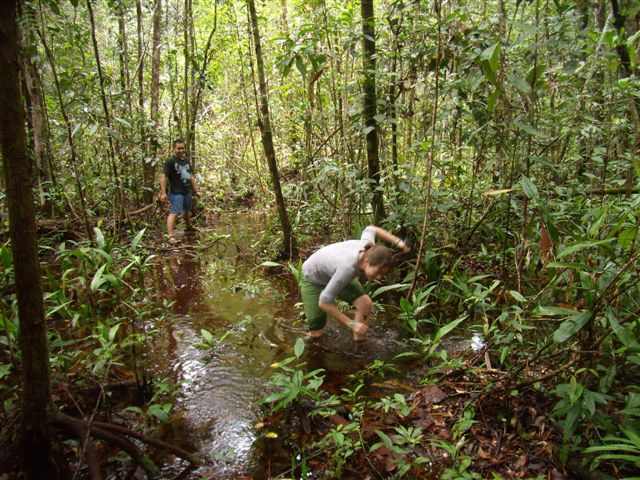
All the swamps are full. I was the first to stumble in but, I am pleased to say Devis and Elly quickly followed suit. Also, as I was the one with the camera my mishaps are not recorded :-)

Devis Goes In

Elly Goes In
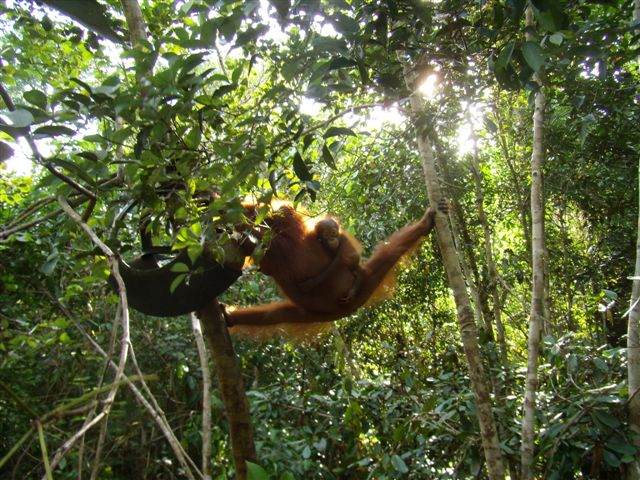
(Devis insists I tell you that, in the photo, he is not in fact falling over, but picking up a stick. I leave it to you to decide!)

We then went up to Camp Leakey. I hope next year we can update the displays in the Information Centre which are starting to deteriorate and look a bit tired. I was attempting to show this to Elly but understandably she was far more interested in the orangutans.
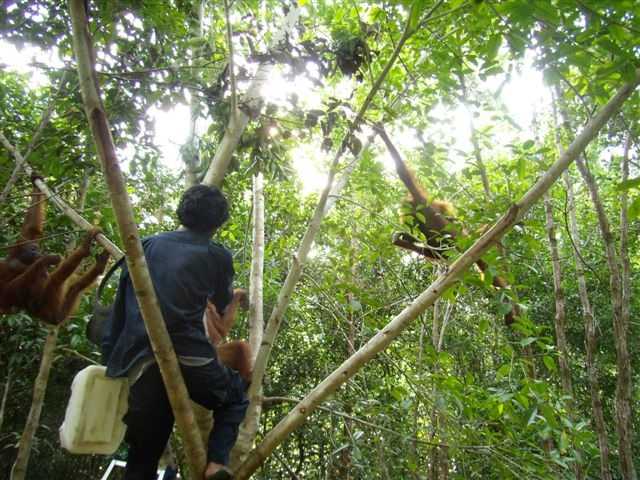
With Gara and her new baby around, who can blame her?

Gara

Gara and baby

Zindane: Orangutan Out Of Intensive Care

This blog was supposed to be about my most recent field trip. However, this afternoon I had to pop over to the Orangutan Care Centre & Quarantine so I thought I would give you a quick update on Zidane. Bottom line – he’s out of intensive care.

Zidane at OCCQ September 2008

Zidane when he first arrived at the OCCQ -emaciated and very sick.

Zidane 24/9/08

Zidane 24/9/08

A few weeks later Zidane is now alert and looking better (apologies if the photos are blurry. I switched off the flash again).

He is looking much better. His eyes are fuller and brighter. You can tell he is much more alert and active. His carers say his appetite has picked up, though he remains reluctant to drink. Tigor has, as a result, been plying him with isotonic sports drinks which, at least, he seems to enjoy.

“There are many a slip twixt cup and lip” and he is certainly a long way from being ready to return to the forest. But, the fact he no longer needs 24 hour care is a positive sign. I am now cautiously hopeful Zidane will make a full recovery.

In the next day or so I’ll tell you about the field trip. Sheryl, thank you very much for your most recent donation and your continued support. Donations will go towards funding our new orangutan feeding system in Lamandau and a new solar power set for Pondok Ambung, our research station.

Thank you and best wishes,

Stephen

Orangutan still very sick but now eating.

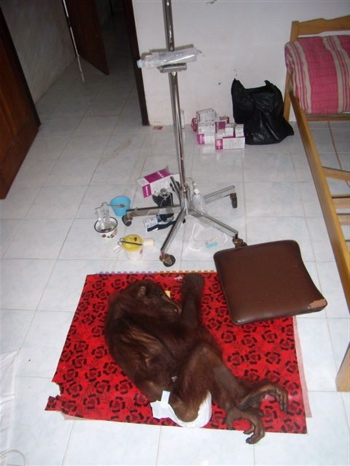
I went out to the Care Centre today to check on Zidane. While still in a pretty awful state he is improving. We have brought one of the Camp Buluh staff back to town to sit with him throughout the day. He offers Zidane food whenever he feels like it. Zidane is eating but he is reluctant to drink. However, the affection he shows for people is touching. He actually slid off his makeshift cot for a hug. Thank you Brigitta for your generous donation of $100 it is very much appreciated by all of us. Zidane at OCCQ September 2008

(Apologies if the photo is dark – I deliberately switched the flash off)

Elly, from the UK office, is visiting the field projects at the moment so she came to the Care Centre too.

Elly at OCCQ

Elly at OCCQ

Elly receiving an enthusiastic welcome.

There is a pair of binturongs (Arctictis binturong) also known as bearcats at the Centre at the moment.

Bearcats

Bearcats

They are very cool animals. It is a dream of mine to see one in the wild… as well as to Zidane back in the trees.

A Very Sick Orangutan

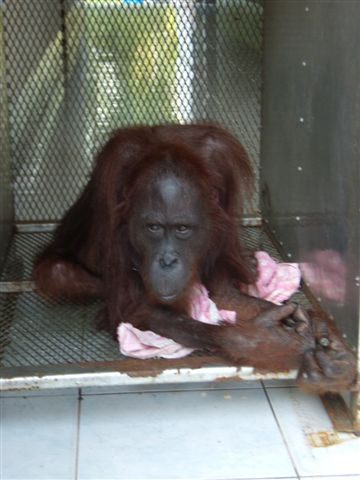
Two weeks ago we were all very shocked when Zidane (pronounced Gee – dan) was brought back from Camp Buluh in the Lamandau Wildlife Reserve to the Orangutan Care Centre & Quarantine. Not only did he have rampant diarrhoea, was emaciated, running a fever but, more worryingly, he had 16 air rifle pellets under his skin. We have never seen this before and therefore we knew we had to act immediately and sort out what had happened in Lamandau. Zidane at OCCQ September 2008

Zidane Sept 08

A very sick Zidane at the OCCQ

A Forestry Police patrol went out for three days to interview all the rubber-tappers working along the river. Yesterday, the Lamandau Camps Manager, Tigor organised a community meeting to which he brought along district Government representatives, the police and a doctor from the Health Department. We want everyone who lives or works inside the Reserve to take worming medicines to prevent more infections. However, as this is the holy month of Ramadan, when people are fasting, yesterday’s meeting was a socialisation exercise. Once Ramadan is over we will have another meeting when the doctor will distribute the medicine.

14 days on and Zidane’s condition is stable. For the first few days we did not think he would pull through. He was given two blood transfusions, from another orangutan at the Care Centre, was on a constant drip to keep his fluids up, and as far as his body would take it, was given worming and anti-dysentery medication. But every day that he manages to hold on gives us slightly more hope.

Having the individual feeding tyres for the orangutans will help us distribute their medicines more easily and will stop orangutans congregating on a feeding platform, therefore reducing the chance of infection – thank you very much to everyone who has donated so far. Please do consider donating so that we can implement this new feeding system throughout Lamandau.

New Feeding 2

New Tyre Feeding System.

Camp Buluh

Camp Buluh

We will also build another Guard Post on the western side of the Reserve, which will prevent access to the headwaters of the Buluh River.

Although I can’t promise Zidane will pull through, I will give our word that we will do everything possible to find out what happened and to prevent another orangutan suffering in the same way.

Thank you,

Stephen

Bringing the office to our orangutan release camps.

A huge thank you Anna M, Kit C and Wanda H for responding to our recent ask for donations towards the solar power sets and the new feeding system, that we are establishing in Lamandau at our orangutan relesase camps. Both projects are very important and still require your support so please do consider donating. In response to my post about my awful journey to choose a guard post site, Sheryl (thank's Sheryl for your offer of a donation as well) commented “Your day at work is always infinitely more interesting than my day at work”. Do you really think so? I can assure you we deal with just as many mundane, administrative issues as everyone else. The only difference is the physical environment.

A trip Uli, who is our office manager, and I made proves the point.

The Indonesian government has a health insurance scheme onto which we want to enrol all our staff. In order to do that the necessary paperwork has to be completed. Before the paperwork can be completed the staff have to, firstly, receive the papers – we are talking about eight different project sites - and then know what they have to do.

A lot of our field assistants are, putting it in completely western terms, “country folk”. That, of course, is why they are great for us: they know the trees; seasons; animal behaviour and everything else you could possibly want to know about the forest. However, the flip side is paperwork is completely alien to them.

CampBuluh_Jamsostek

Kitchen

Boths the above photos show Camp Buluh one of our release camps in Lamandau.

So Uli and I set off on a whistle stop tour around four of the five Lamandau release camps, (the idea being for her to explain the form and for me to get a day out of the office!). I am sure it would be a modern “Human Resources Department” worst nightmare. Four people could not remember their own birthdays, with two not even being able to hazard a guess at the year.  A lot of the Dayak’s only have one name. Therefore “Riti” was a typical example of what was written for the section “Mother’s maiden name”. Uli, whose full name is Iria Yuliasih Siregar and who came to us from an office job in Jakarta coped admirably with a situation that was way beyond anything she’d experience previously. And it wasn’t just cultural….

Outside the windows curious orangutans were looking in.

campgemini_audiencejpg.jpg

An interested audience!

At Camp Buluh, Omang actually swung onto the boardwalk to get a closer look at why so many people were talking so animatedly at once.

Omang

Curious Omang

And if I said there was an orangutan at Camp JL called Hercules my guess is you are not picturing a cuddly infant. You’d be right. Hercules is a strapping sub-adult male in the full flush of the testosterone rush which precedes the development of cheek pads.

If I am ever in a camp at feeding time, I always try to accompany the guys out to see the orangutans. Uli came along too. It was good to see Bobi and Dodon with their youngsters. It was less good to see Hercules barrelling towards us once feeding was over.

At a push Uli might agree with Sheryl in describing the day as “interesting”. The rest of us described it as “Phew!!! That was fun”. Which is amazing as all we were trying to do was fill in some forms.

Help Needed with Orangutan’s New Feeding Sites

Last week I asked for your help to buy a solar power set for Pondok Ambung, our research station, well I'd like to ask for it again. New feeding 6 -mother & infant

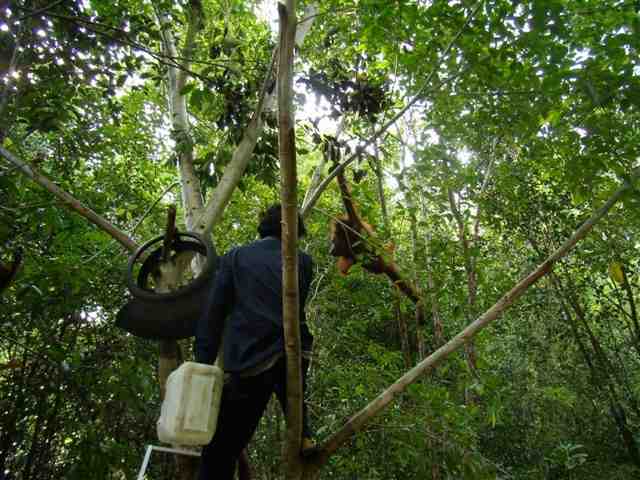
In May I wrote about how we had changed the feeding system at Camp Siswoyo in the Lamandau Wildlife Reserve (Feeding Orangutans - A New Approach). Instead of using a feeding platform as is done at all the other release camps, at Siswoyo we have hung cut-up and inside-out car tyres from trees. The orangutans’ food is then dropped into these heavy-duty “buckets”; the one tyre per orangutan system reduces competition, allows us to give an extra large portion to hungry or pregnant orangutans, or those with infants and the tyres eliminate the risk of disease transfer from the orangutans walking across a dirty feeding platform.

New feeding 1

In May, I said the system was not 100% perfect. We have tried tweaking it: some of the tyres have been lowered so the field assistants can get the food out quicker; and the tyres are now in more of a circular arrangement, rather than in a line, so the orangutans do not all congregate at the start. This week Tigor, the Lamandau Camps Manager and I reviewed the system. Our conclusion was that we should do it in the other five camps!

And that is why I am asking for your help.

We need an extra 80 tyres; for efficiency we will buy an angle grinder so we can cut up the tyres ourselves and a bore to make the drainage holes; we need steel cable to attach the tyres to the trees and step ladders. The total cost will be just over $500 (5 million Indonesian rupiah)

Thank you Mary H. for your donation of $15 on September 1st and Brigitta for your donation $20 on the 5th September- we really appreciate your support.

On a final note, I would encourage all of you to do as Sheryl suggested and sign the petition http://getactive.peta.org/campaign/anjelica_huston_video to end the use of great apes by the entertainment industry. In addition to the obvious welfare issues surrounding performing animals, I read recently “A survey conducted of visitors to Great Ape Trust and cited in Science magazine (March 14, 2008) showed that the appearance of apes in advertising and entertainment negatively influenced the general public’s perception of the conservation status of apes in the wild.”I hope you can help.

As always, I will update you as we progress and thank you in advance.

Stephen.

Add Power To Our Research

Pondok Ambung, our research station in Tanjung Puting National Park, has been mentioned quite a bit in my blog. In the late 80's, Pondok Ambung was established as a proboscis monkey research site but by the end of 90's it had been badly damaged by illegal loggers. The Orangutan Foundation's team of volunteers repaired the site in 2001 but it remained abandoned until 2005 when the Rufford Maurice Laing Foundation awarded us a grant for its complete renovation. Pondok Ambung Tropical Forest Research Station

And this is what we did.

The station requires a new solar power set. Solar is the only source of power providing electricity for the station. A new solar set costs $600 and any donations towards this amount would be hugely appreciated. So far the running and maintenance of the station has been entirely funded by the Foundation or from fees received from researchers staying at Pondok Ambung.

Solar power set Recently, Pondok Ambung was used as the base for the “Orang-utan ‘08” expedition from the University of Aberdeen, Scotland. A team of four undergraduates led by Graham Banes spent eight weeks in Tanjung Puting studying the effects of disturbance, particularly forest fires, on the distribution and density of orangutans. Encouraging scientific research in Tanjung Puting National Park creates the knock on effect of increasing support for its protection.

Here are some of the incredible species that have drawn researchers to Pondok Ambung so far.

Tomistoma 2.jpg

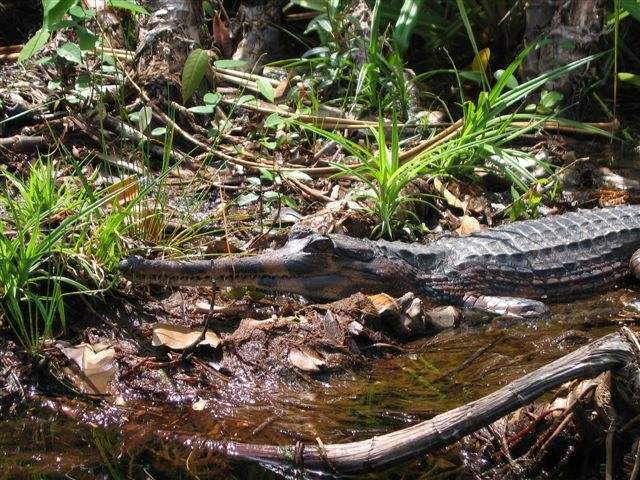
Malaysian False Gharial (Tomistoma schlegelii)

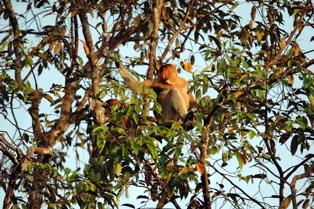
Proboscis Monkey -photo by Dr Mark Fellowes

Proboscis Monkey

Tarsiers

Tarsier

Pitcher Plant

Tropical Pitcher Plant

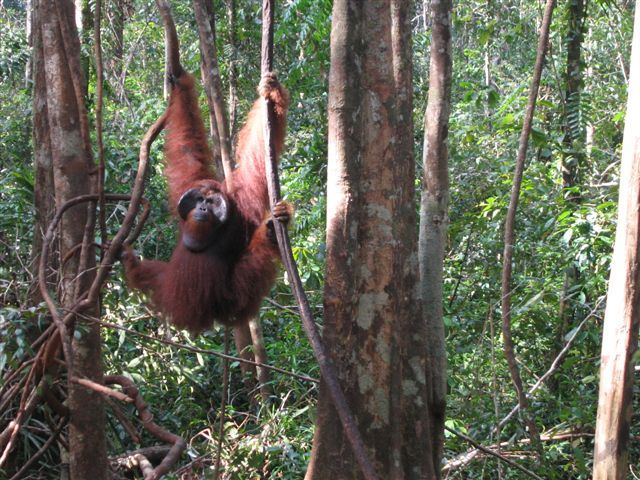
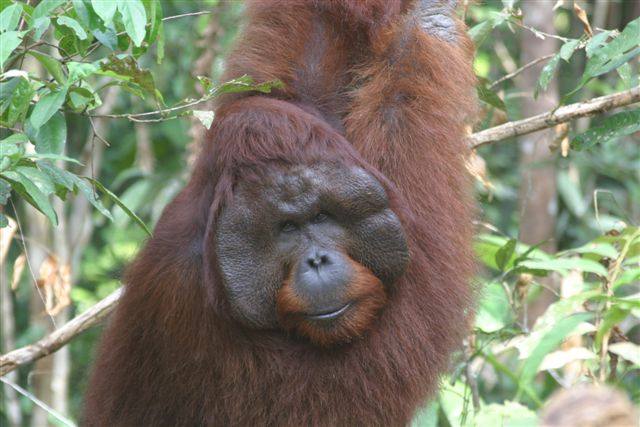
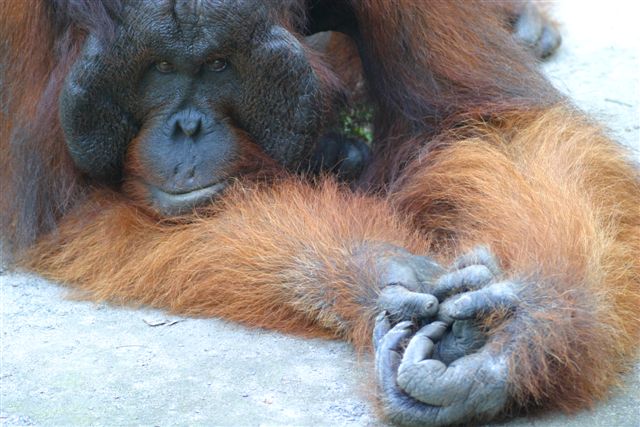
Adult Male Orangutan

And of course...Orangutans!

Thanks for your comments on my last post - I've just about recovered!

Identifying Individual Orangutans

Paula's question of how do we identify individual orangutans is a good one. In many ways, recognition is done as we do with people: it is the whole appearance which guides identity. As with chimpanzees, but unlike gorillas, orangutans have lots of individual differences. One of the features I find most useful is the "forehead bump" all orangutans have but whose shape and size varies. Other unique features are hair colour, hair patterns, body-size, moles and scars. Adult males (cheek-padders) are easy; they all have different facial patterns and pad shapes. You learn to tell adult females apart by their individual appearance. The group I find the hardest (and at times impossible) to identify are old juveniles – young adolescents; orangutans aged from around 5 - 10 all look very similar. You can not tell the sexes apart; they all still retain a youthful lightness to their skin and, quite frankly, appear identical! Only the Assistants who see them very frequently can tell them apart.

I hope the attached photos show what I am talking about:

Tata

Tata: She is a big female; eyes quite close together; dark hair crown.

Princess

Princess: She has a line running from her nose to under her right eye, otherwise she has a smooth face with a narrow, pointy forehead-bump. Her coat colour is dark.

Siswi

Siswi: Obvious!

Tut

Tut: Tut is thin to the point of being gangly; she has a distinctive fringe and her face is very lined.

Uning

Uning: Obviously still a young adult; Uning retains the lightness around the eyes and mouth which is typical of young orangutans. Her eyes are also quite close together.

male_badut-11.jpg

Badut: Compared with other adult males, Badut has a narrow face.

kusasi

Kusasi: His cheek pads are incredibly ragged.

Masran

Masran: The join of his cheek-pads is very triangular and he has a notch on his left pad.

Tom

Tom: Like Siswi, when Tom is around you know it! However, the join between his cheek pads is distinctive. I describe it as “messy”. Compare it with the photo of Win and you’ll see what I mean.

Win

Win: Has a very obvious crease running across his left cheek-pad.

Juvenile

Juvenile: Beat me! I can’t even tell if the orangutan in the photo is a boy or a girl :-)

Photographs by Anna Lewis, Hugh Sturrock, Melissa Tolley, Ursula Fuller and Stephen Brend.

Siswi - Another Camp Leakey Character

Last week Brigitta asked me to give her regards to Siswi.  Unfortunately, I have not managed to get out of the office (hence this week’s blog, which has been more about individual orangutan histories than actual news from the field!).  However, I thought I would tell all of you about her because, like Kusasi, she is one of Camp Leakey’s characters.  Most visitors to Camp meet her and she’s pretty noticeable.   Siswi

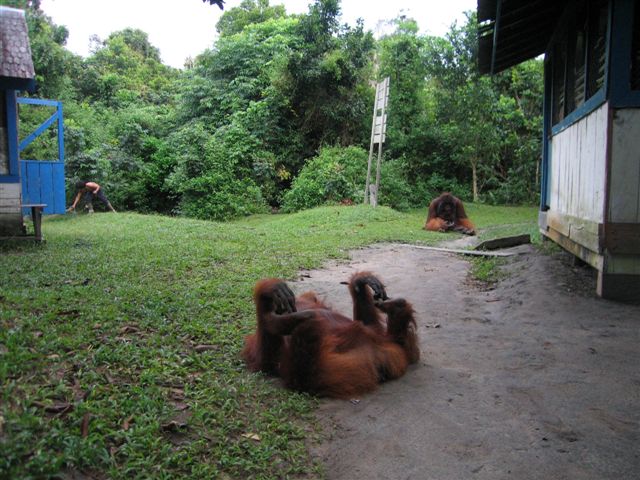
Siswi has a distinctive gait, a unique habit of lying on her back holding her feet and, if there is a male around, she’s almost guaranteed to put in a show. 

 Siswi - Camp Leakey 2

People may consider her “rotund” but that does not appear to diminish her sex-appeal; she frequently consorts (the name given to the temporary male – female pairings, when a female is in season) with Tom, whereas a few year’s ago, she was definitely Kusasi’s girl.  Indeed, without trying to keep going on about the film “Kusasi: From Orphan to King” there is a delightful scene where Siswi is rolling along in front of Kusasi as he walks through the forest.   

Siswi

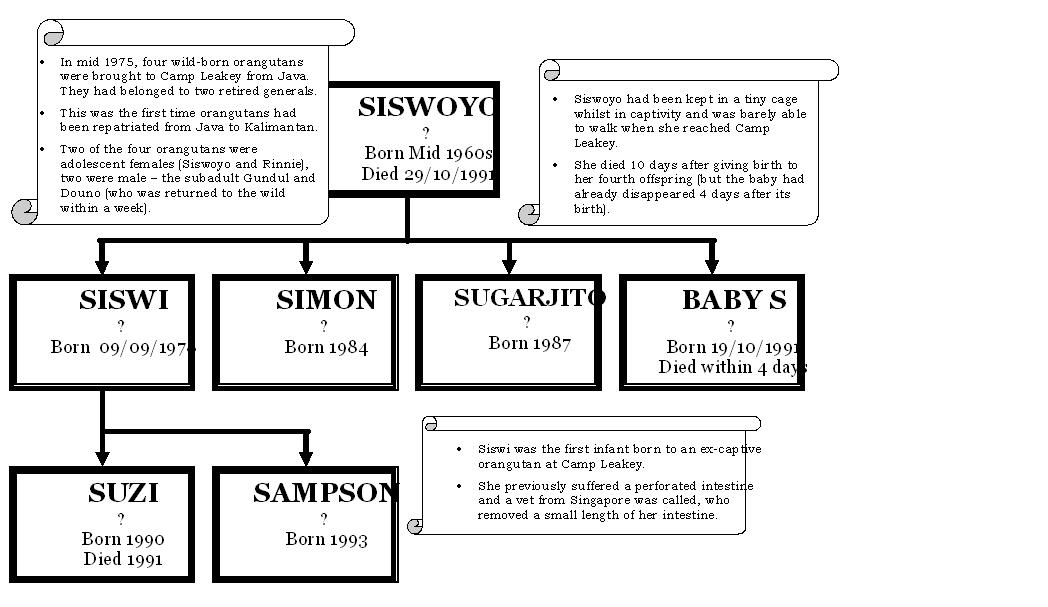
What made Siswi famous from the outset was that she was the first ever offspring of a rehabilitated orangutan at Camp Leakey.  Siswoyo was released by Biruté Galdikas in 1975.  On the 9th of September 1978 she gave birth to Siswi, evidence that once-captive orangutans can return to the wild.  Because of this, the first release camp in the Lamandau Wildlife Reserve is called Camp Siswoyo.   

Attached is Siswoyo’s family tree.  My apologies that the text appears to have jumped inside the boxes; I am no-one’s idea of a graphic designer! You may need to click on the family tree to read it.

Sisiwoyo Family Tree

Monitoring released orangutans

I see a number of people have asked how we monitor the orangutans once they have been released into Lamandau. There is nothing technical involved: our field assistants follow the orangutans from sunrise to sunset (or as we say, "nest to nest") everyday for a week. If after that time it is clear the orangutan has adapted to life in the forest, they will then be followed occasionally like the other previously released orangutans. If after the first week, the assistants are concerned that the orangutan may not be adapting they will continue to follow he or she for a month. Common causes of concern are the orangutans not making their own nests but choosing to sleep on the feeding platform or making a bee-line for Camp and not exploring their new surroundings. Within the first week, we expect to see the orangutans making their own nest, trying wild food and travelling. Nearly all achieve this.

04_andi.JPG

Most newly-released orangutans tend not to go too far in the first couple of days but then they start to travel further and further. Last December I told you about the release of Sawit and her adopted son Andi. They took off within their first week, probably because Sawit was being hassled by a sub-adult male. The Assistants could not follow her through the swamps to the west of Camp Rasak. However, on 22 April, back they came, still together.

Which brings me onto the last element of the post-release monitoring; the daily supplemental feedings. In Tanjung Puting, where orangutans were released from the early 1970s to the mid-90s, the rehabilitants are offered food once a day. In Lamandau food is provided twice a day. This serves three purposes: it keeps up the nutrition levels of the released orangutans; it decreases competition for scare food resources with wild orangutans, gibbons, hornbills, and other wildlife and finally it enables us to monitor the orangutans’ development. All individuals coming to the feeding stations are recorded; over the course of a year, at least half of all released orangutans are seen. The Assistants also note whether they are consorting with the opposite sex, pregnant or with an infant and their general health.

 ladydi_may08-1.JPG

For example, Boni who was released at the same time as Sawit and Andi came into feeding 26 times during April, and then every day in May and June. Lady Di, whose picture I showed you in April, was around for 28 days in April, May and June but Hongky was there for just 9 days in April, 14 days in May and 25 days in June.

ladydi_may08-2.JPG

In answer to “Rick, El Paso, TEXAS” question about the availability of this data, I am afraid to say it is not available online. We produce quarterly reports, in Indonesian, covering this information but the reports are for the Forestry Department and our own internal use. However, Tigor who manages the Lamandau Camps is providing information about our release program to an Indonesian PhD student at Cambridge University in the UK. So hopefully it will be peer-reviewed and published.

ladydi_may08.JPG

Please keep asking questions and I’ll try to keep answering them! Many thanks.

More orangutans returned to the wild.

Wow Kusasi certainly proved popular! Thank you for all the positive comments and nice to hear from you again Brigitta. If people want to see the film "Kusasi from Orphan to King" I understand it can be bought on-line from PBS.

The other week I wrote that July was Pondok Ambung, our Tropical Forest Research Station’s, "month". Certainly, the research activities there dominated my time, but that does not mean everything else stopped. In fact, four more orangutans were released from the Orangutan Care Centre & Quarantine into the Lamandau Wildlife Reserve.

I now have a bit of time to tell you about them. Biruté Galdikas supervised the releases with Tigor, the Manager of the five release camps. On 28 July, the adult female Sasha was released along with her adopted daughter Monica. Though Monica was no longer an infant, it is always good to see these adoptions work; no matter how competent the staff at the Care Centre are, obviously a female orangutan is the best possible mother for youngster.

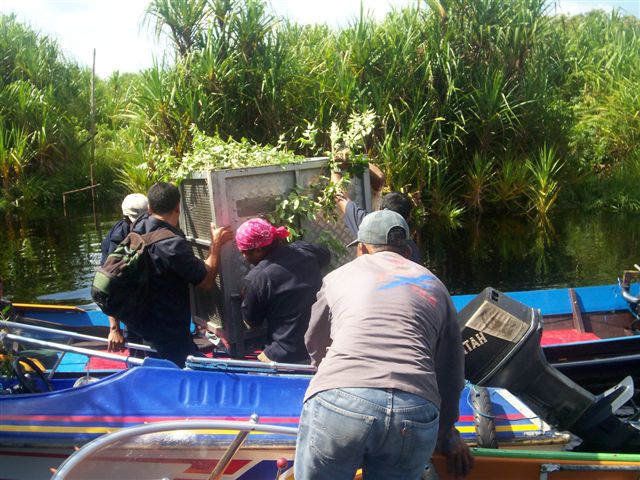
The second release on 4 August was a bit more traumatic. The orangutans, Ucok and Lori, were OK, but the people had some problems! The orangutans were moved out of the Care Centre in the morning, to avoid them travelling in the heat of the day and were carried in a kelotok (a traditional boat a bit like a motorized canoe). Biruté, Tigor and other staff travelled up later in speedboats. Or at least that was the plan; low water levels meant the speedboats could not get up. They lost two propellers and cracked the hull of one of the boats after colliding with submerged logs. Eventually, the kelotok had to come back for them.

The pictures below show the release from the Care Centre to Camp Rasak and then freedom, once again, in the wild.

 Monica

Monica

Sasha & Monica 4

Sasha & Monica

Monica and Sasha leaving the OCCQ

release

release 2

release 3


Feeding plaform

Feeding platform 2

 Back in the wild

These photos show the orangutans being moved from the Care Centre, into the kelotok, then having a few minutes peace on the feeding platform before some other interested orangutans came for a nose.

All the photo's were taken by Uduk, Tigor's deputy, on a camera recently donated to the Orangutan Foundation at our Members and Supporter's Evening in London, in July.

Kusasi a great great ape

I was pleased to read that some of you have seen the PBS documentary “Kusasi from Orphan to King” which was shown on PBS television in the States, on the BBC in the UK and ABC in Australia (I think it may also have been on Animal Planet). I think it is a great film giving you a real insight into Kusasi’s world.  Kusasi 06 

Kusasi -the old king of Camp Leakey 

However, the second reason I like it is much more personnel; Kusasi has been a large figure throughout my time here.  When I first visited Camp Leakey as a tourist, in 1996, Kusasi was the contender in waiting.  By the time I came back in 2001 he was the undisputed king.  He dominated Camp throughout 2003 but even by then Win was challenging him.  In 2004 twice we had to operate on him up at Camp. 

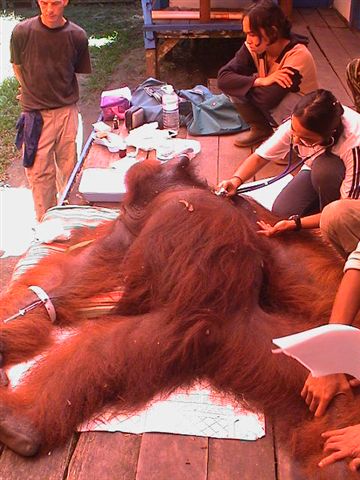
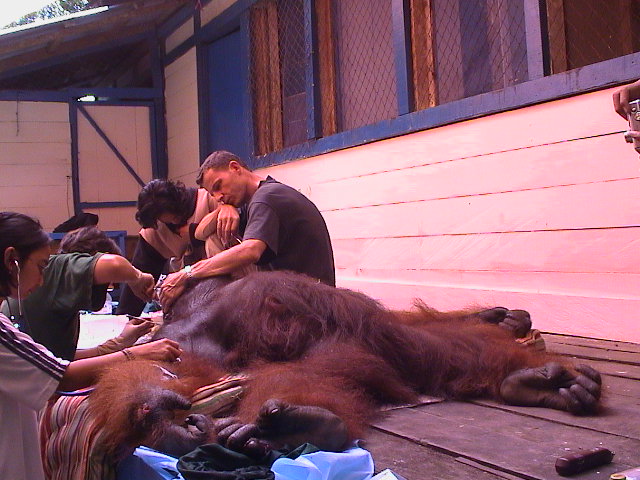
Kusasi operation 

Kusasi operation 2 

Kusasi during an operation at Camp Leakey, Tanjung Puting National Park 

I remember eight of us struggling to lift him; his head alone felt as heavy as a sack of cement.  2005 was little better for him; he broke his arm and had to be moved to the Care Centre where he spent the next year.   By the time he was moved back to Camp in 2006, he was very much “in retirement”. 

Kusasi june 06 

Kusasi, after his time in the OCCQ, in 2006 

Tom had taken over as king and is still the dominant male, he rarely comes into Camp though.  Kusasi, for his part, is either in Camp or deep into the forest.  He does not go anywhere where Tom might be.  And that is probably very wise. 

Kusasi 1 

Kusasi -relaxing (photo by Hugh Sturrock)

I have seen Kusasi relaxing, even looking bored.  I have seen him grab a person, which was frightening and I have seen him fighting other males, which was even more frightening.  He gave Ashley and I the shock of our lives when he entered a small building where we sat.  But I have also seen him grow old.

Kusasi 2008 

Kusasi - still a magnificent orangutan 

These days he appears thin rather than massive as he did a few years ago and he has lost two of his canine teeth.  It is probably in his best interests if his fighting days are over. That said, even if he is past his prime, in his prime he was unbeatable.  And even now he remains magnificent. 

Tropical Forest Research Station

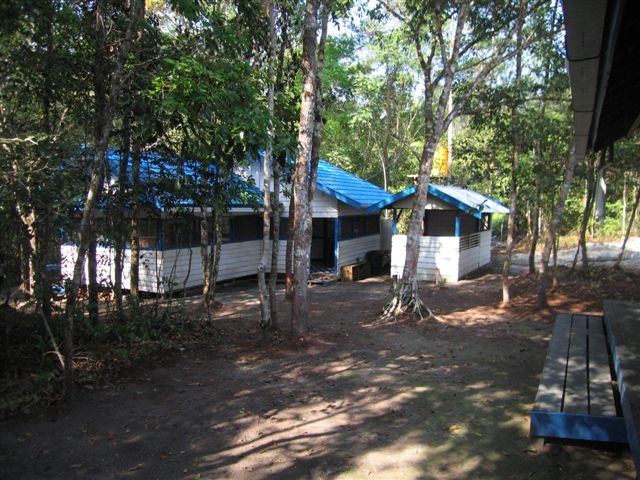
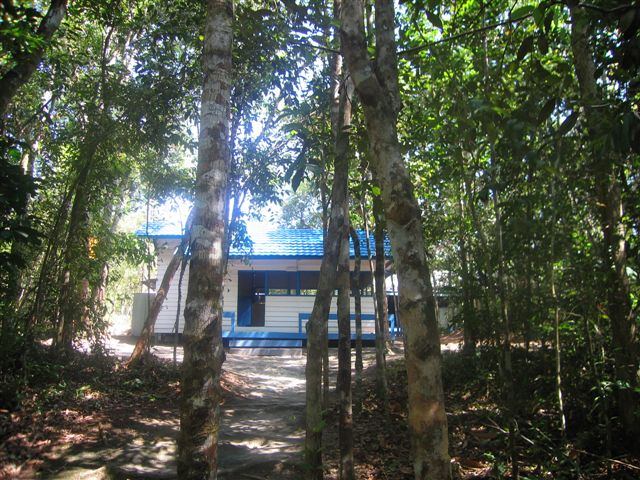
July has been a busy month, hence my lack of posts (apologies) and it looks set to continue into August. This has definitely been Pondok Ambung’s month. Pondok Ambung is the Tropical Forest Research Station we operate inside Tanjung Puting National Park. Pondok Ambung

Pondok Ambung front shot

Pondok Ambung is set in a beautiful location on the Sekonyer River, TPNP.

I have already told you of Rene’s study on crocodiles but I think it completely slipped by to tell you that the University of Reading's ‘Summer School’ were here earlier this month. This is the second year, Reading University have run a ten-day field course at Pondok Ambung. It is always great to see students getting out of the classroom and into the forest. I hope it inspires them. They were certainly captivated by the orangutans and gibbons.

Two gibbons

Gibbon Pondok Ambung

Reading Field trip

Pondok Ambung visitors; orangutans, gibbons, and humans -whose watching who?

And just to prove there are always new experiences to be had, the day Brigitta (who contacted us through Wildlife Direct) was with us at Pondok Ambung, we found a tree that had been absolutely torn apart. You will have seen photos of the damage sun bears can do to trees in one of my earlier posts. Orangutans will also tear off bark to either get at sap or insects. But, on this tree, half the bark had been shorn off and huge chunks of heartwood pulled out. If it was an orangutan or a bear, I would not want to meet them!

It was Rene who gave us the answer: the tree had been struck by lightening (he said there had been an almighty thunder clap and lightening flash the day before). That was why the wood appeared to have exploded outwards. Still it was incredible there was no sign of burning. Despite the downpour, I would have thought a million plus volts would have at least singed the leaves…

Stuck in between two great apes

During last week, when I was in Tanjung Puting National Park, I had a close encounter that reminded me just how impressive these great apes are. Walking down the jetty from Camp Leakey we found our way blocked by Kusasi, who, I can assure you, is quite some bloke! kusasitut_jul08.JPG

Kusasi and Tut blocking the way.

Kusasi was the dominant male of Camp Leakey for many years. Tut, a female, sat patiently in front of him; if he was not going to shift neither was she. So we called Abdi who is magical with the orangutans. Abdi simply walked up to Kusasi and shooed him away, much as you or I would a kitten.

Humbled, we thanked Abdi and walked on, only to find Uranus, another cheek-padded male, at the far end of the jetty. The rule with all orangutans is “never within arm’s reach” which means there was no walking past Uranus who has a 2m/7’ arm-span.

Tom Cheekpadded Male

Tom, another cheek-padded male - thank goodness he wasn't on the jetty!

Kusasi had by this time returned to the jetty, which meant we could not walk on or go back. I tried my Abdi impersonation but failed dismally. With Uranus, we had to wait him out. It was almost sunset before he sauntered off to make his nest….