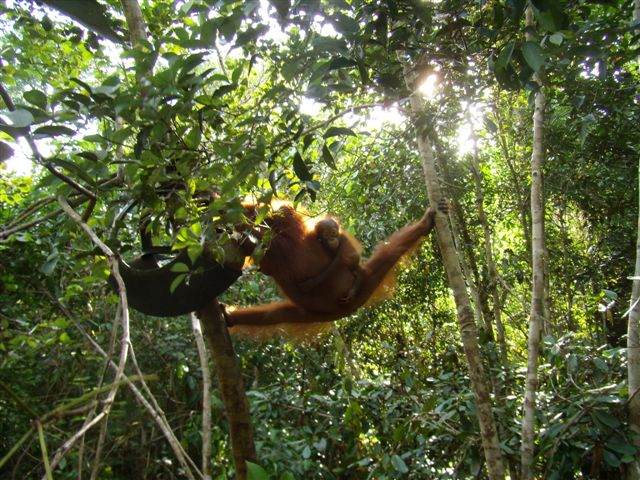
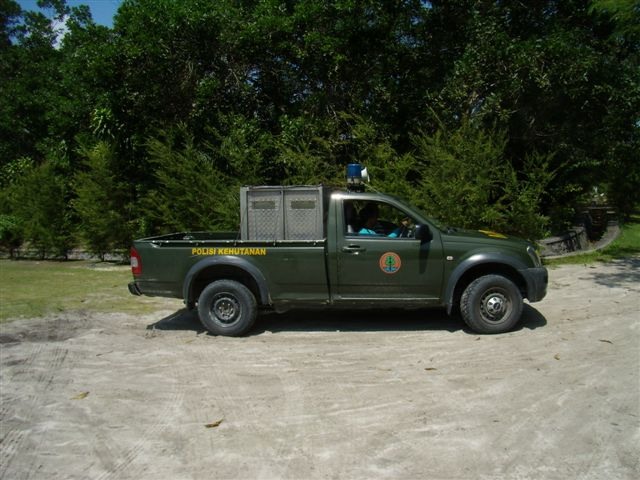
Illegal Farming Inside Protected Area

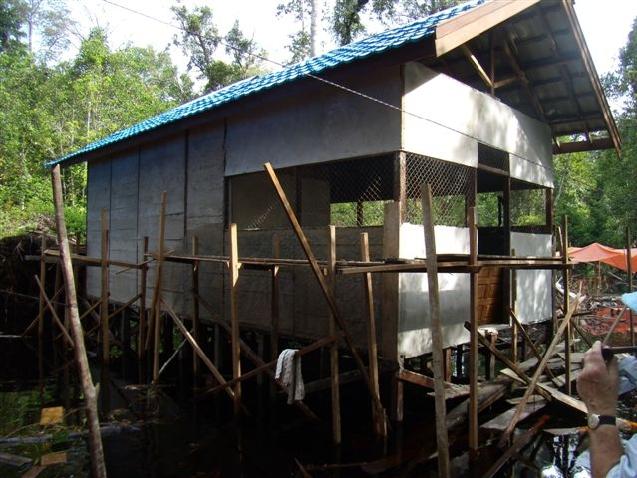
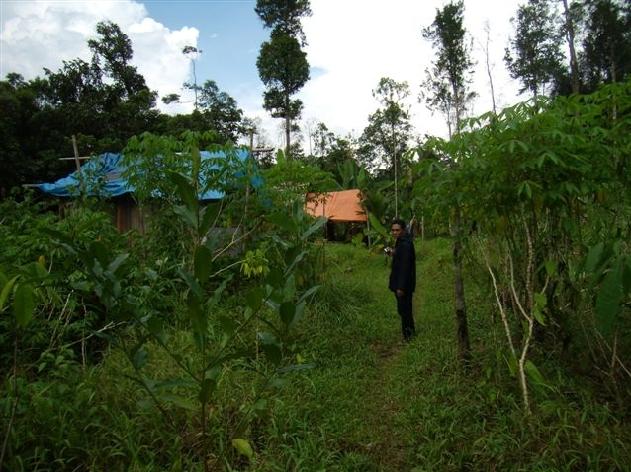
Following on from my last post “Busy, busy, busy”, here’s some more detail about the illegal farming. The farm was obviously productive and well-maintained. It had a fence around it to keep out wild pigs and deer. Inside, bananas, rice, cassava and a number of vegetables were all growing well. Indeed, if our agricultural demonstration plots looked that good we could be justifiably proud. LWR -illegal farming Illegal farm inside Lamandau Wildlife Reserve
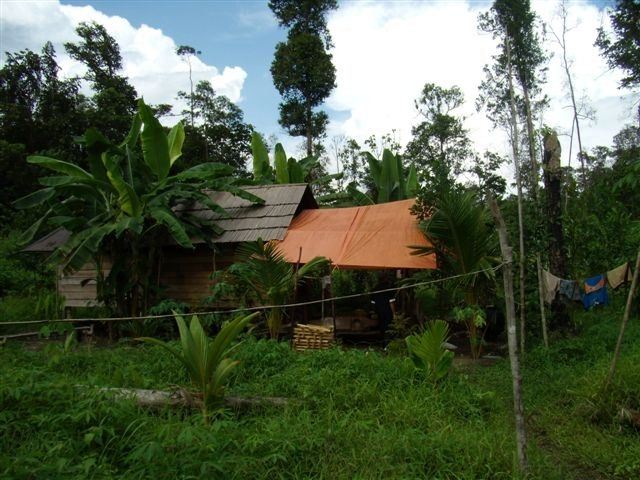
But there was one big problem with this farm – it is inside the Lamandau Wildlife Reserve. It is obvious from the surrounding forest the farmers were not making use of fallow land, as we try to do with the demonstration farms. No, here, they had cleared the forest and then burnt it to boost soil fertility.

Illegal farming

Note the surrounding tree-line.

This situation gives us a problem, as there is no real alternative to evicting them. We do not wish to have a confrontation with the surrounding villages; one of our aims is to establish harmonious relations between the neighbouring communities and conservation areas. However, if there is a flagrant violation of the law, as in this case, there is little that can be done. The farmers can not be allowed to continue. They are clearly damaging the forest, increasing the risk of forest fires and would almost certainly persecute any wildlife that took to crop raiding.

Farming inside Lamandau

Once forest, now farm land.

Technically, the farmers could be arrested, but pragmatically this would only inflame local sensibilities and even the police would be reluctant to arrest someone for (as they will see it) “just growing food”. The balancing act facing us, therefore, is to get the people out of the Reserve without turning their whole village against us but, at the same time, creating a strong enough front to deter anyone else from attempting to farm there. The Forestry Department officials, under whose auspices we work, have suggested giving the farmers six months to complete the current harvest after which they must leave.

This seems reasonable. We can easily monitor them to make sure there is no further expansion or burning. We can also make use of this time to erect a signboard/ block on the river the farmers are using for access to prevent anyone else from saying “I did not know it was a Conservation Area”.

It is worrying that people still do not respect Lamandau’s borders but it is encouraging that our patrols clearly have good enough ground coverage that they were able to detect the farm and, secondly, that the Forestry Department has the resolve to deal with it. A strong display now will go along way to reducing such incidents in the future.

- P.S. Brigitta, thank you for the comment. It is a pity about the video question and answer session, but it will still be good to meet up. As I said, I will be at Pondok Ambung or Camp Leakey on the 10th, so we’ll meet up then. Safe travels!
Busy, busy, busy

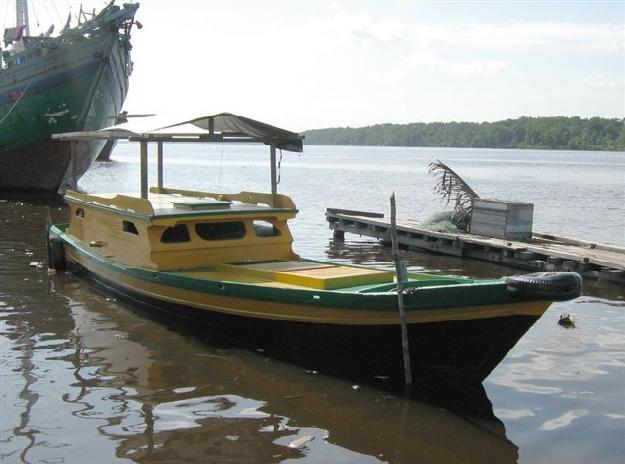
Once again, I find myself in the unenviable position of having to apologise for the long silence.  I know I have neglected to keep you up to date with all that is going on in orangutan-land.  If I have an excuse it is only that I have been struggling to keep up myself.  June has looked like this:  afloat_again.JPG

 (Supply boat after it was refloated, repaired and painted)

First week:  Five straight days in the field investigating a case of illegal farming inside the Lamandau Wildlife Reserve, which is when I managed to get Jak hopelessly lost (or vice-versa as I still maintain!) followed by a meeting with the mangers of one of the palm-oil plantations which border the Reserve.  After that, we continued onto Sukamara, the next district capital, where we are establishing an office. 

jak__illegalfarm.JPG

Second week: To Jakarta where Astri, I and representatives of seven other projects attended a coordination meeting with the European Commission Delegation prior to the opening of the Indonesia Environment Week exhibition.  If nothing else, the meeting made us proud our little project is holding its own at the sharp end.  I also met with the director of a company which conducts bio-carbon surveys.  Many people are talking about trying to protect forests through carbon-offsets, or Reduced Emissions through avoided Deforestation and Degradation (REDD) projects, but very little is actually happening on the ground. That is a ring into which we want to throw our hat – Belantikan is a stand-out candidate for protection.  For a taste of what this involves have a look at http://www.climate-standards.org/ and follow the links to “Climate, Community & Biodiversity Project Design Standards, Draft Second Edition”.  Finally, I met with the coordinators of the cross border, USAID funded project we are working on. 

Third week:  Should have been back in the office attending to paperwork, but it did not turn out that way!  Our supply boat was battered in heavy seas, made it to the Buluh Besar guard post then promptly sank.  Our supervisor, Teguh, was apologetic but he really needn’t have been: clearly not his fault.  I also went back to Lamandau to check on progress at the new release camp which the volunteers are building.  Then, last weekend, I went up to Pondok Ambung to have a few days with the crocodile researcher.

kelotok_sunk.JPG

In between there was the usual mix of staff management issues (how do you budget for out-of-the-blue double digit inflation?); an audit; a volunteer with a horribly infected leg derived from over-zealous scratching of mosquito bites and my Indonesian counter-part saying he can’t continue to work in Borneo with his wife – who is expecting their first child – still in Java.  He has been like a second limb to me, and his departure is big blow.

volunteers_work.JPG   

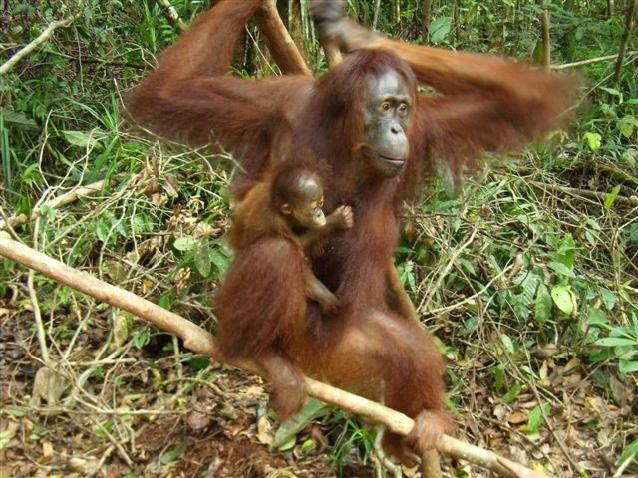
I am sure like many other people reading this blog, my problem is trying to juggle too many balls at the same time. A problem which is made worse by my being a mere male who is genetically incapable of multi-tasking!  The up-side, however, is that I did manage to sneak up to Camp Leakey to see Uning the daughter of one of my favourite orangutans, Unyuk.  Uning has just had her first baby.  It was great to see them.

uning_01.JPG

uning_02.JPG

Many thanks,

Orangutan Foundation

Thank you!

Stephen is currently in Jakarta so a quick post on his behalf. We have just received our donation's report for the second half of May and we are extremely grateful to following people who have donated towards the Orangutan Care Centre's enclosure repairs; Paula B $200, Maciej G $100, Sheryl B $25 and Hilary B $300. In total we have raised $2,375 which means we are only $625 off our $3,000 target. Thank you to everyone who has supported us with this appeal.

For those of you in the UK you might be interested to know the Foundation are holding a Supporters' and Members' Evening on Wednesday 2nd July, at Asia House in London. Stephen, who will be back in the UK, and Ashley Leiman, Director and Founder of the Orangutan Foundation, will be giving a presentation about the Foundation's projects, achievements and challenges. Please visit our website for more details.

Many thanks,

Cathy, Orangutan Foundation.

An evening walk in Lamandau Wildlife Reserve

“Hey Jak” I called over my shoulder “Are you following me or the path?”. “Following you” Jak replied.

Not good.

I wasn’t leading; I was merely walking in front. For the last 100 odd metres I’d become increasingly convinced we’d left the path and were following a pig’s trail through the forest. It was 5pm. It would be dark in an hour. We were both soaked to the skin and had been walking in ankle deep water for the last twenty minutes, as a result of the afternoon downpour. And a 100 metres may not sound much but given I wasn’t sure of the exact distance our chances of back-tracking weren’t promising.

I remembered there was a tree with unusually large leaves where the proper trail re-entered the forest after crossing the open bit where we were now standing. Jak’s face was a picture when I said “look for a tree with big leaves”. In a forest, right… good idea.

Example of forest

(Example of the forest terrain, without the water!)

Still, I had my revenge. Jak got out his GPS which told us accurately where we were on the earth’s surface and it even told us it was only 2.9km to the guard post. Did it, however, tell us where the path was? The path that would enable us to get through the forest and to the post before nightfall? The path that I had been unable to follow in daylight let alone pitch blackness?

I wanted to turn east along the forest edge, Jak opted for north-west. As I had got us into this mess I decided not to argue and to follow him. Of course, he was right. Consequently, I was secretly delighted when he failed to notice the tree with big leaves and I could call out “here it is” as we crossed the right track.

That was Tuesday evening. We were in the field until Friday…last week was a long one!

Non-timber Forest Products

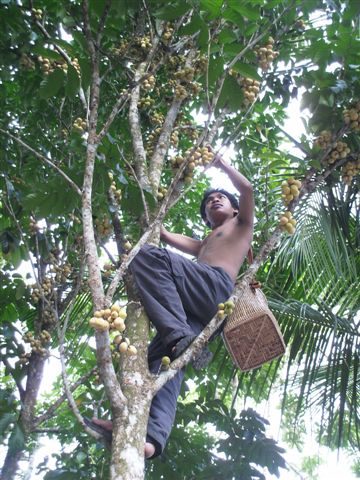
This morning we attended a meeting organised by the local forestry department. They are creating “An Inventory of the Potential for Non-timber Forest Products” in the local government district. Non-timber forest products, or NTFP, as they are referred to in conservation jargon, are an often used argument for the protection of forests. Local people for millennia have exploited NTFP and although their impact on the local environment and wildlife may be debated, in comparison to bulldozers their impact on the forests was negligible. Therefore, we consider NTFP a valuable tool in protecting the forests and we are pleased that the local government is taking this initiative (see the photos below showing various examples of NTFPs).

fruit picking

Fruit picking

making baskets

Making rattan baskets

Baskets

Rattan Baskets

Rattan craft wear

Other craft products

This week I’ll have my own opportunity to assess the sustainability of NTFP. I’m off into the Lamandau Wildlife Reserve until Friday. A pleasant round of investigating reports of farming inside the reserve, plantation expansion on its border, and an assessment of activities on the western edge. Hopefully, I’ll see an orangutan or two.

I’ll write again when I get back on Friday or Saturday.

A very rare crocodile

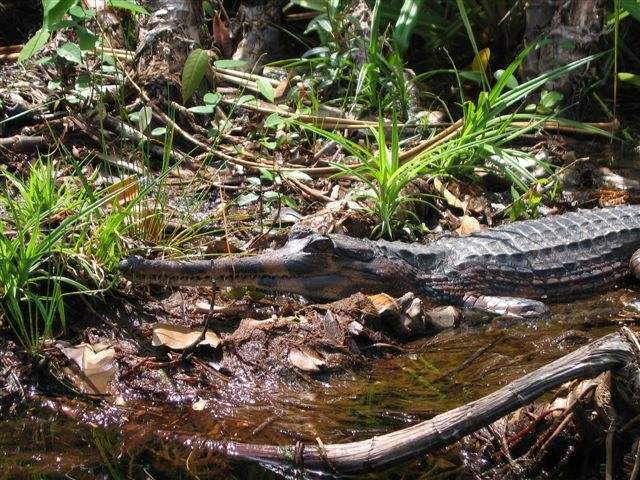
Compared with the week before, when I spent four days out of six in the field, this week seems to have been very office bound with only one visit to the Orangutan Care Centre. I guess that is what happens as audit-time approaches. One exciting thing did happened. Rene Bonke, a German PhD student arrived to begin research into the ecology of the Malaysian False Gharial (Tomistoma schlegelii), one of the world’s rarest crocodiles. Tomistoma.jpg

Malaysian False Gharial (Tomistoma schlegelii)

Rene will be spending the next three months at Pondok Ambung Research Station in Tanjung Puting National Park (TPNP). Earlier studies, on which we also collaborated, found “the highest ever recorded density of wild Tomistoma” on the river system leading to Pondok Ambung and Camp Leakey.

Tomistoma are easily distinguished from the other species of crocodile found locally, the saltwater or estuarine crocodile (Crocodylus porosus).

Saltwater Crocodile

Saltwater Crocodile 2

Top photo large Tomistoma on Sekonyer and one below saltwater crocodile (Crocodylus porosus) - not so sweet!

Tomistoma, like the true gharial of India, have slender snouts which are an adaptation for catching fish, their main prey. Tomistoma can reach lengths of over 5 m. Individuals of that size are rarely seen, but we know of a very large one on the Sekonyer River.

Tomistoma 2.jpg

One of the residents in the Sekonyer River, TPNP

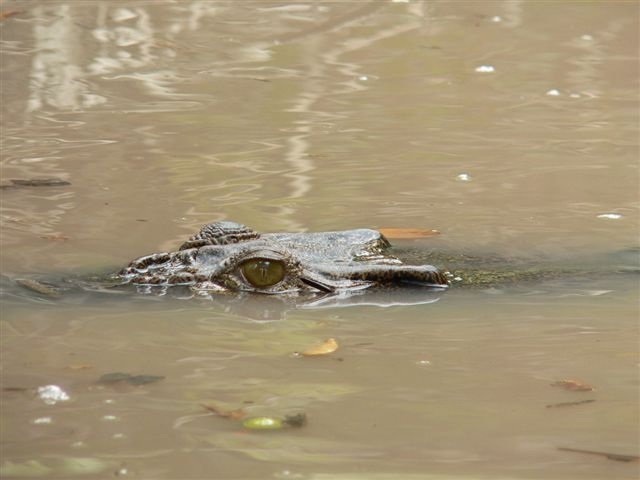
Tomistoma have never been known to attack people, though they have been recorded catching swimming monkeys. By comparison, saltwater crocodiles can be aggressive and extremely dangerous. Unfortunately one actually took a tourist in 2002. As the sign at Pondok Ambung says “There is a reason why crocodile researchers come here: No Swimming!”

Tomistoma_MarkAuliya_

Tomistoma - Photo by Mark Auliya

Sheryl, thank you for your offer of a donation. I read your blog on your visit to the Centre for Great Apes. I hope you are not too offended by chimps spitting because orangutans do it too. And they blow raspberries…

For more information Tomistoma Task Force

Enclosure repaired but more work needed

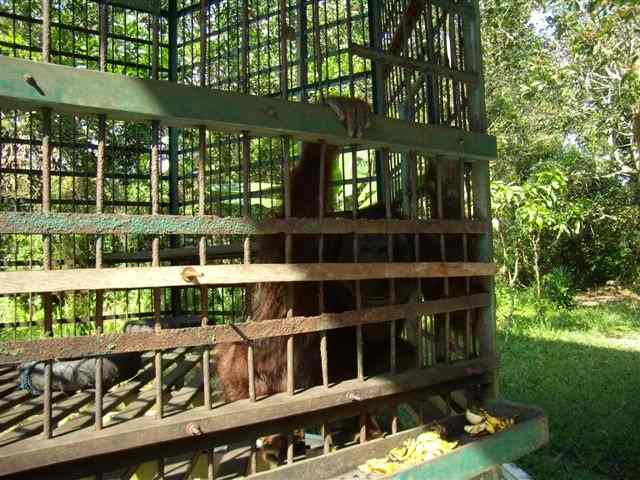
Once again, thank you very much to everyone who donated to our request for funds to repair the orangutan enclosures at the Orangutan Care Centre & Quarantine. I was there today and can happily report the first round of repairs has been completed and the escapees are now back in their secure enclosure. Repaired cage

The repaired cage is the one in the middle.

Repaired cage -occupants

And these are the occupants.

Repaired cage -occupant

This photo was taken one second before he made a grab for the camera!

Unfortunately, there is still more to be done. Montana’s cage is getting thin and the youngsters on the other tower keep trying to pop out. May I ask again for your support? We guarantee all money raised will be spent on fixing the enclosures.

Cage in need of repair

The youngster's enclosure - rusting bars.

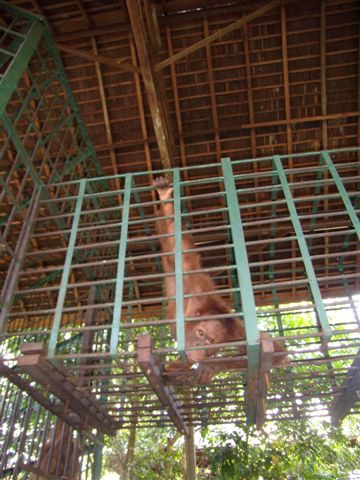
Upside down!

It is strange to have an orangutan hanging upside down looking directly at you!

Montana May08

Montana’s cage (above and below)

Montana May08 -how long will these bars hold?

How long will these bars hold?

And a final photo included for no other reason than I thought this orangutan simply had the sweetest face. Your thoughts?

Sweet

Sowing the seeds…

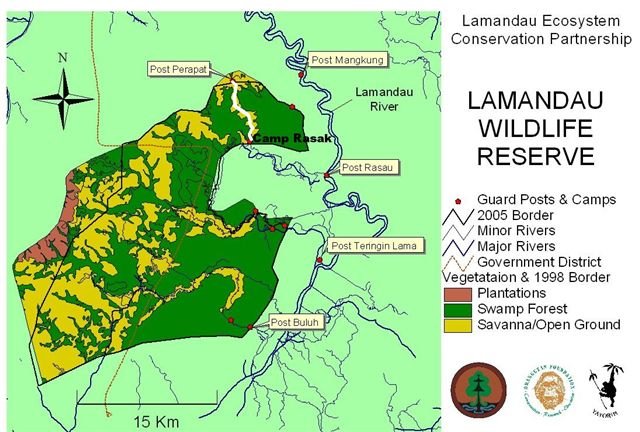
My every sense says the forests on the northern border of the Lamandau Wildlife Reserve are in trouble. Already split into thin fingers of forest, separated by degraded areas, it seems these forests are retreating not expanding. However, with the support of local communities, we have chosen this area as a reforestation site. A few days ago I went there with Rene Dommain, the visiting German peat researcher, and we stayed at the very northern point of the Reserve, where we have a guard post, Post Prapat (see map).

Map Lamandau

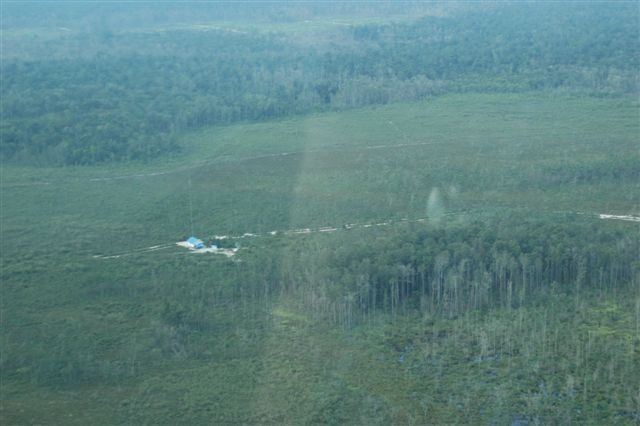
Behind the post is one of the fingers of forest. Here there are tall trees, including those species found in deep forest, but they are only 20 metres away from sand. Clearly this is remnant primary forest and the thinner it gets, the more vulnerable it becomes.

Ariel view

Aerial view of Post Prapat with the remnant forest behind.

Rene helped to explain the process and no surprises here – the villain was fire. Whilst he described it as an “anthropogenic impact”, you and I can hear “man made”. The southern part of Borneo is a relatively “young” landscape. The base material is sand, deposited either from erosion of the high interior mountains or during the periods when the area was an ancestral seabed. Over thousands of years, grasses, shrubs, and then trees gradually covered the sand and forests grew.

Fires have had a major impact on this ecosystem. The first fires burning through the shallow humus layer, killing the trees’ roots. With the trees fallen the next fires to occur were even more destructive with subsequent fires encouraging scrub growth. Ultimately this left an exposed layer of sand with the original nutrient rich humus having been destroyed. Presently, these remaining forests are just waiting for the next dry year, the next fire.

The aim of the reforestation programme is not ambitious – even in our wildest dreams we cannot envisage the day when this will be thick forest. What we are trying to do is broaden the forested fingers, reduce the gaps and push the balance in favour of the trees not the scrub.

It is a tall order to regenerate this area, but you know us, we like a challenge!

We have established a tree nursery at Post Prapat. The people from the surrounding communities have been enthusiastic in finding wildings (seedlings harvested from wild seed-fall) to stock it. We will keep the trees in the nursery until their rooting systems are well established.

Nursery

Nursery

The whole process is hugely resource-intensive and the return may be as little as 50ha (1/2 km2 or 123 acres). But that is hardly the point. The real points are:

  • People learn about how fragile these ecosystems are.
  • We are demonstrating that protecting the existing forest is much more effective than trying to re-grow it
  • By protecting the fragile fringes, you prevent damage spreading to the core

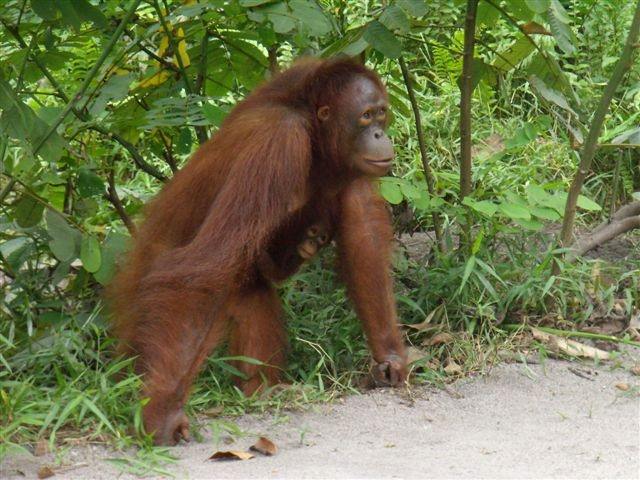
In the case of Lamandau, the forest core is still rich in biodiversity. I led Rene on the 7 km walk southwards from Post Prapat to Camp Rasak. On the way, we saw a few birds and a snake. At Camp Rasak, I was hoping to catch of glimpse of Boni who we are told is seen most days and neither did we see Andi and Sawit, who seem to have gone off together (see post 'More orangutans back in the wild'). However we were fortunate to see Lady Di and her baby.

Lady Di and infant

Lady Di and infant 2

Lady Di and infant 3

Lady Di was released into Lamandau in Febuary 2006 and this is her first baby.

It is hard to believe our reforestation programme site is only 7 km away, but without this added protection, this forest and these orangutans would seem a lot more vulnerable.

- PS, Sheryl, you’ll be pleased to know once the eagle, snake and monkeys were out of the traps, I also set the fish free :-)

We are participating in WildlifeDirect's business strategy. Please help us by taking this user survey, thank you.

WD user survey

Thank you!

Wow - We have just received our donations report from 1st -12th May and we are delighted with the response to our Orangutan Enclosure Appeal to raise $3000. Thank you very much to the following people; Nancy M $50, Brigitta S $50, Cathy R $250, Anonymous $100, Derek F $200.00, Anonymous $1000, James G $100, for your most generous donations. We're almost two thirds of the way there!

Trapped Wildlife

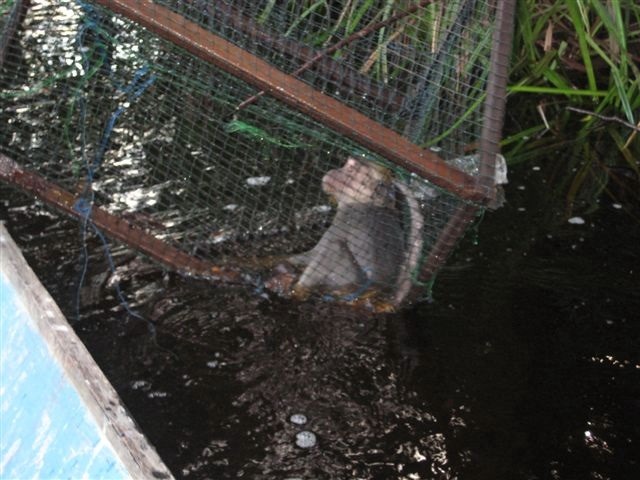
Releasing caged wildlife is rarely anyone’s idea of fun. Panic-stricken animals tend to lash out and they don’t have claws, teeth and talons for nothing. Which is why, yesterday, finding an eagle, a snake and two macaques caught in fish traps provided a challenging finish to the day. As always, I must apologise for the photos; but this time we did have a good excuse; we were all a bit too busy to take photos. So, thank you Rene (a peat forest researcher) for taking the ones below. The fish traps were made of a wooden frame wrapped in netting with an inverted slit through which fish can enter but can not escape. Because the water level in the Mangkung River, the Lamandau Wildlife Reserve, has dropped so much the traps were exposed and the fish inside had obviously tempted the monkeys and the crested-serpent eagle in for an easy meal. Certainly, I have never seen animals caught in them before.

Jak, the Lamandau Patrol Manager and I tackled the eagle first, only to find there was a small python in the trap as well. I was certain that as we cut away the netting the eagle would either peck or slash with its talons, which were wrapped in the netting. Amazingly, once the roof was cut away the bird freed its feet and flew out right in front of our faces, without scratching either of us.

Trapped Eagle

Crested serpent-eagle caught in a fish trap (photo by Rene Dommain).

The python was half way through the netting but having gorged on the trapped fish had a bulge three quarters of the way down its body, which would not fit through the mesh. Jak was all for leaving it and I have to say as its head twisted around I thought he had a point. However, as it was, the snake would be a sitting target for the next eagle to come along. So trying to keep the sharp edge away from its skin, I slid my knife in between the snake and the netting and cut it free. Great, we were now in the water with a python and neither of us wanted to think about crocodiles!
Trapped juvenile macaque

Juvenile macaque caught in a fish trap - once freed he swam away (photo by Rene Dommain).

The macaques were about 100m downstream. In one trap there was a juvenile and on the opposite riverbank, an adult female, thrashing around madly. We were able to free the youngster and I swam over to cut out the female. Again, having some experience of macaques, I thought as soon as the top was open she would come flying out and bite. My dulcet tones did nothing to calm her and, as I cut away each side, she would retreat into the opposite corner ensuring she was always under netting until the whole top was cut off. Only then did she come out.

It was obviously our lucky day for instead of flying out as predicted she actually dove down and swam away under the water. We saw her pop up and climb out, maybe, 15m away.

Four animals released without injury to either them or us. Not bad. Then I scrapped all the skin off my shin climbing back into the boat!

Nancy M., thank you very much for your donation of $50, that you made at the end of April, your support is much appreciated.

"We are participating in WildlifeDirect's business strategy. Please help us by taking this user survey, thank you"

WD user survey

Feeding orangutans - a new approach

“Why do you do it like that?” “That’s the way it has always been done.”

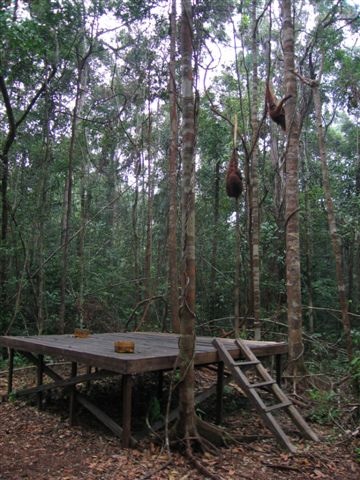
One of the standards in orangutan rehabilitation is released orangutans are fed on a platform.

Pondok Tanggui -feeding platfrom

Feeding platform

Old feeding platform

Photos showing the feeding platforms that have always been used.

Everyone does it; as do we. But then we got to thinking there has to be a better way. Wild orangutans, especially in Borneo, rarely if ever, feed in groups. So why should ex-captives?

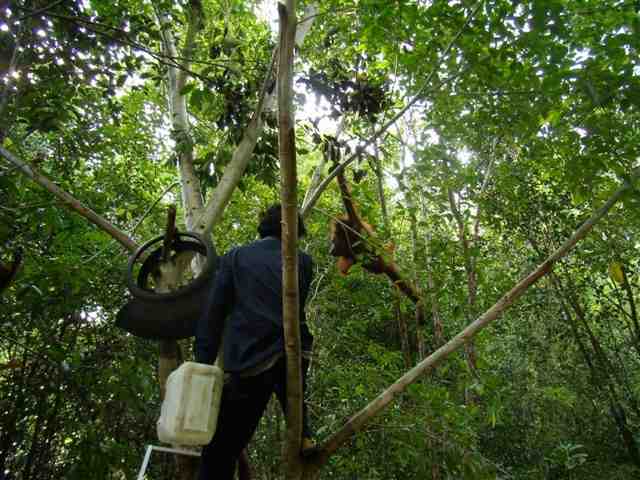
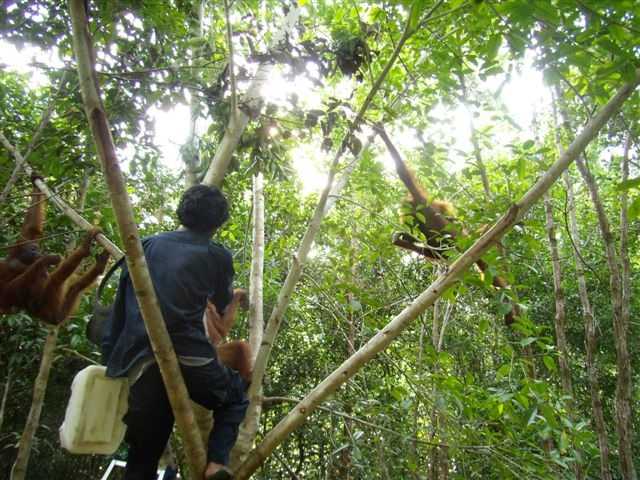
Without the platform though, how do you feed them? By hand is not an option. So we thought “put a bucket on a tree”. No, the orangutans will destroy a bucket in seconds. OK, use a cooking pot. Imagine the noise they would make banging that around, plus they will rip it off the tree! Alright then, use an inside out car tyre as a bucket. Fine, but how are you going to attach it; we don’t want to bore into the tree? Here’s an idea, when you cut off the side walls to invert the tyre, use the off-cuts as straps to hold the tyre against the tree.

New Feeding 2

Old tyres- they have many uses, if not for fire beaters then as a feeding bucket

So we’re settled: the food goes in the car tyre strapped to the tree. But how do you give them their milk (which many love more than fruit)? Cups – they’ll break, be lost and will become litter. Water bottles – even worse. Let’s try coconuts. Cut the top off, pour the milk in, put the coconut in the tyre; if the orangutans drop it, it will be easy to find and even if we don’t it is hardly litter.

All good then - let’s try it.

New feeding 1

Its a good job our assistants are tree climbers too!

New feeding 3

New Feeding 4

The feeding system has been running in Camp Siswoyo for a month now. It is not perfect. More than one orangutan may descend on each tyre. Some still walk on the ground between the feeding trees. We are buying an awful lot of coconuts – the orangutans drink the milk then eat the nut! It is more work on the staff and they have to be quick to get the food out.

New Feeding 5

But is it better than the platforms? Oh yes. You can ensure a fairer distribution of food. It lessens competition, facilitates giving medication when necessary and it keeps the orangutans feeding in the trees.

New feeding 6 -mother & infant

The system needs to be tweaked, but as a first attempt at a new idea we are all delighted with the result. And here’s where I have to add a thank you not only to Tigor and his staff for their enthusiasm to give it a go, but also to Jodie and Peter: the endless night’s talking about how we could make individual feedings work were worth it!

"We are participating in WildlifeDirect's business strategy. Please help us by taking this user survey,

thank you"

WD user survey

The Gibbon’s Gone

I felt really good about what we achieved today. Early, last week, an agile gibbon (Hylobates agilis) was delivered to the Orangutan Care Centre & Quarantine (OCCQ). Gibbon OCCQ 1

The gibbon

The story went he did not “belong” to the man who brought him to the Centre. Rather the man had caught the gibbon after it had escaped from a neighbour’s house. Maybe, maybe not. However, at least the man was giving the gibbon up so we could not be too angry. But, with over three hundred orangutans in captivity, plus a sun bear, we really don’t need another mouth to feed.

Gibbons in the wild

As gibbons should be!

Especially not a gibbon. They are fascinating creatures but require specialist management. Gibbons mate for life and fiercely defend their territories. They swing through trees with amazing ease but that does mean their enclosures should ideally be very high and long so they have room to move. None of this suits the set up at the OCCQ.

So we called up Kalaweit, a gibbon rehabilitation project near the provincial capital, Palangka Raya (www.kalaweitfm.com/kalaweituk.htm) . They would happily take our new arrival. The Head of the local Forestry Department’s Agency for the Conservation of Natural Resources, under whose jurisdiction we operate, offered the loan of his vehicle and prepared the necessary paper work. This morning, the gibbon set off to begin what will hopefully be the final stage in his journey from captivity to the forest.

Gibbon OCCQ 2

Gibbon OCCQ 3

Hopefully the final stage in this gibbon's journey back to wild.

It will cost us $150 in fuel, a night’s hotel accommodation for the drivers, and a donation towards the gibbon’s necessary medical checks. In return we have supported the Forestry Department in achieving their mission, maintained positive cooperation with another wildlife NGO and, most importantly, done the right thing.

Gibbons don’t belong in cages. We can not set him free but Kalaweit can.

"We are participating in WildlifeDirect's business strategy. Please help us by taking this user survey, thank you"

WD user survey

Palm oil, People, Bears and Banteng!

Dear All A few quick replies before the weekend to comments received during the week.

Firstly, the thorny issue of “sustainable palm oil”. Cathy, at the Foundation office in London writes:

“So far there is no sustainable palm oil from Indonesia or Malaysia. The Roundtable on Sustainable Palm Oil (RSPO) has said they hope to have some sustainable palm oil on the market at the end of this year. As far as we are aware most products that are "palm oil safe" or "Orangutan Friendly" are products that actively avoid palm oil. For example, the companies Paterson Arran and Little Satsuma, both supporters of the Foundation, avoid or have stopped using palm oil because of its associated problems. They are not products that “contain sustainable palm oil’, rather they are palm-oil free. However, there is palm oil that has been certified organic and is apparently grown in a sustainable way from Columbia.

It is probably worth asking companies, that declare their palm oil is sustainable or "Orangutan Safe", where it is sourced.”

Chris asked about the attitudes of local people. It is a huge question that most conservation organisations must deal with. What is clear, in order to be successful, you have to have the local people on your side. The reality is people will generally be motivated by self-interest. Employment is one way of marrying our and local people’s interests and has the added benefit of, over time, generating a heartfelt commitment to conservation. Many, if not all, of our staff have internalised respect for the forest and being “Orangutan Foundation” is part of their identity.

Mutual attachment

Mutual attachment 2

Mutual attachment!

It also has a trickle-down effect that spreads to their families and outwards to the communities in which they live. It is much harder for someone to take up illegal logging when they know their next-door neighbour will be out patrolling against them. In my blog I have also mentioned our programmes in Lamandau and Belantikan. Here we are actively working alongside local village communities to create and generate alternative and sustainable ways of earning an income from the forests.

You were all way too kind about my sun bear photos. Have you seen on Wildlife Direct there is actually a new blog about sun bears http://sunbears.wildlifedirect.org/ This group is based in Sabah, Malaysian Borneo.

Also in the week there were a few comments about Banteng. One of the little known facts about Banteng is that the largest population anywhere in the world is in Northern Australia, where they were introduced over a hundred and fifty years ago.

Lastly, thank you very much to the person who made an anonymous donation last week – your support of our work is much appreciated.

Have a good weekend.

Morning at the Orangutan Care Centre

As promised, I went to the Care Centre this morning to check on progress with the cage repairs. As requested, I also gave Montana “a nod”, as well as a bunch of flowers which he devoured. To be honest, I think he was more interested in watching the workman than in eating. His neighbours, however, were watching the flowers greedily. Montana May08

Montana

neighbours

Montana's neighbours

Thank you so much for everyone who donated to the repairs. The welding has been completed. The metal work is now being painted with rust proof paint which will then be covered with the standard green paint used at the Care Centre.

Cgae repairs 1

Cage Repairs 2

Cage Repairs 3

Repairs 4

Sleeping shelves and tyres will then be fitted. After which, all that remains to happen is to fill it with orangutans. And that should not be difficult. The escapees are crowded into one cage just down the line from Montana. We are hoping that once their enclosure is fixed, we’ll be able to repair the one they are now in.

Escapees’

The Escapees

It was good being at the Care Centre in the morning, as I could see the orangutans being taken out for their day’s exercise in the forest. As always, it was amazing to watch Mr. Laju, one of our blind assistants, leading the orangutans out. Mr Laju went blind later in life but he can still follow the forest paths and board walks into the surrounding forest, and when I say board walk I mean a single plank pathway!

Mr Laju

Mr Laju

The other incredible thing is the orangutans never mess him around. If you and I tried to take them out, I guarantee they would be scrambling up the surrounding bushes, dashing off here and there. Mr Laju does ties a piece of string around their arms but that can’t be the secret. Any self respecting orangutan could pull away from that, if they wanted to. Clearly, they don’t.

Also at the Care Centre at the moment is a female sun bear. I did take a couple of photos but, even by my low standards, they were only fit for the recycle bin! Of course, I have excuses: the bear’s enclosure is very dark; it would not stop moving around; there are too many branches in the enclosure - that's my excuse.

Sunbear 1

Sunbear head shot

Sunbear

There is also a gibbon newly arrived at the Centre which we’ll arrange to have sent to Kalaweit, a specialist gibbon rehabilitation centre, in the next few days. We have our hands full with orangutans, without adding gibbons into the mix.

Again, many thanks.

Endangered Species Confirmed!

Very exciting news just in from our partner organistation, Yayorin about banteng (wild cattle) being found in Belantikan. Please see the press release below. How the banteng were found also highlights the work needed to be done to save this species. This news comes just after my last few posts about orangutans and is another example of why protecting orangutan habitat is important to all biodiversity, especially those that are threatened. PRESS RELEASE

For Immediate Release

Endangered Animals found in Central Kalimantan

Biodiversity research in the Belantikan Hulu ecosystem of Central Kalimantan (Indonesian Borneo) was started in 2003 by Yayorin (Yayasan Orangutan Indonesia). Other than a large population of orangutan, the research also gathered some information on the existence of the endangered banteng or wild cattle (Bos javanicus) from the local people who live in the research area. This information was valuable because it is believed that banteng distribution in Kalimantan is becoming more and more limited and largely unknown.

Banteng

Banteng confirmed in Belantikan

In 2005, Yayorin conducted further research and was able to gather more information and data. According to the local people, banteng were often seen in sopanan or saltlick areas, saltwater sources where animals go to drink and to get the mineral they need. Although the team found their tracks and faeces many times in these saltlick areas, they were not completely convinced of these findings because it was possible that they belonged to cows that were common in Belantikan.

On November 20th, 2007, Yayorin team conducted yet another survey on Bukit Durian area of Kahingai Village. There they encountered a surprising find: two well-preserved banteng tracks; one was about 12 cm x 11,5 cm and another one was about 14 cm x 13 cm. According to their sizes, it was believed that those tracks belonged to one male and one female banteng. In addition, the tracks were also found in a habitat dominated by bamboo trees.

On April 11th, 2008, two local people went hunting using dogs and spears. On their way, their dogs found two banteng (mother and child). They then killed the mother using spears, while captured the baby and took it to the village. The location where these banteng were captured was around Tungkapan River, Belantikan Raya District, Lamandau Regency. Moreover, according to some local people who go into the forest to hunt pigs, they also encountered more than ten bantengs between January and February 2008.

All stakeholders need give their serious attention to this matter and do concrete actions to preserve the existence of these endangered banteng in Belantikan area. The last thing we all want to happen is to see these wonderful and beautiful animals extinct in the wild.

FACTS ABOUT BANTENG (bos javanicus)

Status: Endangered

Population: 3,000 – 5,000

Distribution: India, Bangladesh, Brunei Darussalam,Kamboja, Thailand, Laos, Myanmar, Vietnam, Malaysia, Indonesia (Java, Bali, Kalimantan)

Threats: Hunting and habitat loss and/or degradation (agriculture, plantation, forestry, housing)

For more information:

Togu Simorangkir – Chairman of Yayorin Email: togu@yayorin.org

Yayorin (Yayasan Orangutan Indonesia) Jl. Bhayangkara Km.1 Pangkalan Bun, 74112 Kalimantan Tengah Telp. (0532) 29057 Fax (0532) 29081 Email: info@yayorin.org Website: www.yayorin.org

Palm Oil - what’s the cost?

Nancy, Cathy and Theresa, thank you very much for your donations. So far on Wildlife Direct when we have asked for your support we have always received a positive response. This is really, really appreciated. The rebuild of the “escapees'” enclosure is progressing well with one whole side already chopped away (of course, I forgot to take my camera some photos soon I promise). Brigitta delighted to know everything is all set for your trip. I will actually be in Tanjung Puting on the 9th so it is probably best if we make a date for the 10th. If you tell your boat driver to stop at Pondok Ambung I’ll meet you there. If for any reason, I have had to go on ahead to Camp Leakey just ask around and someone will point me out. I quite like the idea of videoed questions and videoed answers. I hope it works!

Now onto more serious matters, I am surprised my last post, ‘Small feel of freedom’, was considered light-hearted. I admit the story of a bunch of adolescent orangutans running amok makes me smile, but the story of yet another orphan breaks my heart. And it breaks my heart that he came from a village we know, but outside of our project area. Why can’t we work everywhere?

Late last night, Bhayu (Foundation’s Project Co-ordinator) and Teguh (The Guard Post Supervisor) got back from a trip to the Buluh Kecil and Buluh Besar Rivers in Tanjung Puting National Park, where they had accompanied a German scientist interested in studying TPNP’s peat forests. In one stretch of river, heading upstream from the Buluh Kecil post, they saw a phenomenal 26 wild orangutans.

Orangutan at river’s edge

You can just make out an orangutan in the middle of the trees.

Admittedly, ketiau trees were in fruit, which had drawn the wildlife in, but still that number of orangutans in a journey of, at most, 10km is extraordinary. Two cheek padded males were happily eating less than 200m apart. Clearly, not a lot of competition there. Next, on the Buluh Besar River, our guys encountered a huge colony of fruit bats or flying foxes (Pteropus vampyrus). Flying foxes have a wingspan of up to 1.5m (4’) and have been described as “resembling a small eagle in flight.” According to Bhayu, this colony (or camp as they are technically called) numbered well into the 1,000’s yet elsewhere in Central Kalimantan they are, or already have been, hunted to virtual extinction.

Today, I was told a story by an old friend and colleague, Fajar who does most of his work on the east side of Tanjung Puting. We are helping his team build a guard post there or, more accurately, relocate a guard post because the current site is about to be converted to a palm oil plantation. Fajar and his team were looking for a site for the new post. They went up the Baung River on day one and came back three days later. On the way up, they passed a stand of trees with long-tailed macaques and birds in it. When they came back, all the trees were gone.

Bulldozer TPNP

Deforestation happens that quickly. And it is very, very real.

Fajar GPS

Fajar taking GPS reading of an oil palm plantation's boundary.

The photo shows Fajar taking a GPS reading in front of one of the plantation’s approved markers. It is a line of trees, like the one in the background, which has now been flattened. If you look at the map (sorry it is in Indonesian) you can see Pos Baung, the post we want to move and why. Amazingly, the company (P.T.) KUCC has already exceeded its designated area, planting out in P.T. Giat’s concession.

Map - oil palm plantations East TPNP

That is a border conflict that we find amusing, but cynical me thinks it will turn out that P.T. KUCC and PT Giat will have the same holding company which means it will make no difference to anyone at the end of the day. It certainly won’t change the fact that the forest, and its wildlife, will be gone.

On the news I heard an announcement that Unilever has promised to only use “sustainable palm-oil” by the year’s end, despite their being no suitable palm oil yet on the market. Greenpeace replied “good, but what is needed immediately is a moratorium of forest clearance”. I am pleased with Unilever’s announcement – they do have the clout to drive change (and it's consumers who have brought this about), but I agree with Greenpeace. This forest clearance has to stop.

Read about Unilever's announcement in the Jakarta Post

Small feel of freedom

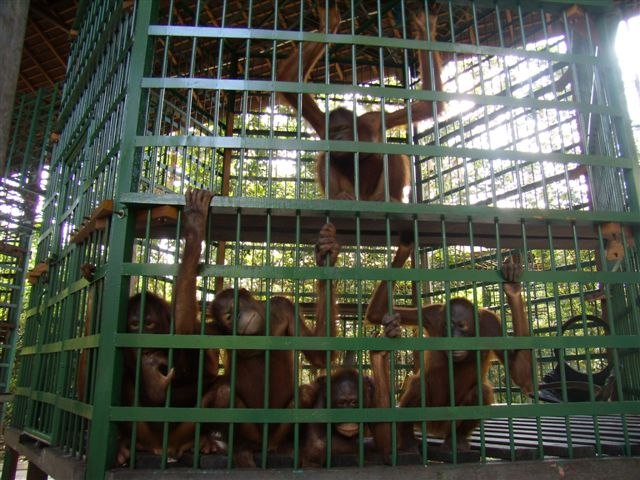
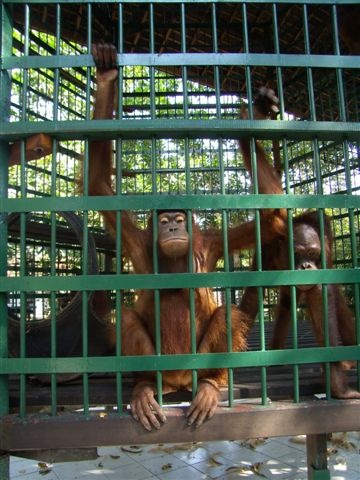
I had a great weekend but the home-coming was a little rough. As we have said, the orangutans at the Orangutan Care Centre & Quarantine (OCCQ) are let out to play and learn in the forest. That is good. When the orangutans let themselves out, that's a problem! On Monday eight of the little, "less-than-adorable" orange bundles of mischief took it upon themselves to demonstrate just how rusty their enclosure had become. They popped out its side. Three were obviously a bit shocked at their new found freedom and contented themselves climbing up the outside. One went straight for the food room while the others dispersed themselves around the adjacent cages and our guess is they wanted to find the girls.

All of which would be an amusing anecdote if weren’t for the fact that their enclosure really is beyond repair. For a long time we have actually being patching up earlier repairs but that is getting ridiculous. It is time for a rebuild. And, as the staff are quick to point out, there is another cage in almost the same state.

Cage that has broken

Photo of the enclosure (middle one) that has now broken.

Rusting cages

Rusting bars

I am writing in the hope you will consider donating towards the cost of the repairs. A rebuild will cost 13,000,000 Rupiah (approximately $1,410/£714 each). The Foundation has found the money for the first - just so we can minimise the over-crowding that would be caused by moving the eight escapees to other already occupied spaces. At this stage, we have no budget allocation for the extra repairs. We are hoping to raise $3000. This will cover the cage repairs and money remaining from your donations will go towards building temporary holding cages in Lamandau, our orangutan release site. Your support, helping us to reach this target, will be most appreciated.

To put the “happy” story of the breakout into context, that same afternoon we received a tiny infant orangutan, probably around 9 months old. It is rumoured that his mother had been shot and eaten (a practice still carried out by some remote Dayak tribes), he was being kept tied up in a house. The village he came from is at the very southern edge of the Belantikan region but is in the same logging concession in which the Foundation/Yayorin's, Belantikan Conservation Programme (BCP), work. The orphan was found by a couple of logging operation supervisors who took him from the house and gave him to Iman, head of the BCP team. Iman immediately set off on the seven hour drive back to the OCCQ.

Abraham -infant

I am sorry I did not have my camera with me on Monday - this is an orphan we received sometime ago called Abraham. Helpless doesn't quite capture it, does it?

That orphan will almost certainly have to remain in captivity for four years. And he is only one of the thirty or more orphans we are likely to receive this year. I think there is no better testament to the work of Mr Sehat, Dr Popo and all the other staff at the OCCQ that they can nurture tiny, helpless, traumatized orphans into the boisterous youngsters who then break out. The number of orphans we take in and the length of time rehabilitation takes also explain the wear and tear on the cages.

A final word, to end on a positive note, what made my weekend so good: I went to Camp Leakey, the old orangutan release site. Seeing the orangutans which have been successfully rehabilitated, climbing free in the trees (see photos below) reminds you that there can be a happy outcome to such tragic beginnings.

Apologies for my awful photography.

SB Camp Leakey 4/08

SB 2 Camp Leakey 4/08

SB 3 Camp Leakey 4/08

Volunteering

Stephen has been in Tanjung Puting National Park over the weekend visiting Pondok Ambung Research Station and Camp Leakey so we can look forward to hearing some interesting stories on his return! I have been reading through the past comments and noticed there are a few about volunteering or working with orangutans that haven't had a response. The Orangutan Foundation run a Volunteer Programme which is based in and around TPNP and the Lamandau Wildlife Reserve - click on the the Volunteer Programme category to read about it in this blog. Anyone interested in volunteering or supporting our work by joining one of the trips (Study Tours, Photographic Trip) that the Foundation runs should visit our website (link on the sidebar) or contact the UK office (info@orangutan.org.uk).

On behalf of the UK office thank you for your interest and support,

Cathy

Orangutan Foundation

Part 3: Protectors of the rainforest ecosystem

In my last few posts I have been explaining about orangutans and why they are dependent on the forests for their survival. However, the forests also need orangutans. I have mentioned that orangutans are primarily frugivorous and that they are experts at moving through the forest canopy. The combination of these factors makes the orangutan an excellent seed disperser. Also, because of their large size, orangutans are able to eat bigger-seeded fruit which other species in their ecosystem aren’t able to. Orangutans thus play a crucial role in propagating fruit trees.

As orangutans move through the canopy they will inevitably bend or break branches, opening up the forest canopy. This allows light to reach the forest floor thus helping seedlings to grow and the forest regenerate. Truly, orangutans are a vital cog in the working of the rainforest ecosystem.

SB Dense Jungle

The rainforest floor - seedlings compete for light and space

The interdependence between orangutans and the forest has huge implications for conservation. I think I have written before that Indonesia has the world's highest deforestation rate; it also has the world's highest number of threatened mammal species (146 species); is number two in the world for threatened bird species and remains high up there for the remaining taxonomic groups. To save the orangutan, you have to save the forest and when you save the forest you save everything else. (For better or worse, that includes spiders!)

An example closer to my heart is the proboscis monkey, which is only found on Borneo. Tanjung Puting National Park has one of the largest remaining populations. Why? Because of our orangutan conservation work. As an aside, proboscis monkeys are fascinating in their own right. The males have a spectacular nose! (see photo)

Dr Mark Fellows - Proboscis Monkey

Photo by Dr Mark Fellows - Male proboscis monkey (sorry the photo is so small)

Another special thing about the proboscis monkey is that they swim, a rare behaviour amongst primates. Proboscis monkeys actually have slightly webbed hands and feet and are able to swim underwater for about 20 metres.

Proboscis monkey swimming

Proboscis monkey swimming

Similarly, a study of the critically endangered Malaysian False Gharial, a type of crocodile, concluded “High observational records of Tomistoma at the main study site may represent the most viable and stable Tomistoma population of the entire National Park due to the conservation efforts of the Orangutan Foundation”.

False Gharial

False Gharial

There is a lot I haven’t mentioned and I could go on but I don’t want this to turn into a textbook. I find the science of conservation fascinating; indeed the Foundation always argues conservation has to be based on sound science. But, as the saying goes, science only informs. It is passion that persuades.

If you have any questions please feel free to ask.