Very quickly, if anyone would like to see Tanjung Puting National Park, one of the protected areas in which we work, then a short video clip has been released by a German film company who made a film about Tomistoma crocodiles last year. The narration is in German (which will probably be OK for our Swiss friends :-) and an English translation to follow shortly) but the pictures speak for themselves. Its shows orangutans, proboscis monkeys and Pondok Ambung Research Station.Here is the link: http://www.br-online.de/bayerisches-fernsehen/welt-der-tiere/sunda-gavial-krokodil-sumatra-ID1234357757657.xml
Kampung Konservasi February Blog - Garbage!
The smoke from garbage burning started to hurt our eyes...million of flies swarmed around us...and the unmistakable aroma of garbage welcomed us as we drove into this local waste collecting location. A trash-picker moved quickly passed us toward the incoming yellow garbage truck; he wanted to be the first to find anything inside that he could sell.

Burning garbage at Pasir Panjang waste collection centre.
Student participating in Yayorin's environmental extracurricular activity seemed a little bit bewildered this afternoon. The main subject of today’s discussion was garbage – its role on the environment, its problems and management. It was obvious that they had never seen as much garbage in their lives and probably felt quite overwhelmed by it.
Most of the students did not even know that such place exists in their city. Many could not even say where the garbage they produced at home or at school went to. In the beginning, they were not happy being ”dragged” into this disgusting place and could not stand the smell. With the passing of time, though, they started to understand why we brought them there and involved entusiastically in the learning process.
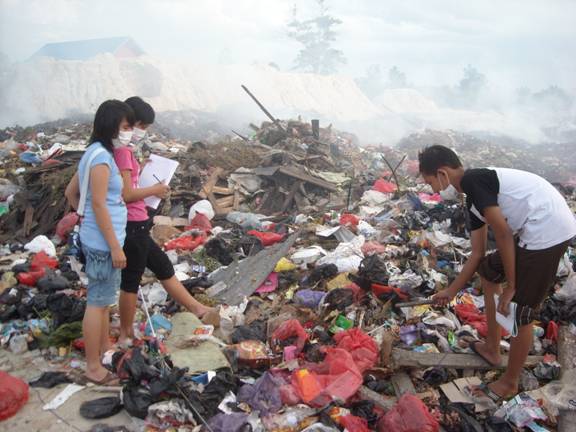
In this meeting we asked them to identify the types of garbage they could find in an area of 1m x 1m. They then had to identify which ones were organic and which were inorganic. They were also asked to pay attention to how the garbage was collected, transported and managed.

The Pasir Panjang Waste Collecting Location is the largest in this city and its surrounding areas. This is where all of the waste of the city finally goes to. Unfortunately, like most garbage collecting locations in Indonesia, the concept of garbage management is through burning. What was ironic was the big sign we saw there that clearly said "Do Not Burn the Garbage"!
The students had a tour around the Location. They found an abandoned composting house, filtering pond and a monitoring well. The well was located about 50 meters from the collection area, and the water inside was quite clean. It was supposed to mean that the soil water was in good condition.
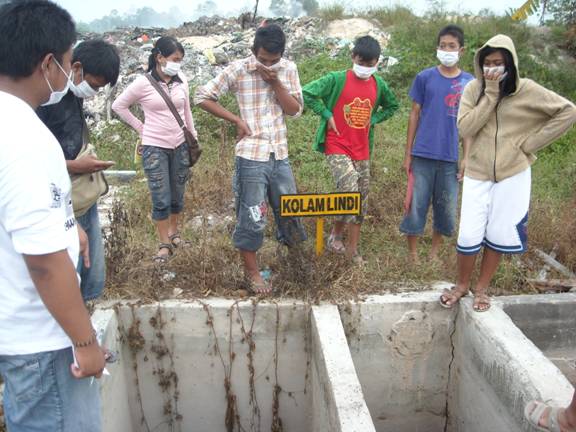
The students took home with them a valuable learning experience. We hope that now they realise where their garbage goes, and how the waste can put a really heavy burden on the environment. Next time they want to throw their garbage on the street or anywhere else inappropriate, we wish they will stop and remember their unique experience at the ”garbage place”.
Thanks,
Riyandoko and Sally (Yayasan Orangutan Indonesian www.yayorin.org)
Double Our Funds For Orangutans
To celebrate the 200th birthday of Charles Darwin, a philanthropist organisation, The Reed Foundation, has promised to double any donations made to five different wildlife charities through its charity website www.theBigGive.org.uk. The Orangutan Foundation is delighted to be one of the chosen charities and donations will go towards our project 'Protecting Orangutans and Rainforest Biodiversity Through Carbon Markets' in the Belantikan Arut region of Central Kalimantan. On Monday 23rd February at 10am The Big Give will start doubling donations of £5 or more and they will finish when £50,000 has been spent. Please be as generous as possible on the 23rd February, when every donation can go twice as far to achieve our aims in the Belantikan Arut region of Central Kalimantan
Put a note in your diary or an alert on your mobile and just before 10am have your bankcard at hand and simply visit www.thebiggive.co.uk. There will be a 'Darwin's Natural Selection' link in the matched funding area of the Big Give.
The money will be allocated on a first come, first served basis, so it is important that you make your donations as soon as possible after the launch of the scheme. The last time The Big Give ran a scheme of this nature, they gave away one million pounds in 45 minutes!
Thank you!!
The People Who Look After The Orangutans
Having told you about Zidane, I thought you might be interested to learn a little about the people who are looking after him day to day. He and twelve other orangutans live around Camp Buluh which is supported by the Australian Orangutan Project and is one of six orangutan release camps the Orangutan Foundation operates in the Lamandau Wildlife Reserve. Six people are employed there; five field assistants and a cook. Their daily duties at Camp include preparing food and feeding the orangutans twice a day, monitoring the orangutans, keeping records, clearing trails, clearing the river and other camp tasks. Camp Buluh, like all the other Camps, comprises a kitchen and dining hall, sleeping block and toilet/washroom. Unlike the other camps though, Camp Buluh is totally surrounded by swamps. There is no dry ground anywhere near by. This does make following the orangutans difficult and especially so last year when there was no noticeable dry-season. Water levels varied from knee to waist deep for most of the year!

The team at Camp Buluh
The Field Assistants generally spend 26 days at a time at Camp. Back in November (Bringing the office to our orangutan release camps) all the staff were enrolled in the Government's Health Insurance scheme which provides cover to both them and their families.
Huge thanks to the Camp Buluh team who do a fantastic job.
Zidane - Orangutan Back to the Forest
I am very pleased to be able to tell you that Zidane was re-release at Camp Buluh, in Lamandau Wildlife Reserve, on 19 January. His recovery is down to the excellent care (which included two blood transfusions) he received from the Orangutan Care Centre and Quarantine facility.
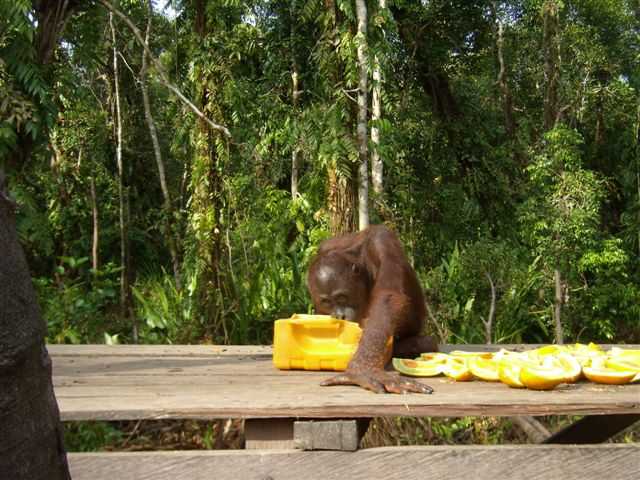
Zidane - male orangutan re-released into Lamandau
Though Zidane appears happy to be back in the forest, he is being monitored very closely as he is still perilously thin. We obviously want to do all in our power to ensure he spends the rest of his life in the forest and so our new vet, Dr Fikri, has been tasked to develop a special dietary regime for him to ensure he gains weight. We’ll keep you updated on his progress.
Indonesian Govt to allow peatland plantations
The article below appeared in the National section of the Jakarta Post on Friday 13th February and it causes great reason for concern. Govt to allow peatland plantations
Adianto P. Simamora , THE JAKARTA POST , JAKARTA | Fri, 02/13/2009 10:02 AM | National
The Agriculture Ministry will issue a decree to allow businesses to dig up the country’s millions of hectares of peatland for oil palm plantations.
Gatot Irianto, the ministry’s head of research and development, said his office was currently drafting a ministerial decree that would explain in detail the mechanism to turn the peatland areas into oil palm plantations, a move that many say will further damage the country’s environment.
“We still need land for oil palm plantations. We must be honest: the sector has been the main driver for the people’s economy,” he said Thursday on the sidelines of a discussion about adaptation in agriculture, organized by the National Commission on Climate Change.
The draft decree is expected to go into force this year.
“We’ve discussed the draft with stakeholders, including hard-line activists, to convince them that converting peatland is safe,” he said.
“We promise to promote eco-friendly management to ward off complaints from overseas buyers and international communities.”
Indonesia is currently the world’s largest crude palm oil (CPO) producer, and is expected to produce about 19.5 million tons this year.
Overseas buyers, however, have complained about Indonesia’s CPO products, saying they are produced at the expense of the environment.
Activists point to the massive expansions of plantations, including in peatlands, for the deaths of large numbers of orangutans in Kalimantan and Sumatra and for releasing huge amounts of carbon emissions into the atmosphere.
Indonesia has about 20 million hectares of dense, black tropical peat swamps — formed when vegetation rots — that are natural carbon storage sinks.
A hectare of peatland can store between 3,400 and 4,000 tons of carbon dioxide (CO2), but emits a much larger amount when burned.
Asked about the contribution to global warming, Gatot said trees planted in peatlands would absorb greenhouse gas emissions.
“The peatland will produce emissions only in the opening of the land, but this will be reabsorbed after new trees are planted,” he said.
However, a World Bank report from 2007 showed Indonesia was the world’s third biggest carbon emitter after the US and China, thanks mainly to the burning of peatlands.
A Wetlands International report from 2006 said Indonesia’s peatlands emitted around 2 billion tons of CO2 a year, far higher than the country’s emissions from energy, agriculture and waste, which together amount to only 451 million tons.
The country would have ranked 20th in the global carbon emitter list if emissions from peatlands were not counted.
The ministerial decree is being drafted at a time when President Susilo Bambang Yudhoyono is still preparing a decree on peatland management in an effort to help combat global warming.
The draft of the presidential decree, drawn up in 2007, calls for tightened supervision on the use of peatlands across the country.
Auction Finished
Congratulations Tracy Whitfield you have won the Orangutan Calendar signed by Sir David Attenborough for US$100.00! A huge thank you to you Tracy, to everyone who took part in the auction and to David Attenborough for signing the calendar. We are thrilled with the amount the calendar reached and the money, paid as a donation through Wildlife Direct, will go towards supporting our conservation programmes.
Orangutan Calendar Auction Ends Today
Today is your last chance to own the wonderful Orangutan Calendar signed by Sir David Attenborough! Auction ends at 21.00 (UK time) today, Friday 13th. Danielle currently has the highest bid at US$80.0o. To make your bid leave a comment on the Orangutan Calendar Auction post.
Thank you!
Orangutan Foundation
Camp Buluh - Orangutan Release Camp
Camp Buluh is one of six orangutan release camps in the Lamandau Wildlife Reserve. Since September 2006, 13 ex-captive orangutans have been reintroduced at Camp Buluh and three wild orangutans have been translocated from vulnerable situations outside the reserve.

Omang, one of the ex-captive adolescent male orangutans, seen regularly around Camp Buluh.
After the incident with Zidane (an update to follow soon) an orangutan holding cage has been built at Camp Buluh. This is necessary to allow the care and treatment of orangutans in Lamandau.

Camp Buluh and the orangutan holding cage.
The future for the orangutans in Lamandau looks encouraging. The Forestry Department's involvement has increased and the reserve's protection has been strengthened. The new guard post, called “Bird Lake Post” that was constructed to prevent access to into the Lamandau Wildlife Reserve via the Buluh River became operational at the end of December. In 2008, only 3 cases of illegal logging were discovered, all outside of the reserve border. This is down from 2007 when 12 cases were identified in and around the reserve.

Map showing Camp Buluh and the guard posts in Lamandau Wildlife Reserve
We are extremely grateful to the Australian Orangutan Project for their continued support in Lamandau.
Going, Going, Gone!
Thanks Sherri for getting the Orangutan Calendar Auction started and to Pirjo and Dawn for adding your bids. Dawn you're currently the highest bidder at $65.00. Come on surely there must be more people out there wanting this wonderful calendar signed by David Attenborough! The auction finishes this Friday (13th) and your money will go towards supporting our orangutan conservation programmes. To make your bid leave a comment on the Orangutan Calendar Auction post. You can also receive this blog's latest posts straight to your email. Simply type your email address into the subscribe box, top right of this blog.
Orangutan Calendar Auction
Own a unique 2009 orangutan calendar signed by one of our famous supporters, Sir David Attenborough! Sir David Attenborough, the world famous natural history film-maker, has kindly signed one of our calendars and we thought it would be fun to auction it on Wildlife Direct in order to raise money for our conservation programmes. The calendar features beautiful photographs of orangutans taken in and around Tanjung Puting National Park, Kalimantan, Indonesian Borneo.

Please place your bid in the comments box below (starting bid £5). Bidding ends at 21.00 (UK time) on Friday 13th February. Orangutan Foundation will then notify the winning bidder who will make their pledged donation through the Wildlife Direct donation bar.
You can buy an unsigned calendar, which we are now selling at half-price (£4.95), from the Orangutan Foundation online shop
Place your bid now and remember it all goes to a good cause!!
Out of the office and back to the forest, at last!
Stephen’s just emailed to say that today he’s heading to Camp Buluh, one of the five orangutan release camps, in Lamandau Wildlife Reserve. Hopefully early next week he should have some interesting stories to share. I think he’s relieved to be out of the office and back to the forest! Thank you Matthew K for your most recent donation we really appreciate your ongoing support. People might also be interested to know that Orangutan Foundation 2009 calendars are going half price at £4.50. They are full of beautiful photos of the orangutans of Tanjung Puting National Park. To purchase a calendar please visit Orangutan Foundation online shop
For those of you wishing to make your calendar that extra bit special then how about bidding for a unique 2009 calendar which has been signed by one of our famous supporters, Sir David Attenborough.
The calendar will go to the highest bidder on Wildlife Direct and the auction ends on Friday 13th (!). You can place your bid by leaving a comment with the bid amount on the post entitled "Orangutan Calendar Auction".
A Remarkable Encounter with an Orangutan
During the late 1970s & early 1980s Dr Gary Shapiro taught America Sign Language (ASL) to some of the ex-captive juvenile orangutans at Camp Leakey in Tanjung Puting National Park. His star pupil was, beyond any doubt, Princess. The connection between Gary and Princess continues to run deep. Gary once said, as part of a sworn testimony no less, he had two children: his biological son in the US and an adopted orangutan daughter in Borneo.

Princess and her baby Percy
Anyway, I digress. I have my own Princess story which I was reminded of today and thought I would share with you.
One afternoon, a couple of years ago, an assistant and I were leaving Camp Leakey walking down the jetty to where our boat was waiting. I was carrying a bottle of water. Ahead of us, Princess and Percy sat on the jetty. As we approached, they moved politely to one side. Princess then very obviously made a fist with her thumb extended, and raised the thumb to her lips; the ASL sign for drinking.
It was incredibly touching and remains one of my favourite orangutan memories. There was no doubt Princess was trying to communicate with me. What is more she was using a human language, not her own. That she could remember the language after so long only shows her remarkable intelligence. There was also sensitivity in her actions; if she had wanted the water she could have just taken it. In the twilight of a day, which was also the twilight of my thirties, an orangutan asked me for a drink of water, which I gave her, and I sat next to her as she drank it.
You can find out more about Gary’s work at Orangutan Republik
A wild orangutan
Are you familiar with the concept of speaking too soon? Well, last week it worked in my favour. As we travelled up to Pondok Ambung Research Station, I said to my colleagues, “It’s been ages since I saw a wild orangutan along the river”. Literally, not a minute later there was this young one.

Adolescent wild orangutan at the edge of the river in Tanjung Puting National Park.
It was impossible to tell if the orangutan was male or female but its size suggested it was an adolescent making its first forays away from its mother.

The orangutan is right in the middle of the photo - looks like a dark bundle!

Can you see the orangutan?
Seeing any orangutan is great but we all especially love seeing wild ones, as opposed to the rehabilitated ex-captives seen near to the camps or in Lamandau. Anyway, I am now saying “It’s been ages since I saw a river dolphin….”
Kampung Konservasi January Blog - Sustainable livelihoods for communities living close to areas of orangutan habitat.
FISH HARVEST One of the alternative income-generating activities that Kampung Konservasi offers the local communities is low-impact fish farming. On Kampung Konservasi ground, we have three very simple fish ponds, which are – literally – just “big holes” on the ground.

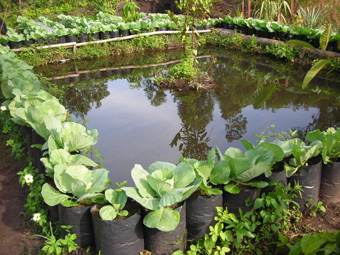

The three different styles of simple fishponds demonstrated by Kampung Konservasi.
Because our ground is naturally “wet” (mostly peat swamp), we do not have to do much to regulate the water flows. We just worked with the land contour and designed our ponds so that they are as low maintenance as possible. This way, local farmers can easily duplicate our methods and feel interested to try because it does not require much commitment from their part. To fortify the walls, we used simple materials such as bamboos, sand bags and polybags filled with vegetable seedlings.
We then put two species of fish in our ponds: one is nila, a consumption fish species that originally came from Africa but has become very common all over the world; another one is patin, a local Kalimantan species that has also become a very common consumption fish species. Both have been doing very well in our ponds, although our patin grow a little better and faster in semi-peat swamp water.

Encouraging community participation and the uptake of this low-impact fish farming.

Patin - common species of fish found in Kalimantan, Borneo
Just recently Kampung Konservasi decided to empty its fish ponds because we wanted to fix the walls. We did not expect that there will be so much fish! In only this one harvest, we managed to sell 56 kilograms of fish to the local housewives and restaurants. In 2008 alone, our alternative fish farm produced more than 200 kilograms of fish and sold well in the local market. Once again, Kampung Konservasi have proven to the local communities that fish farming is another potential income-generating activity for this area.
Thanks,
Sally (Yayorin)
Who patrols the logging concessions?
A quick answer to Sheryl's question about David Hagan's blog Vounteering in Belantikan - Morning Commute , “Are there police patrolling this logging concession? Is there no plan in place to replant trees to rebuild the forest?”. Logging concessionaires have police on check points on access routes into their concessions, because illegal logging isn't just a problem for the National Parks, it occurs in many forms. The police, however, only monitor local people who try to extract trees – they are on the side of the concessionaire. It is the Forestry Department who monitor the activities of the concessionaires. The operator in Belantikan seems reasonably respectful of the law. In other areas the ‘legal’ loggers are less responsible.
Personally, I think our partners Yayorin (www.yayorin.org), a local Indonesian NGO, deserve big credit for the behaviour of the concessionaire in Belantikan. By simply being there, they are helping to keep everyone on the straight and narrow. As for replanting, there is a reforestation program but one hopes the forest there will recover on its own. The soils are more fertile than those we have in the lowlands and there should still be a crop of regenerating young trees left behind.
Thank you and more on the crocodile.
Firsly, Mike S thank you very much for your recent donation. Please bear with me I will blog more about orangutans soon but first I'd like to reply to Dana and Sheryl who commented on my last post Endangered crocodile species kills local man. I agree it was a sad end for this crocodile that had lived for over 50 years and is an endangered species. As soon as I saw the photographs of her caught and dead, I realised how old she must have been. The cynic in me is surprised she lived as long as she did. The pragmatist in me knows, as soon as she took the man, her life would probably be short. Here, in Kalimantan, for the people who live on and from the rivers or forest, nature is a little more redder in tooth and claw than it is for those of us who deal with emails, traffic jams and income tax returns. An eye for an eye – even between people – remains acceptable.
Even if we had been informed straight away, there would have been next to nothing we could have done. In no way are we equipped to deal with the capture and translocation of a reptile – especially one almost 5m long. Moreover, none of our staff could have calmed the crowd that went out on the hunt.
The crocodile had apparently been seen before. How, when and where has been harder to find out, especially in this case, when our questions inevitably carry the sense “What was the man thinking of? It is partly his fault.”
As with snakes and spiders, almost universally crocodiles get bad press. Tomistoma normally eat fish – hence their elongated snout – so people do not seem too concerned about them. That all changed when the crocodile attacked. By catching the right crocodile, we can hope no further action will be taken against other Tomistoma. Certainly, the attack has not unleashed indiscriminate slaughter of all crocodiles.
By encouraging Devis (Manager - Pondok Ambung Research Station) to write up this case we can hopefully understand more about the attack and learn the right lessons. Tomistoma are fish specialists but it should not be surprising they are capable of eating people too. However they should not be given the title ‘man-eaters’ but should just be treated with respect.
Apologies for the length of this post; complex and emotional issues can’t be explained succinctly. I am just happy I have electricity tonight, so I can keep typing.
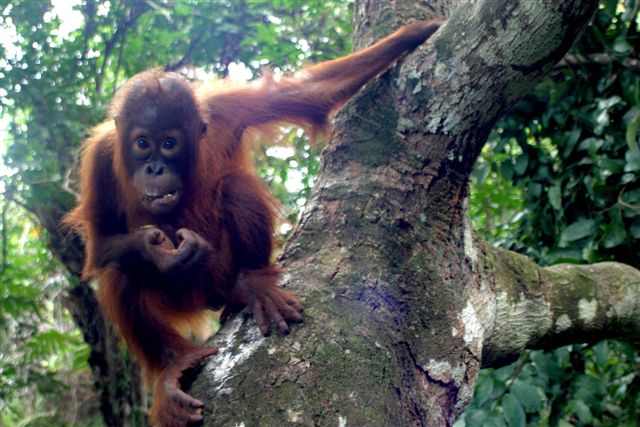
Here's an orangutan picture to end on. I think this is a great photo, it was taken by Hugh Sturrock at Camp Leakey a good few years ago.
Endangered crocodile species kills local man
I am afraid orangutans won’t feature in this post. Unfortunately, I am writing about something rather sombre. On the 31st December a local man was killed and eaten by a large crocodile. A group of people went out the same night to look for the man and the crocodile but found neither. The next day they called on a pawang or shaman who has the ability to call crocodiles. He worked his magic and within 17 hours of the attack the crocodile was caught and killed; it was almost 5m long and must have been over 50 years old. Inside were the remains of the man.


The Malaysian False Gharial (Tomistoma schlegeli) that killed and ate a local man.
What makes this interesting, as well as tragic, is the crocodile was a Malaysian False Gharial (Tomistoma schlegeli). You may remember last year (A VERY RARE CROCODILE), Rene Bonke was out here studying them. They are one of the crocodile species never reported to have attacked people. Because of this, we need to write up the case. Devis, Pondok Ambung Manager, has been leading the investigation and yesterday we went out to look at the site where the attack occurred.
It isn't surprising Tomistoma kill people. What surprised me was the river where the attack happened. It was an ordinary, peaceful, black-water creek, not 15 minutes upstream from town. It was identical to literally dozens of such rivers that I have seen, been up, even waded across. Never once did it occur to me that such a large Tomistoma might live there. They are an endangered species and you rarely see them.
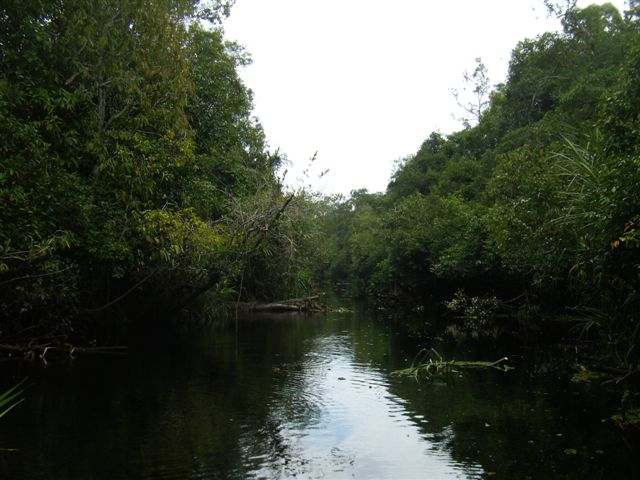

Being in that place, where I knew someone had died, gave me pause. But behind that was a wonder; a wonder that in this era of chainsaws, speedboats and wanton habitat destruction, an animal of such size could have survived for so long.
For more information about Tomistoma please visit Tomistoma Task Force
The cost of the biofuel boom on Indonesia’s forests
The cost of the biofuel boom on Indonesia's forests. The clearing of Indonesia's rainforest for palm oil plantations is having profound effects – threatening endangered species, upending the lives of indigenous people, and releasing massive amounts of carbon dioxide, writes Tom Knudson from Yale Environment 360, part of the Guardian Environment Network.
This interesting and informative article appeared in the guardian.co.uk, Wednesday 21 January 2009. Here is an extract from the article featuring Stephen.
"This isn't mowing your lawn or putting up a factory on the outskirts of town," said Stephen Brend, a zoologist and field conservationist with the London-based Orangutan Foundation. "It's changing everything as far as the eye can see."
Like tigers, orangutans — which are found only in Sumatra and Borneo — are also being nudged into increasingly isolated population units by rain forest destruction. Their numbers are dropping, too. But because there are more of them — between 45,000 and 69,000 in Borneo and 7,300 in Sumatra — extinction is not an imminent threat.
"They are still going to be in the wild, but in fragmented populations that can never meet," Brend told me one evening. "And if it's reduced to that, we've just lost everything. It's not only the orangutans. It's what you lose alongside them — the birds, insects, pollinators, all the environmental services that forests give, as well as a thing of beauty."
Indonesia has long been known for its heavy-handed logging and plantation clearing. Rain forests fall faster in Indonesia, in fact, than almost anywhere else on earth. But Riaz Saehu, a spokesman for the Indonesia Embassy in Washington, D.C., told me that under the country's new president, Susilo Bambang Yudhoyono, who took power in October 2004, the era of widespread clearing for oil palm may be coming to a close.
"There is an effort to reduce plantation expansion," Saehu said. "What we do now is basically to promote sustainability."
Many scientists are skeptical. "After 23 years there, I must say they can talk the talk but never walk the walk," Lisa Curran, director of Yale University's Tropical Resources Institute, told me in an e-mail. "The richest folks in Indonesia are owners of these oil palm plantations, so the corruption and patronage are linked to the very top of the food chain and power structures."
In 2006, Curran was awarded a so-called MacArthur genius award for her work on deforestation in Indonesia. "Oil palm is a disaster all the way around for biodiversity if converted from logged forest or peat swamp," she said. "Oil palm is fine if they actually put it on totally degraded lands – but they don't." Read the full article
National Park Visit
I am sorry for the long silence – I had a fantastic break with my family in Australia. I hope you all had a similarly good end to the year. I actually got back to Indonesia on 9 January but had to spend a frustrating week in Jakarta; the traffic jams in the city are something else! Anyway, I arrived back in Pangkalan Bun last Thursday and, you’ll be pleased to know, I wasted no time in getting back into the forest. Yesterday, the National Park office hosted a visit by the Bupati, the head of the local Government. There was a cast of thousands; well 67 to be precise but the orangutans did not seem at all fazed.

Visit to Camp Leakey organised by the National Park Office.
There were lots of orangutans about including Tom who remained incredibly cool despite the crowd of onlookers. Even the gibbons came in.


Feeding Site - Camp Leakey
After everyone had moved back to Camp I stayed on at the feeding site as there was a new sub-adult male at the feeding platform. The Assistants tell me it is Popeye, the son of the wild female orangutan Peat. Ashley and I can remember following him when he was just an adolescent. Unfortunately, it was getting very dark and overcast by then so my pictures don’t do the scene justice.

There are in fact three or four orangutans in the photo spread out through the trees - you might be able to just work them out.
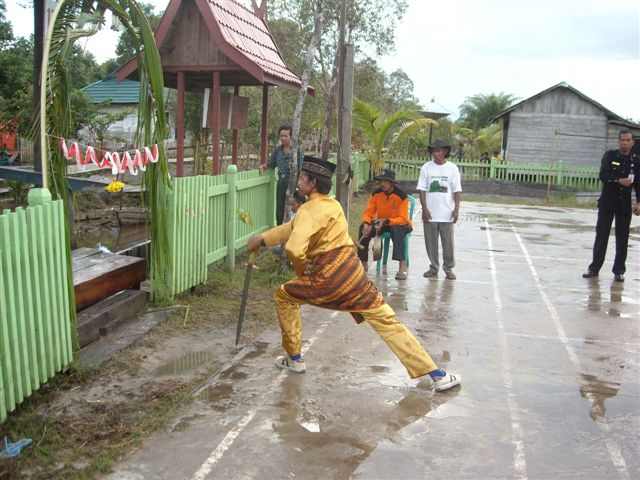
The day ended in a local village with a display of traditional dancing. All in all it was a fine welcome back!
Brigitta - thank you very much for you recent donations we really appreciate your support.