Volunteering in Belantikan - A Dayak Perspective

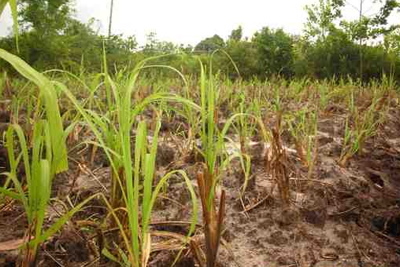
During our time in Belantikan we were also fortunate enough to have the opportunity to have some long conversations with some of the older villagers about their way of life. We visited the ladang of Pak Taryom outside the village of Nanga Matu, to see the new crops he is cultivating with Yayorin’s help and find out how their new methods are bringing benefits to the area. Pak Taryom

Pak Taryom in his ladang near Nanga Matu, cultivation here has been much changed with Yayorin's help

Pak Taryom also explained to us about the traditions and ceremonies of the Dayak people. His brother, Pak Maju, is the last man of Nanga Matu refusing to convert to one of the five state approved faiths of Indonesia and still clinging to Kaharingan – the traditional Dayak religion. He is also the father of Yayorin’s cook Ani, the youngest of his seven daughters.

Pak Maju lives outside Nanga Matu and, on our last day in Belantikan, we went to visit him at his ladang tucked away inside the forest. He’s 58 years old and still working in the fields. We found him sat under a tarpaulin sheet in the centre of his ladang, a thin line of smoke twisting to the sky from the fire he was sitting by chewing tobacco rolled in leaves, a rifle and a long knife by his side. I got a little perturbed at one stage during our conversation when he turned to me and mimed pulling off my head and drew his knife. Although it turned out, via translation, that he was just explaining that when a Dayak is angry they can pull off an enemy’s head with their bare hands without recourse to a blade.

Pak Maju

Pak Maju - Nanga Matu's last adherent of the Kaharingan religion in his ladang

Pak Maju also told us how the villagers of Nanga Matu and Bintang Mengalih still come to see him and ask him to summon the spirits to grant their wishes. Nevertheless, it seemed to me that he could accept the end of the Kaharingan culture, religion being in his mind a matter of personal choice. He could not, however, accept the destruction of the forest. When we asked him what he thought of it he told us that the balance of life has been upset and ‘when the trees and the hills are all gone [to logging and mining] the people will all die.’. The world around Pak Maju is changing so fast that his fears for the forest, and everything that lives within it, could be realised within his lifetime.

We left Belantikan full of great memories. The work of the Orangutan Foundation, Yayorin and the local communities to protect this area for the benefit of people, orangutans and the forest continues.

Thank you,

David
Volunteering in Belantikan - Working with the forest

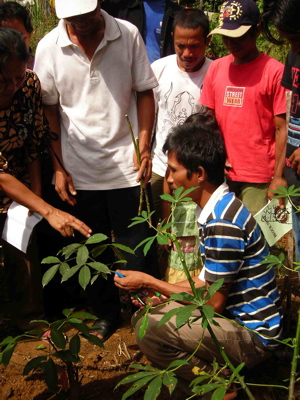
The Dayak people of Belantikan have lived with the forest as subsistence farmers for centuries and still it thrives. They carve out their small field (ladang) in the forest for cultivation and occasionally venture into the interior to hunt and gather other food to supplement their diet. However, some of their other practices for example, traditional slash and burn agriculture, unnecessarily destroy patches of forest annually. As the amount of available primary forest shrinks year on year due to the incursions of logging, palm oil and mining, it’s more and more important to ensure that the agricultural methods of the people living in the forest are as sustainable as possible. Therefore, Yayorin is working to introduce new practices for the benefit of the forest and the people, showing the villagers how they can continue to use the same field year on year. Introducing the cultivation of rubber, which takes five years to mature, means that the villagers cannot simply burn the field after they have harvested their vegetables, and this benefits the forest. The production of rubber is also beneficial to the people as it provides them with a long-term continuous income source. The vast majority of farmers across the three villages have already started to cultivate rubber, significantly reducing the use of slash and burn.

Rubber Training (Photo: Yayorin)

Rubber Training - Photo: Yayorin ("We do not have full-scale rubber cultivation. What we do is agroforestry with rubber as main plants. In the agroforestry system, we mix different plants in one area like vegetables, fruit trees, gaharu and rubber. This way, the community can enjoy the short and long harvest" - Togu Simorangkir, Chairman of Yayorin).

Yayorin’s community development and empowerment work is also helping the villagers to recognise that the long-term value of the forest is more precious than the short-term rewards that could be gained by surrendering their traditional land to those who would destroy it in the interests of quick profit. The benefit of this strand of Yayorin’s work was shown in June 2006, when the villagers of Kahingai chose to reject an astounding offer of 30 million rupiah per family to sell their land to a palm oil company.

Volunteering In Belantikan - An Absolute Pleasure To Teach

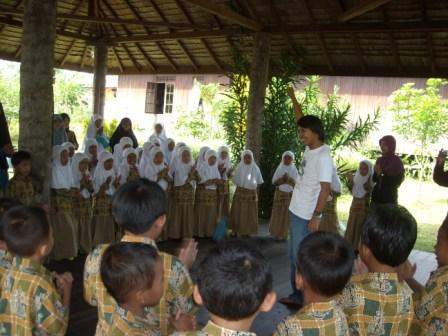
As part of Yayorin’s programme of conservation and community empowerment they are also prioritizing improving education generally for the villagers. It’s this aspect of the programme, and the communities’ request for English language teaching, that led us to go to Belantikan to work in the village schools. Living in Belantikan for one month was an absolute privilege and teaching the children an absolute pleasure. They were a joy to work with, keen and enthusiastic, and seeing them go in one month from speaking no English to confidently expressing themselves in their new language showed the enormous potential they have. Teaching in Belantikan

Class 3 and 4 in Bintang Mengalih after English class.

It was also funny to hear how the children of these remote villages picked up touches of our distinctive Liverpool accent in their spoken English, which might sound a bit odd to any future English visitors who stop to chat to them. The children also seemed to really enjoy the lessons, although some of their teachers looked a bit bemused watching their students dancing around outside class singing “if you’re happy and you know it clap your hands” or the “happy days theme tune”.

When we were leaving Kahingai after our last lesson there some of the children followed us down to where our boat was waiting on the river. We asked them if they’d rather leave the village behind and go to live in England and they said no. I think their quality of life here, living in this beautiful forest is better, I hope it remains that way.

Volunteering in Belantikan - The Morning Commute

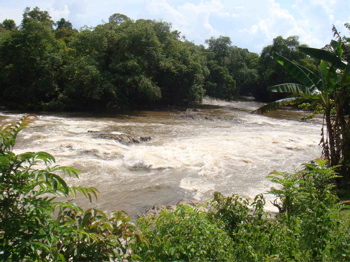
Its 6:30 on the 3rd December and we’re on our morning commute to work. Our boat is cutting its way through the rapids of the river and we’re on the look out for crocodiles lurking on the banks. morning commute - belantikan

Morning commute - the rapid at Nanga Matu the starting point for the morning commute to work!

On the river - Belantikan

On the river - mist over the Belantikan river on the early morning journey to work.

On this early morning a mist still hangs over the top of the forest-covered hills on either side of the river. All around us the forest still thrives, providing sufficient sustenance for both the huge range of wildlife and the small village communities that have made this beautiful corner of Kalimantan their home. We are on the way to teach in one of these villages, Kahingai, and it’s the most incredible commute to work I could ever imagine, but sad too to think what this might be like in five years time if the fate of the forest here follows much of the rest of Kalimantan.

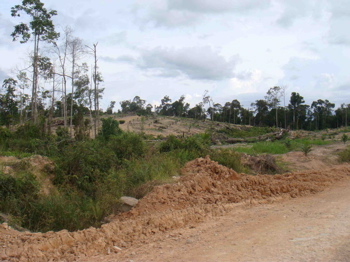
Our journey up to Belantikan from Pangkalan Bun, one month ago, showed us what the future might hold for the forest here. Passing us on the road heading back to town were the biggest trees I’ve ever seen, all stacked up two by two on the trucks that filed past in a long procession. Further piles of enormous dead trunks, neatly stripped of all unnecessary leaves and branches, lay by the side of the road awaiting transportation.

Logging concession - destruction of the forest on the road to Belantikan

Logging concession - destruction of the forest on the road to Belantikan

Rampant logging was only part of the problem; most of the journey out was through oil palm plantations, with the neat ranks of oil palm advancing into the former territory of the wild forest. The new plantation is a parody of the original forest, providing no home to the orangutan or other animals, and when the planters have finished they leave a land degraded that can never become forest again. If Borneo was once a Garden of Eden then what has been done to the trees here makes stealing a bit of fruit look very innocent indeed.

oil palm plantations en route to Belantikan

Oil Palm Plantations on the way to Belantikan (Photo: Orangutan Foundation)

We were fortunate enough on our journey up to Belantikan to have an unscheduled overnight stop off in a richer part of the jungle when our van, swerving to avoid a fallen tree, got stuck in the mud.

Van stuck in ditch

Our accomodation for a night in the jungle, a van stuck in a ditch.

The accommodation, on the back seat of a van sunken on one side into a deep muddy ditch, wasn’t the most comfortable, but it was amazing to wake up with the dawn to a chorus of gibbons in the trees overhead. We were also lucky enough to see a deer flash across our path to disappear into the trees on the other side of the road. We were still in the territory of the logging concession that envelops Belantikan, but in a relatively untouched part of the forest. A well-policed logging concession can actually be considered the lesser of three evils, and there are fears of what might happen to Belantikan when the concession expires in 2012 if the twin terrors of illegal logging and palm oil move in en masse. It raises the question, what will be left when the children we are teaching today have grown up?

Volunteering in Belantikan

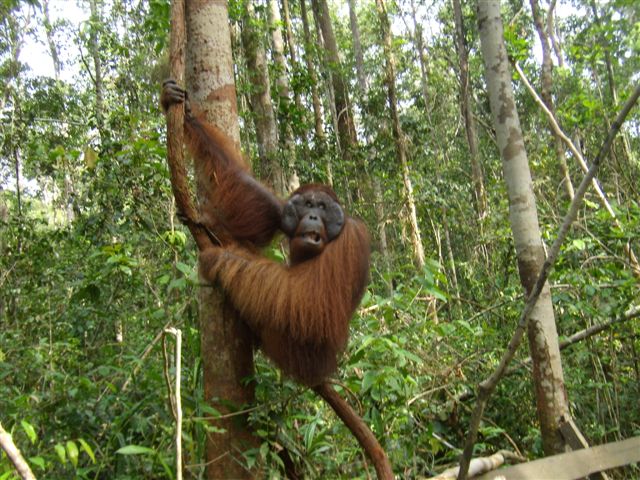
The Belantikan Hulu ecosystem in Central Kalimantan is a priority conservation area for Orangutan Foundation and their partner Yayorin. The still surviving dense forest there is home to an incredible diversity of species, including the largest population of wild orangutans outside of a protected area. Belantikan Conservation Programme focuses on both researching and cataloguing the wildlife of the area and working with the local communities to develop ways to maintain their traditional lifestyles without having a detrimental impact on the forest ecosystem. As part of Yayorin’s capacity building educational programme Catherine Burns and myself, former Orangutan Foundation volunteers, travelled to Belantikan to work with Yayorin as English teachers in the schools of the villages of Nanga Matu, Kahingai and Bintang Mengalih. Orangutan Foundation invited me to blog about our time there and the ongoing struggle to save this precious part of the Borneo forest. You can read my account of our experience over the next week.

Thanks,

David Hagan
Thank you and Happy New Year!

Thank you Mike T. and Matthew K. for your donations in support of our work - a good start to 2009. We are delighted to begin this year by bringing you a really interesting blog from David Hagan, a committed volunteer of Orangutan Foundation and our partners, Yayorin. David and his fellow volunteer Catherine Burns spent a month teaching English in remote village schools of the Belantikan Hulu forests, Central Kalimantan (Borneo). We hope you will enjoy reading David's blog, which will be posted throughout this week.
Thank you for your continued support and interest,

Cathy - Orangutan Foundation

Orangutans and Holidays

Some months ago one of our readers asked after an orangutan at the Orangutan Care Centre & Quarantine called Roland. Roland

Roland

Roland came to us on 28 July 2004. Today, he is a boisterous 23 kg youngster. I am sorry it has taken me so long to ‘track him down’ but every other time I have been to the Care Centre recently he has been out in the nursery forest.

This week I also caught up with Violet who continues to grow and develop with no hint of her tragic start in life.

Violet Dec 08

Violet with carer

Violet Dec 08

Violet

One of our readers, Mara, who spent some time with us earlier in the year asked me to look out for Maggie, one of her favourite orangutans. Maggie was not an orangutan I knew, but she quickly became one of my favourites too.

Maggie

Maggie

Zidane (see post A Very Sick Orangutan)was out in the forest. Though he is still very thin he is well on his way to making a complete recovery.

And that ended my ‘orangutan time’ for the year. I am now heading to Australia for Christmas with my family. I would like to thank you all for the support you have given us, and the interest you have shown in our work throughout the year. I wish you all very best for the festive season and every success for 2009. You’ll hear from us again early in the New Year.

Many thanks,

Stephen

Reply to comment - orangutans in zoos

Amy thanks for your question. Without entering into a debate about the value of zoos hopefully I can address part of your question. Stephen is currently very busy but he'll hopefully blog again at the start of next week. The assumption should not be made that just because orangutans spend a lot of time alone in the wild that this behaviour must be replicated in captivity. How solitary a wild orangutan is depends on factors such as food availability or type of forest habitat. For example, Sumatran orangutans are observed to be more social during times of increased fruit availability. If the habitat allows a higher density of orangutans then social behaviour is more likely to be observed. If food is scarce and long distances have to be travelled then orangutans don't necessarily have the time or energy to invest in social interactions. Zoos often keep orangutans in small family groups, an adult female orangutan with her infant and perhaps juvenile offspring and this reflects a grouping that is observed in the wild.

What is certain is that there still remains a great deal to be learnt about this highly intelligent great ape!

Many thanks,

Cathy

Orangutan Foundation

The future of the orangutan - BBC Radio Interview

Here is the link to the BBC Radio 4's science programme Leading Edge which features an interview with Stephen about the future of the orangutan. Stephen recently blogged about it in An Interview with Kusasi. The programme was broadcast on Thursday 11th December 2008 and Stephen's interview is towards the end of the programme. Click here to go to the Leading Edge page and select the 11th December programme.

Reply to comments

A very quick reply to recent comments... Orangutans clearly recognise each other (Princess will always run from Siswi) but because they are generally semi-solitary and uncommunicative you rarely get the insight into whether there is recognition of a biological relationship.

Regarding the drinking of milk, orangutans naturally have a high-fibre, low protein diet with huge fluctuations in sugar intake, depending on the availability of fruit in the forest. It seems fair enough that orphaned, infant orangutans are bottle fed with milk made for human babies. Milk has always been given as supplimentary to the orangutan's fruit and it has become part of the rehabilitant's diet.

Abraham -orphaned infant orangutan

Abraham - orphaned infant

Tom - adult male Bornean orangutan

Tom - dominant male

Brigitta, good to know you still think of Siswi! Regarding post, the best thing to do is send anything to the London Office. I look forward to seeing the photos.

Orangutan Foundation 7 Kent Terrace London NW1 4RP

Many thanks,

Stephen

School Visit to Kampung Konservasi

"By listening I know; By seeing I understand; By doing I make a difference.” The children enthusiastically approached the two cows in their stable. In their hands were the newly-cut, fresh, green leaves. They waited impatiently for their turns, and their face lit up when the cows ate the leaves.

Feeding Kampung Konservasi’s cows

Feeding the cows is probably a simple and common thing for those who live in small villages and have cows. For these children from Islam Terpadu Elementary School, however, this simple thing became an extraordinary experience. It was probably the first time they ever saw a cow in their life. The participants on this visit were 1st grade students, 55 of them, and 5 of their teachers.

Feeding the cows was one of education activities we conducted during this school visit at Yayorin's Kampung Konservasi. This outdoor learning focuses to integrate knowledge the children learn from school with some field experiences. This way, students not only understand the theories and facts, but most importantly, understand and respect the knowledge they receive.

School Visit to Kampung Konservasi

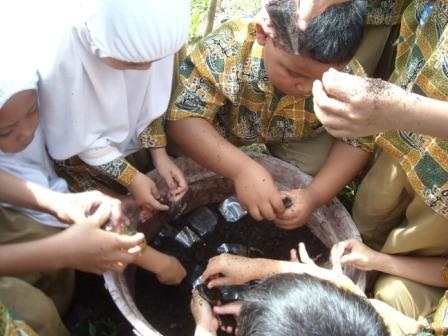
Another activity that the children found very exciting was when they were asked to plant vegetable seeds. This time, they planted pokchai ( a type of vegetable similar to chinese spinach) in black polybags. With enthusiasm they grabbed handfuls of soil that was already mixed with organic compost and put it in the polybags. Each of them made a little hole on the soil with a finger, put one seed in it, and covered it with soil. Finally, they carefully watered the planted seeds. The children really loved it!

Sowing Seeds

Other than feeding the cows and planting vegetable seeds, the children also watched an environmental movie in our little theatre and listened to story-telling in the library. The morning passed by very quickly, and everybody was sad when we had to say goodbye.

Kampung Konservasi tries to use nature as a learning ”canvas”...where simplicity and friendship with the environment are keys to understanding and respect. By giving opportunities for young people to express themselves and learn by doing, we are actually influencing their behaviors and future choices. In the long run, we hope that they can then influence others around them, including the adults. When that happens, the world will definitely be a better place!

Thank you,

Riyandoko (Education Facilitator) & Sally (Yayorin)

Orangutans and water - an unusual mix

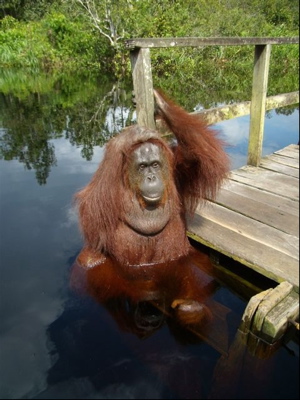
Thank you for all your comments and I'll do my best to respond to them soon. Another interesting thing happened on Sunday at Camp Leakey: Siswi almost completely submerged herself in water. Orangutans can’t swim though they do wade. The rehabilitated, ex-captives at Camp Leakey will also play with water but that is probably a behaviour learnt from watching the staff. What made Sunday interesting was that Siswi spent so long in the water. She sat there for a good fifteen minutes and actually bobbed up and down so the water rose up to her chin.

Siswi bathing

Siswi - adult female orangutan in the river.

I am quite convinced she was simply trying to cool off. However, that does not fully explain a) quite how an orangutan’s natural wariness of water could be so totally overcome; let’s not forget there are crocodiles in these rivers and b) how an orangutan who instinctively shelters from rain, which makes them cold, would on another occasion use water for exactly that purpose.

Siswi in the river

Siswi sitting in the river

Who knows whether Siswi would have sat in the water for so long if we had not been there and it is not a huge intellectual leap to realise water makes you cold and you can choose when you want to be cool or dry. However, none of that dry scientific reasoning detracts from the interest: orangutans are fascinating!

Interesting orangutan behaviour

Firstly, a big thank you to Brigiatta for your monthly donation and Maciej for your donation of $100. As you recently visited Tanjung Puting National Park and Camp Leakey this post should hopefully be of interest to you. In July, we discussed why the orangutan Riga shared her food with her mother, Rani. The reason may be biological or social but what is certain is that it is a rare event between adult orangutans; which is why it was surprising to see it happen again on Sunday – but this time with another twist.

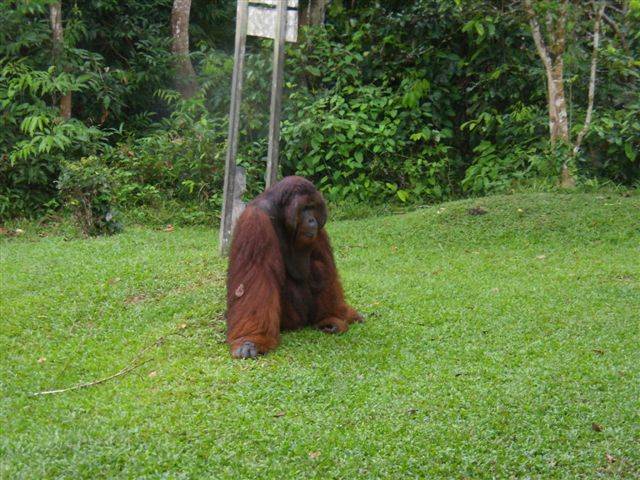
Tom December 08

Tom - dominant male

Tom is the undoubted King of Camp Leakey; the dominant male. He doesn’t have to share anything with anybody if he doesn’t want to. On Sunday, he sat down with his bucket of milk and proceeded to slurp away at it with Siswi looking enviously at him. Tut then came up, she had not been to the afternoon feeding so may have been hungry. Tut is Tom’s mother but subordinate to Siswi, so she approached warily.

Tom, however, passed over the bucket without hesitation (and all Siswi could do is continue to look on greedily!).

Food sharing Dec 08

But what made all this doubly interesting is that it points to an answer to one of the big remaining questions of orangutan research: do they recognise their own parents/offspring? In reality, there is no more reason for Tom to share his milk with Tut than with Siswi (indeed, Tut is not in season but Siswi could be) and yet he did willingly. Why? It would be interesting to think Tom knows his mother and that was why he acted favourably towards her but like so much about orangutan behaviour we still have a lot to learn.
Thank you,

Stephen

PS Apologies for the rain spot on the photo.

Camp Leakey Tanjung Puting National Park

Thanks to Georgina Kenyon who has written this short piece for us about her experience making the BBC radio programme. "It’s embarrassing to say but I can’t remember being that interested in orangutans…until I saw the big male Kusasi coming straight for Stephen and me at the feeding platform at Camp Leakey.

What an animal!

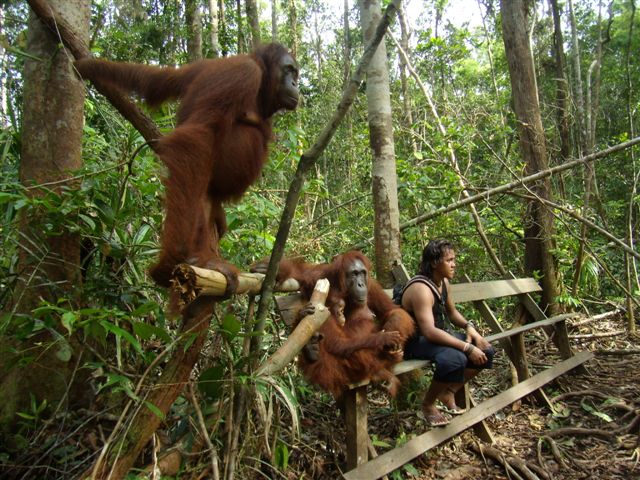
I also loved walking through the forest, following the other orangutans as they were looking for food– those four hands and those eyes!

I’ll always remember my stay that night on the klotok and listening to the sounds of the Borneo jungle – the rowdy chainsaw beetles and the gibbons at first light and watching the butterflies and the birds of prey.

I have always thought the issues surrounding conservation can be very complicated - so many threats, so many issues.

Yet I was impressed by the pragmatism of the staff at the Orangutan Foundation; they made all the problems facing the jungle appear manageable.

A big ‘thankyou’ to all the team at the Orangutan Foundation-everyone went out of their way to help me make the BBC radio programme."

An Interview with Kusasi

One of the rules of working around orangutans is to never get within arm’s reach of them.  On Saturday, in the middle of an interview with a journalist, I was horrified to find Kusasi less than 2m away and coming straight at us. If I was horrified, I dread to think what the journalist thought!  Her tape contains the memorable line “Time to GO!” 

The problem was we were watching Unyuk and her baby who were joined by Uning and Ukraine.  When we arrived at the feeding station Unyuk, who has a reputation for being naughty, was sitting peacefully with Mr Otter.  They looked like two neighbours having a chat.  Mr Een then walked up and Unyuk went over to say hello to him.  Shortly afterwards, Uning and Ukraine swung in.  Uning is Unyuk’s daughter so we were looking at three generations of their family:  Unyuk the mother and grandmother; Uning the daughter and Ukraine the grandchild.  It was a captivating sight.

unyukotter_29nov08.JPG

unyukuning_29nov08.JPG

Rather too captivating:  never forget what is going on behind you!  Een’s eyes went wide and he slide off to the side. I turned around and there was Kusasi. All I could see was him!  I won’t say he was going for us, but I will say he was moving in a straight line for Uning and we were in the way.  Look at the photos:  the vine Uning is holding onto at the start is the very same one Kusasi is on: she had the sense to get out of his reach.

unyukeen_29nov2008.JPG  

I grabbed the microphone case and pushed the journalist with my other hand.  Kusasi passed behind us stopping in the spot recently vacated by Uning.  Once heart-rate and blood pressure had returned to normal we got some photos.  Just look at the size of his arm! 

kusasi_29nov08_01.JPG

That evening, I left the journalist to spend a night on her boat in the park, and I travelled back to Pangkalan Bun.  The sunset was spectacular.  The sky was every shade of red which was reflected off the still black-water of the Sekonyer River.  It felt as though we were speeding through fire. 

sunset.jpg 

Back at the office, I saw the education team had returned from their field trip.  From the state of the car it looked like they had had their own adventures! After all of which, I would like to say thank you to Julie (Art for Gorillas) and Adam Hardy for their sympathetic comments.  Adam, I agree with you: there is no comparison between an 8mb broadband internet connection and a fast-moving 120 kg male orangutan.  I’ll stop complaining.

strada_29nov08.JPG

Fed Up…

To start with the fun stuff, I was over at the Care Centre today. As always I was saddened by the number of orangutans we have in captivity but I was still amused by some of their antics. Of course, I popped over to see Montana who I thought was looking particularly like King Kong.OCCQ November 2008

OCCQ November 2008

OCCQ November 2008

A few of the hundreds of orangutans at the Orangutan Care Centre & Quarantine

Montana Nov 2008

Montana

Unfortunately, my general mood was less than cheery. I don’t wish to burden you with my whinging but I am really fed up. For the whole of this year the electricity supply here in Pangkalan Bun has been abysmal but this month has been extraordinary. Every second day we suffer a four to five hour black out. Today, we had no electricity from 9 am to 4 pm, hence my trip to the Care Centre. Throw into the mix a truly awful internet connection and you have a recipe for frustration. Last night I had to do emails on a 14kbs dial-up connection.

I promised the UK Office I would be better at writing my blog more regularly. I hope you can understand now why it is not always so easy….

No doubt things will get better so thank you for allowing me to get that off my chest!

Stephen.

- Mara, thank you very much for your $50 donation.

Here, there and everywhere!

I hope the orangutans appreciate it! In the past two weeks, I have gone from Pangkalan Bun to Jakarta and back, Sukamara and back, and finally to Sebangau National Park and back; the last journey involving a cramped 10 hour overnight bus ride. In all that time, while I have seen their nests, I did not once lay eyes on a wild orangutan :-( This is an extraordinary amount of travelling, particularly so late in the year which is usually our quiet time. The meetings in Jakarta concerned the potential for protecting forests through the carbon markets, a process know as “Reducing Emissions from Deforestation and Forest Degradation” or REDD. REDD as a conservation tool is in its infancy though many groups are exploring how it could be applied in Indonesia.

Sukamara Meeting

Multi-stakeholder meeting with communities surrounding the Lamandau Reserve.

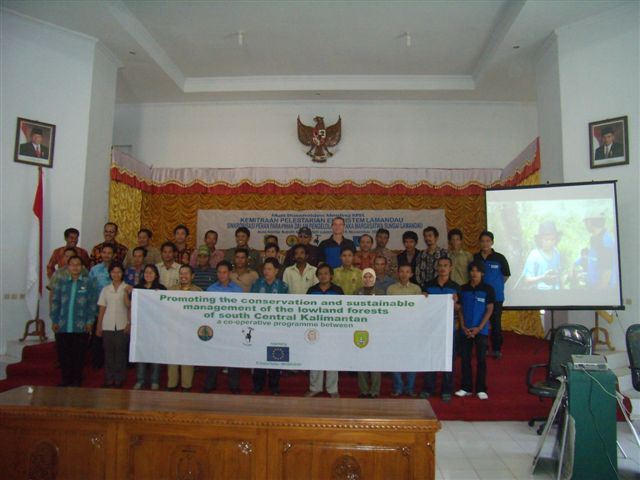
We went to Sukamara for a “Multi-stakeholders Meeting” when we bring together representatives from all the communities surrounding the Lamandau Wildlife Reserve as well as the local Government. The two-day meeting was a great success, helping us set our plans and targets for next year. Truly, we are receiving an incredible amount of support from the local Government.

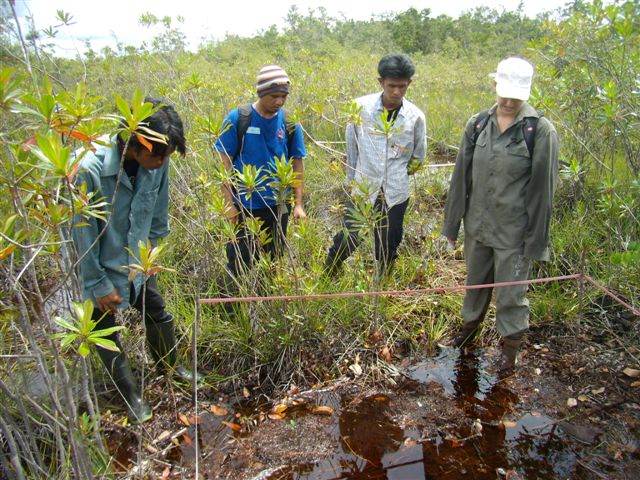
The trip to Sebangau was arguably the most interesting, not least because I had never been there before. Sebangau was only designated a National Park in 2004 and yet is home to arguably the largest population of orangutans in any national park. Estimates consistently show a population of over 6,000 orangutans. Our reforestation team and I travelled there to see the land rehabilitation research being undertaken by the Centre for International Co-operation in Management of Tropical Peatlands (CIMTROP).

Research team

Research into peat swamp rehabilitation.

Cimtrop Camp

CIMTROP's is a pure research project, experimenting with different techniques, habitat types and tree-species to find what works best in degraded swamps. Our work is rather more applied – we want to cover a much larger area than the research project does but there is no sense in reinventing the wheel, or worse, repeating mistakes already made, so it was a valuable visit.

Tower Structure

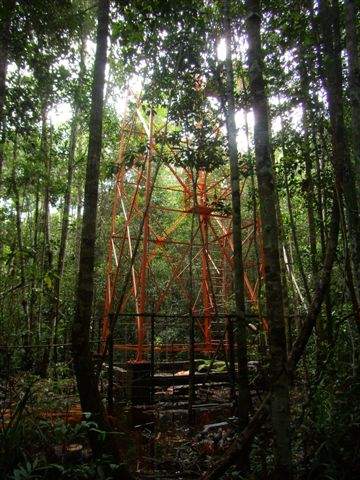
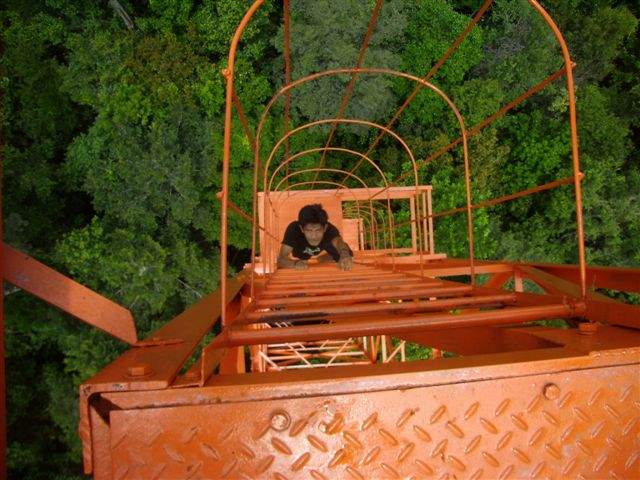
Interestingly, at the edge of the CIMTROP study area a team of Japanese scientists have erected an environmental monitoring tower which is some 40m high. I have always wanted to have an observation tower in Lamandau. Having climbed to the top you had to conclude the view was great.

Tower Climb

The climb. Not one for the faint-hearted!

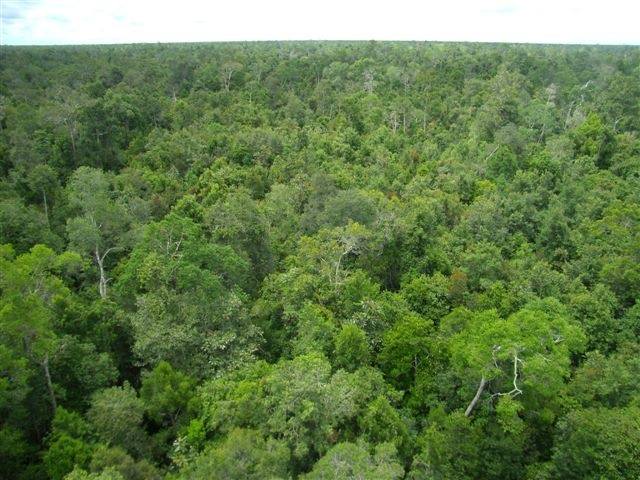
View from Tower

The view

Isam at the top of the tower

Isam -Orangutan Foundation Land Manager at the top of the tower

Reforestation Team

Orangutan Foundation's Reforestation Team looking a little tense on top of the tower!

Sunset from Tower

Sunset

Isam, our Land Manager who had never been anywhere near as high in his whole life, was finally persuaded to let go of the hand rail. Once on the ground though he did agree the climb was an adventure worth having.

Thank you Patrik W, Lucia C, Mia B and Wanda H for your recent donations. We really appreciate your support. We are now only $205 short from reaching our $5,000 target – please help us reach this by the end of November.

Thank you,

Stephen

Orangutan driving a message home in London

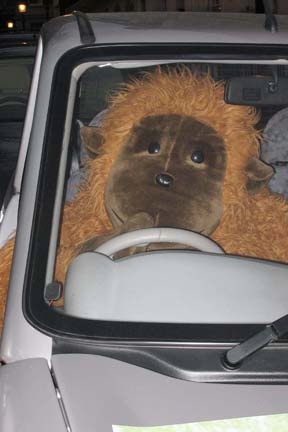
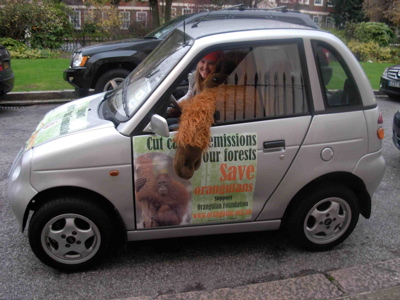
Stephen is out in the field all week and so won't have any internet access. Hopefully we'll hear from him when he gets back. We thought we'd show some photos from last week. Helen, who volunteers one day a week in the UK office, has written a short piece about driving an orangutan around London (don't worry it wasn't real!) on Orange Day. Over to Helen.... Helen & Ou in Gwiz

"One of last week's Orangutan Awareness events involved the London office borrowing a G-Wiz (electric car) in order to highlight the effect deforestation and carbon emissions have on the plight of the orangutan. I was happy to offer to drive the car around for the day with the company of my very own orangutan!! I drove around central london and tried to stick to the roads where there would be the most pedestrians so that as many people as possible might spot the car.

Helen & Ou in Gwiz

As it was 'Orange for Orangutans" day I wore an orange t-shirt and one of the bright orange hats that Ashley's mum knitted for us. I think the hat helped alot as people would spot the bright orange out of the corner of their eye then notice that not only was I driving a g-wiz emblazoned with stickers but that I had an orangutan sitting in the passenger seat.

Gwiz orangutans

Close up orangutan

I had a very amusing time especially whilst driving up Constitution Hill. I had timed my drive so it was just after the changing of the guards when there tends to be more people outside the palace. Whilst we were waiting for the guards to trot up the hill and back to their stables a gentleman in the taxi in front noticed the orangutan. He pointed it out to his friends in the taxi and they all had a good look and a giggle! I also had lots of waves from people on buses whilst stuck in traffic. Hopefully lots of people noticed us and read the stickers and were persuaded to join the Foundation."

Gwiz orangutans

Thank you Helen for being such a sport and thank you Gwiz for the use of the car.

One year on…

It has been nearly a year since Stephen started this blog on the 23rd November 2007 and so far you have donated US$4,680 towards our programmes in Central Kalimantan, Borneo. This money has been spent on; buying medical supplies for the orangutans at the Orangutan Care Centre and Quarantine; for enclosure repairs (remember the escapees!); fire beaters and equipment to tackle forest fires in Tanjung Puting National Park; and more recently the new feeding system for released orangutans in Lamandau Wildlife Reserve. THANK YOU! THANK YOU! THANK YOU! We are hoping to reach the $5,000 target by the end of November. What we really need at the moment or what the Indonesian field staff need is new equipment. On our donation bar under One Time donation there are the options Uniforms or Compass & Wrist Watch. A donation for one of these would be a practical and useful contribution towards our work. Please consider a donation to support our work this month.

On behalf of Orangutan Foundation in Indonesia and the UK thank you for your interest and support over the last year.

Cathy

(UK office)

Kampung Konservasi (November blog) - Sustainable Agriculture

An exciting development just happened at Kampung Konservasi this week that we would like to share. We finally published the first book on cabbage cultivation using the alternative agriculture method that we develop at Kampung Konservasi. Why is this exciting? The book is the result of long, hard work of our agriculture facilitator, Mr. Suwardi, who is now famous as “the cabbage man”. Pak Wardi “cabbage man”

Pak Suwardi - photo by Yayorin

I remember the first time Pak Suwardi joined the Kampung Konservasi team. He came all the way from Magelang, Central Java, where he was a successful farmer and an experienced community facilitator. He seemed to me as a “typical” Javanese farmer: calm, quiet, simple and hardworking. Kampung Konservasi was nothing like it is now. The area was practically empty, just high grass and a few young trees. The first thing Pak Suwardi noticed was, of course, the sandy soil. He told me that he had no idea what to do with it because he had never seen anything like it before. We then agreed that the only thing that he could do was to do as many trials as possible and learn from them.

Barren land

Barren/sandy soil - photo by Yayorin

cabbage plot

Cabbage Demonstration Plot - photo by Yayorin

Pak Suwardi has been working so hard since day one. He wakes us as early as five o’clock in the morning and works on the demonstration plots right away before the sun gets too hot. He has tried so many different things, planted so many seedlings, spoke with so many people and made many “mistakes”. The amount of physical work that this man can do is incredible! He has changed the face of Kampung Konservasi, almost all by himself. Before we knew it, we had wonderful harvests of tomatoes, chilies, string beans and cabbage! The cabbage was a major thing because nobody has ever grown cabbage in Borneo before. Just like most vegetables available in this area, cabbages come from Java, shipped across the sea.

Book cover

The book to be distributed to local farmers.

Now, all of his experiences and findings, especially on cabbage cultivation, are written in a simple book that will be distributed to the local farmers. This book will be the first of many. Yayorin plans to publish a series of books on alternative agriculture, based on real experiences and field trials. These books are powerful tools that we can use to further our education efforts.

Terima kasih,

Sally (Yayorin)